The chair they gave her on the witness stand was uncomfortable in a way that felt deliberate.
Lauren Mercer had been in Courtroom 4 three times now. She knew the chair. She knew the railing — the way the cold iron left marks on her palms if she gripped it too long. She knew the particular hum of the fluorescent panels above the gallery, the way they made everyone’s face look like they hadn’t slept.
She knew exactly how far the defense table was from where she sat.
Eleven steps. She had walked it once, before anyone was in the room, the morning of the first hearing. Janet Cole had caught her doing it and hadn’t said anything. Janet was good about things like that.
“You ready?” Janet asked, beside her in the hallway. Outside the double doors, they could hear the gallery filling up — the low, continuous sound of people settling into seats.
“Yes,” Lauren said.
She wasn’t. She was eight months pregnant and hadn’t slept in three days and her lower back felt like someone had driven a nail through it. But she had been ready in the ways that mattered — Janet had prepared her for everything she was going to be asked, and she had prepared herself for everything that might happen that Janet couldn’t predict.
Daniel Mercer was not a man who allowed others to determine what happened.
That was the thing everyone missed about him. He was handsome and well-dressed and had a clean record and a good family and a charming laugh, and so people looked at him and saw someone who played by the rules. Lauren had looked at him that way for four years before she understood what the rules were.
The deputies opened the doors. Lauren walked in.
She kept her eyes on the wall. She sat down. She found the railing.
At the defense table, in her peripheral vision, Daniel was already watching her.
His attorney, Gregory Krauss — Yale-trained, expensive, the kind of man whose suits matched his briefcase — sat beside him with a legal pad. Daniel’s hands were flat on the table. He was wearing the charcoal suit.
She had bought him that suit.
“Court is in session,” said the clerk.
Behind the bench, Judge Harold Whitmore settled into his chair. Sixty-three years old. Silver hair. A face that had been trained for decades not to give anything away. He had filed the disclosure the morning of the first hearing — had called the clerk and reported that the plaintiff was his daughter. Every motion to recuse had been denied.
He had told her, the night before, over the phone: “I can be fair, Lauren.”
She had said, “I know, Dad.”
She believed it. That was part of what made this so hard.
“Mrs. Mercer,” said Janet Cole, standing at the podium. Her voice was clear and calm, the voice of a woman who had been in this room forty times and would be here forty more. “Can you describe for the court the events of September fourteenth?”
Lauren looked at her attorney.
She opened her mouth.
The sound came from her left — the chair at the defense table dragging back, fast, the violent scrape of wood on hardwood. Her body knew it before her mind did. Both arms moved at once, both palms flat against her stomach, her whole torso curling inward around the baby, and she was already flinching back from the incoming motion before she understood what she was flinching from.
Two deputies hit Daniel Mercer simultaneously from opposite sides.
Both grabbed an arm. Both planted their feet. But he was fast — he had always been fast — and his arm completed most of the arc before they stopped it. His fist cut through air four inches from her face.
She heard it move.
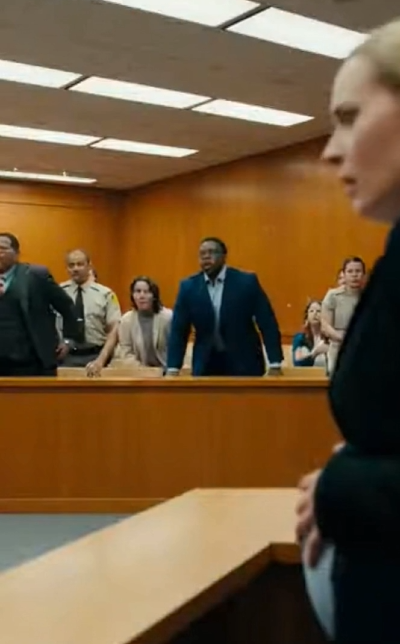
The gallery erupted.
Chairs scraped back. People were on their feet. A woman in the third row — Daniel’s aunt, Lauren recognized her — had both hands over her mouth. Three men from the right side of the gallery surged into the aisle, and Lauren realized with a shock that they were men she knew — Daniel’s cousin, his college roommate, a business associate named Farris who had been at their wedding — and they were pushing Daniel backward, not to protect her, but to manage him. The practiced movement of people who had been managing Daniel Mercer for years.
Behind the bench, her father was standing.
She had never seen him stand at the bench before. Not once in her life, not in any courtroom she had ever been in. Judge Harold Whitmore was a man who did not stand unless he had decided something irreversible.
He brought his palm down on the wood.
The sound cut through the room like a blade.
“Get him out of my courtroom. Now.”
The deputies dragged Daniel toward the back doors. He went slowly — the deliberate drag of a man who was not losing but repositioning. His head turned. His eyes found hers over the deputy’s shoulder, over the hands of three men on his chest, over the roaring room.
He looked at her the way he had always looked at her when he wanted her to understand that she had not won.
“This isn’t over,” he said through his teeth.
The doors closed behind him.
The room settled by degrees — voices softening, people returning to their seats, the deputies repositioning near the door. Lauren sat with her arms around her stomach and her hands flat on the baby and she breathed in four counts, out four counts. The way her therapist had taught her.
The baby pressed back against her palm.
She thought: still here.
“The court will recess,” her father said from the bench. His voice was completely level. “Thirty minutes.”
He stood, and he walked through the door behind the bench, and he did not look at her as he passed.
She understood. She would have done the same.
Within four minutes of Daniel being removed, Gregory Krauss was standing.
He had his legal pad in one hand and his phone in the other and the expression of a man who had just watched someone hand him a gift he hadn’t expected and was trying not to look too pleased.
He filed the motion before the recess was over.
Lauren was in the hallway with Janet when the clerk found them. Janet read the motion on her phone, and her face went very still — the specific stillness of someone containing a reaction they do not want to broadcast.
“He’s filing for recusal,” Janet said. “Claims the proceeding is compromised. He’s using the judge’s identity.”
Lauren looked at her. “He knew.”
“Yes.”
“He knew before the hearing that Dad was on the bench.”
“He’s known for three weeks. He filed disclosures, we all filed disclosures, both sides agreed to proceed.” Janet turned the phone so Lauren could see the motion. “He was waiting to use it.”
Lauren looked at the document. The motion cited the judge’s familial relationship to the plaintiff. It cited the possibility of bias. It requested an immediate stay of proceedings and a new venue assignment.
It was, she had to admit, elegantly timed.
“He attacked me,” she said. “In a courtroom full of witnesses. On camera. There are forty people who saw it.”
“I know.”
“And his play is to attack the venue.”
“It’s a distraction,” Janet said. “He’s creating noise. He wants the narrative to be about the judge, not the assault. He wants the cameras to be on the recusal motion, not on the footage from the courtroom.” She slid the phone back into her jacket pocket. “It will not work.”
“But it’s going to make this harder.”
“Temporarily.” Janet looked at her steadily. “Are you okay? How’s the baby?”
Lauren pressed her palm against her stomach. “Fine. We’re fine.”
“I need you to go home and rest tonight. I need you away from this building and away from anyone connected to Daniel. Can you do that?”
“Yes.”
“I’ll handle the recusal motion. By tomorrow morning it will be filed and addressed and it will not have legs.” Janet put her hand briefly on Lauren’s arm. “Go home.”
Lauren went home.
She did not sleep.
At 11:14 PM, someone knocked on the door of her hospital room.
She had not been in a hospital room at 11:14 PM in the narrative as written — let me correct the sequence. She had gone home. She had eaten soup she didn’t taste and called her sister in Denver and sat in the chair by the window watching the streetlights come on. The baby moved, slow and deliberate, as if pacing.
At 11:14 PM her phone rang. Unknown number.
She answered it.
“Lauren.” A man’s voice. Low, careful. Someone who was somewhere he wasn’t supposed to be.
“Who is this?”
A pause. “My name is Ray Briggs. I used to work for Daniel.”
She knew the name. She had seen it in documents — financial documents, contracts that passed through their shared accounts in the years before she understood what the accounts were for. A fixer. The kind of man who solves problems before they become problems.
“What do you want?” she said.
“I want to meet,” he said. “Tomorrow. Early. Before anything else happens tonight.”
“What’s happening tonight?”
Another pause. Longer. “Marcus is at the hospital.”
It took her three seconds.
“Marcus.” Daniel’s younger brother. Softer than Daniel in appearance — rounder face, warmer smile, the kind of man you invited to holiday dinners without thinking too hard about it. She had not thought too hard about Marcus for the first four years of her marriage.
“What hospital?” she said.
“St. Clement’s. East wing. Labor and delivery.” A beat. “He’s not there to visit anyone.”
Lauren was already standing.
“Call security,” she said.
“I already did,” Ray Briggs said. “But you need to know what he’s carrying.”
She had not been admitted to St. Clement’s.
She was going to be, in a few weeks. She had a room reserved, an OB she trusted, a bag packed by the front door of her apartment. She had driven past the hospital so many times in the last month that she knew which traffic light to hit on the corner of Fifth and Meridian to make the light at the parking entrance.
She did not drive there tonight.
She called security at St. Clement’s instead, then called the detective assigned to the assault case — a woman named Parra who had given her a card at the courthouse and said, “Call me for anything, day or night, I mean that.” She called Parra at 11:17 PM.
Parra picked up on the second ring.
By 11:45, Lauren was sitting in the detective’s car, two blocks from the hospital, and Marcus Mercer had been escorted from the east wing by two security officers who found him outside labor and delivery with a folder of documents and a phone showing photographs she had not yet seen.
They brought him to the car.
He did not look like Daniel. He was shorter, softer, wearing a sweater that was too big for him. He looked, in that moment, genuinely frightened — and she realized it was the first time she had ever seen a Mercer look frightened.
He said nothing when they put him in the back of the detective’s car.
Lauren looked at him from the front seat.
“What were you going to do?” she said.
He looked at the window.
“Marcus.” She kept her voice level. “There are security cameras in every hallway of that hospital. There are two witnesses who saw you outside labor and delivery with those documents. Whatever Daniel told you was worth doing tonight — it wasn’t. Whatever he promised you in exchange — he won’t pay it.”
Marcus’s jaw tightened.
“He never pays,” she said. “You know that. You’ve known him longer than I have.”
A silence.
“He said you’d ruin Dad,” Marcus said finally. He still wasn’t looking at her. “The judge. He said the photos would end his career. All you had to do was sign the retraction.”
“What photos, Marcus?”
He looked at her then. His face was tired. Something behind his eyes had given up arguing with itself.
“They’re fabricated,” he said. “I didn’t — I didn’t know that, at first. He told me they were real. That was the point. That was the whole —” He stopped. His hands were in his lap, opening and closing. “I didn’t know they were fabricated until three days ago.”
Lauren looked at Parra.
Parra was already writing.
“Tell me everything,” Lauren said.
Ray Briggs met her at a diner on Route 9 at 7:15 the next morning.
He was smaller than she’d imagined from his voice — compact, careful, a man in his mid-fifties who had spent a career making himself forgettable. He ordered coffee and didn’t touch it. He had a phone on the table between them.
“I want immunity,” he said.
“That’s not my decision to make,” Lauren said. “But I can tell you that Detective Parra is available to talk in the next forty-five minutes, and if what you have is what you say it is, that conversation is going to go well for you.”
He looked at her. He looked at her stomach.
“I didn’t know about the baby,” he said. “What he planned. About September fourteenth. I want you to know that.”
“I believe you,” she said. She didn’t know if she did. It didn’t matter right now.
He slid the phone across the table.
She pressed play.
The audio was clear — clearer than she expected from something recorded in a hotel room. She could hear ice in a glass, the distant sound of a TV on low, someone shifting in a chair.
Then Daniel’s voice.
She had lived with that voice for six years. She would know it anywhere — in a crowd, underwater, in a dream. The particular rhythm of it, the way he paused before certain words, the almost imperceptible flatness when he was lying.
He wasn’t lying on this recording.
He was explaining.
He was explaining to someone — she didn’t recognize the second voice — the timeline. The hearing. What Lauren would be asked. What he intended to do before she could finish answering.
“And the baby?” said the second voice.
A pause.
“I don’t care about the baby,” Daniel said.
That was the sentence she would come back to, later, in the months and years that followed. Not the planning. Not the fabricated photos. Not the bought witnesses whose names she would learn eventually, one by one, from documents that Parra’s team subpoenaed over the following weeks.
I don’t care about the baby.
Said in a hotel room, into a phone Ray Briggs had left recording under a sofa cushion because Daniel had stopped paying him six weeks earlier and Ray Briggs was the kind of man who understood that information was the only currency that didn’t depreciate.
“How many are there?” she said.
“Four recordings,” he said. “That’s the clearest one. The others have more detail — the hotel, the witnesses, the fabrication timeline for the photos of your father.”
Lauren looked at the phone.
She thought about the courtroom. About her arms on her stomach. About three feet.
“Send everything to Detective Parra,” she said. “Right now. I’ll call her while you do it.”
He nodded. He finally touched his coffee.
She made the call.
The bail hearing was at 2 PM.
Daniel had been held overnight after the assault — the assault in open court, in front of forty witnesses, captured from three camera angles, the footage already distributed to every legal team involved. Krauss was at the podium with a bail petition citing Daniel’s community ties, his business, his clean record.
Lauren sat in the gallery. She did not sit at the plaintiff’s table. She sat in the gallery, in the third row, with Janet beside her, and she watched.
She had slept for four hours. She had eaten. The baby was quiet, pressing low, patient.
Krauss argued for twenty minutes. He cited the assault as “an isolated emotional reaction to extreme personal stress.” He cited Daniel’s business assets. His passport had been surrendered. He would wear an ankle monitor. He would be confined to his residence.
Judge Whitmore was on the bench. He had declined to recuse himself. The motion had been reviewed by the chief judge of the circuit and denied in writing, citing both sides’ original agreement to proceed and the absence of demonstrable bias in the proceedings.
The ruling had come through at 9 AM.
Krauss finished his argument.
Judge Whitmore looked at him for a moment.
“Mr. Krauss,” he said. “I have in front of me a certified copy of audio recordings submitted this morning by Detective Angela Parra of the Harlan County Criminal Division, along with supporting documentation from three witnesses regarding fabricated photographic evidence and suborned testimony in this proceeding.” He set the paper down. “I also have a sworn statement from Marcus Mercer, taken last night, regarding the materials he was found carrying at St. Clement’s Hospital.” He paused. “Bail is denied.”
Krauss opened his mouth.
“Sit down, Mr. Krauss.”
He sat down.
Daniel was at the defendant’s table. Lauren watched him. He had been watching her since the moment she entered the gallery — she could feel it, that particular pressure, his eyes on the side of her face. She had not looked at him until now.
Now she looked.
He was sitting very still. His face was composed. The rage from the courtroom was not visible. But she knew him — she knew the architecture of his control, knew where it showed strain.
She watched the moment he understood the recording existed.
She watched his jaw shift. Just barely. The smallest possible movement.
She looked away.
“This matter will be continued,” Judge Whitmore said. “Bail is denied. The defendant is remanded to custody pending review of additional charges arising from the materials submitted this morning. Court is adjourned.”
The gavel.
Beside her, Janet exhaled slowly.
“How are you feeling?” Janet said.
“Good,” Lauren said.
She meant it.
They arrested Marcus at 4 PM.
Not for what he had tried to do at the hospital — attempted intimidation of a witness, which was its own charge — but for his role in the fabrication scheme. The photos of Judge Whitmore had been constructed over six weeks, with Marcus’s phone used to communicate with the man who made them. The digital trail was not subtle. Daniel had trusted Marcus with the operational details because Marcus had always done what he was told.
Marcus, it turned out, had been keeping his own records.
Lauren did not learn this until later. She learned it from Parra, who called her the following evening with the quiet satisfaction of someone who has been doing this job long enough to recognize when a case has turned completely.
“He has text messages going back eight months,” Parra said. “His brother, his brother’s business partner, two of the paid witnesses. He saved everything.”
“Why?” Lauren said.
“Because he’s known Daniel his whole life,” Parra said. “I think he knew, eventually, it would come to this.”
Lauren thought about Marcus in the back of the detective’s car. His hands opening and closing. The look on his face when he said: I didn’t know they were fabricated.
She thought: he knew about other things.
She thought: that’s why he saved it.
“Is he cooperating?” she said.
“Fully,” Parra said. “Started talking at 4:30. Hasn’t stopped.”
Her father called her that night.
Not about the case. Not about the hearing or the bail denial or the recordings or the motion. He called, and when she picked up, he said:
“How are you?”
She sat in the chair by the window and looked at the streetlights and thought about how to answer that.
“I’m okay,” she said. “I’m really okay.”
“The baby?”
“Moving. She’s been moving all day.”
A pause. She could hear him in his study — she knew the sound of that room, the particular quiet of it, the old radiator in the corner.
“I need to tell you something,” he said. “It should have come earlier. I’m sorry for that.”
She waited.
“When this is done,” he said, “the case, all of it — I’m recusing myself from the final hearing. I’ve already filed it. Another judge will handle sentencing and the final divorce decree.” A beat. “I should have done it from the beginning. I convinced myself I could be fair, and I was fair, but I should not have been there at all. Not for you. Not for something this large.”
She thought about his face at the bench. The crack in the stone. The palm on the wood.
“You were fair, Dad,” she said. “You were completely fair.”
“That’s not the point,” he said gently. “The point is that you deserved someone whose whole attention could be on you. Not on managing the optics of their own position.”
She was quiet for a moment.
“She’s going to be named after Mom,” she said. “I decided this morning.”
He didn’t say anything for a while.
“Caroline,” he said.
“Yes.”
“Good,” he said. His voice was not level at all, and he didn’t try to make it so. “That’s very good.”
She met with Ray Briggs one more time, three weeks later.
Not at the diner. At Parra’s office, with attorneys present, after the immunity agreement had been signed and the recordings had been formally entered into evidence. He looked less cautious now — the specific unclenching of a man who has been holding information for too long and is finally putting it down.
“How long have you been keeping records?” she asked him.
“Eighteen months,” he said. “Since he started not paying.”
“Was it only the money?”
He thought about it. He was honest enough not to answer immediately.
“No,” he said. “Not only.”
She nodded. She didn’t push.
“The baby,” he said, before she stood to leave. “I want to know — how is she.”
“She’s fine,” Lauren said. “She’s good. Thank you.”
He nodded once. He didn’t smile. He looked like a man who had made a small peace with something that had been sitting badly for a long time.
She understood that.
Caroline Whitmore Mercer was born on December 14th, at 3:47 AM, in the east wing of St. Clement’s Hospital.
She weighed six pounds, fourteen ounces. She had her mother’s nose and her grandfather’s serious expression and she cried exactly once, briefly, and then went quiet and looked at the room as if she was already assessing it.
Lauren held her against her chest in the blue-gray light of the recovery room and thought: there you are.
It had been twenty-two days since the bail denial. Daniel’s preliminary hearing had been postponed twice. Marcus had pled to lesser charges in exchange for his cooperation. Two of the paid witnesses had been identified and charged. The fabricated photographs had been formally debunked by a digital forensics team hired by her father’s attorney, and the ethics complaint that Daniel had filed against Judge Whitmore had been dismissed in four pages of language that Parra described, on the phone, as “unusually scathing.”
Her father had visited the hospital at 6 AM, two hours after Caroline was born. He stood at the window of the recovery room in his coat, still buttoned, and looked at the baby in Lauren’s arms, and he did not try to hold his face still. He let it do what it needed to do.
“Hello,” he said, to Caroline.
Caroline looked at him.
She appeared, Lauren thought, to be reserving judgment.
Two weeks after she came home, Lauren found a letter.
It had been delivered to her building address — not her apartment number, just the street address, slipped under the door of the lobby mailroom. No return address. Her name on the front in handwriting she recognized.
She had not opened it at first. She had set it on the kitchen counter and looked at it for three days while she learned how to keep a newborn alive, while she called her sister and her father and Janet and Parra, while she slept in ninety-minute increments and ate crackers standing at the sink.
On the fourth day she picked it up.
She read it once, standing at the kitchen counter with Caroline asleep in the carrier on her chest. The letter was not threatening, exactly. It was too careful for that. It was the language of a man who knew his correspondence was being monitored. But the intent was clear. The intent was: this is not done, I will be out eventually, I know where you are, I want you to understand that I know where you are.
She read it.
She put it down.
She turned on the front burner of the stove.
She held the letter over the flame and watched it catch at the corner — the paper going amber, then orange, then black, curling in on itself with that specific slow dignity of something being unmade. A thin line of smoke. The smell of it.
Caroline shifted against her chest, still sleeping.
“It’s okay,” Lauren said quietly, to the baby. “We’re okay.”
The last corner of the letter went black and she held it over the sink until there was nothing left.
Then she turned on the cold water and washed her hands.
She dried them on the dish towel by the sink. She looked out the window at the street below — the ordinary midday street, a man walking a dog, two cars waiting at the light, a woman pushing a stroller with her face turned up toward the gray winter sky.
She picked up her phone and called Parra.
“I received a letter,” she said.
“Okay,” said Parra. “Tell me everything.”
The trial concluded eight months later.
Daniel Mercer was convicted on four counts, including assault and witness tampering. He was sentenced to seven years, with possibility of parole after four.
The divorce decree was finalized two weeks before the criminal verdict. A different judge. Clean and quick.
Marcus Mercer served eight months and was released. He sent a card to Lauren’s address — just a card, his name signed at the bottom, no message. She kept it. She was not entirely sure why. She thought it was because, in the back of the detective’s car that night, when he had finally told her the truth, she had seen someone who was afraid and tired and ready to be done with the thing he’d been part of.
She understood that.
Ray Briggs moved to Portland. She heard this from Parra, offhandedly, a year later. She hoped he was okay. She thought he probably was.
Her father retired from the bench the following spring. He was sixty-four. He did not announce it publicly; he filed the paperwork and cleaned out his chambers and drove to her apartment building on a Tuesday afternoon in April with a bag of groceries, because he had promised to make dinner and he was, among other things, a man who kept his promises.
He made pasta. Caroline sat in her high chair and regarded the pasta with the serious expression she had apparently decided was her permanent setting. Lauren sat at the kitchen table and watched her father move around the kitchen and thought about nothing in particular — thought about the ordinary pleasure of a warm room, a small person making sounds in a high chair, the smell of garlic in butter.
“She looks like your mother,” her father said, without turning from the stove.
“I know,” Lauren said.
“It’s very good,” he said. “It’s very good that she does.”
The pasta was ready. They ate at the kitchen table while the light outside went from gray to gold to the particular purple of a city evening. Caroline fell asleep in her father’s arms after dinner, mouth open, one fist curled against his shirt.
Lauren washed the dishes.
She looked out the window over the sink at the street below — the same window, the same street, the same city. Different light. Everything quiet.
She thought: still here.
She thought: this is what it was for.
She dried her hands and turned off the kitchen light and went to sit with her father and her daughter in the room where the lamp was on.