The invitation read: Building Brighter Futures: Annual Children’s Hope Gala.
It was printed on heavy cream card stock with gold embossed lettering. Each one had cost $14 to produce. There were two hundred of them.
The event itself cost $340,000 to host.
It raised $1.8 million. After expenses, $210,000 would go to actual children.
The rest was overhead.
Nobody mentioned the math.
Her name was Callie Marsh.
She was twelve years old, and she had been sleeping in the city’s east-side shelter for eight months, ever since the fire.
She didn’t tell people about the fire. There wasn’t much to say. It happened. The apartment was gone. Her mother — who had played piano at the First Methodist Church every Sunday for eleven years — was gone with it. Callie had been at school. That was the only reason she was standing anywhere at all.
The shelter had a rule: minors unaccompanied by an adult had to be in by nine PM.
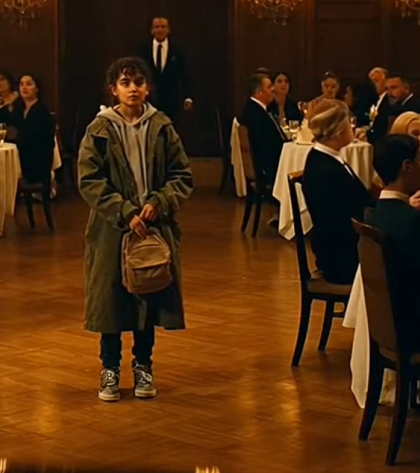
It was 8:47 when Callie crossed the street toward the Grand Meridian Hotel.
She had forty-three minutes.
She’d spent the previous three nights watching the hotel from the bus shelter on Fifth. Watching the catering vans come and go. Watching which door the florists used. Watching which one they propped open.
Tonight, that door had a rubber wedge under it and nobody watching.
She went through the kitchen — steam and noise and nobody looking at a small girl in a big coat — and into the corridor, and through the corridor into the light.
The ballroom was not what she expected.
It was bigger. The ceilings were higher. The chandeliers were more.
She stood at the edge of it for four seconds, taking it in. The white tablecloths. The flowers — centerpieces taller than she was. The two hundred people in gowns and tuxedos who were eating and drinking and talking about the children.
And then she saw the piano.
Steinway Model D. Concert grand. She’d played a D once, at the Young Artists’ Invitational in Boston, when she was nine. Her mother had cried in the front row.
Her chest did what it always did when she thought about that. She let it. She didn’t have time to stay with it.
She started walking toward the piano.
She was twelve steps in when a man stepped into her path.
He was in his fifties. Tuxedo. Silver hair swept back from a face built for authority. He was the hotel manager — she could tell by the way he moved, the way the staff tracked him with their eyes.
His name was Wallace Harden. She wouldn’t know that until later.
“Stop right there, please.”
She stopped.
“This is a private event.” His voice was neutral. Not cruel. Just conclusive. “How did you get in?”
“Side door,” she said.
He looked at her. She looked at him.
“I want to play the piano,” she said. “One song. I’ll take food as payment. Whatever’s left in the kitchen.”
A beat.
Behind her, she heard the shift — the sound of a room adjusting its attention. Forks pausing. Conversation dropping half a register.
“Young lady,” Wallace said. His voice had gone quieter. The kind of quiet that means I am trying to keep this contained. “I understand. But you need to—”
“Please.” The word came out the way she’d practiced it in the shelter bathroom. Flat. Not desperate. Just clear. “One song.”
Wallace’s jaw tightened. He glanced to his right, and Callie followed his look to the security guard — a broad man in a black blazer, moving toward them.
From table seven, a woman’s voice, light and unconcerned: “Oh, that’s unfortunate.”
From the bar, a man laughed. Sharp, short.
The security guard — his name tag said Ray — arrived at Wallace’s shoulder.
“Sir,” Ray said.
“Please walk her out,” Wallace said. “Quietly.”
Ray stepped toward her.
Callie didn’t move.
“I can play that piano,” she said. She wasn’t looking at Ray. She wasn’t looking at Wallace. She was looking at the Steinway. “I’m not lying to you. I’m not going to make a scene. I just need—”
Ray’s hand closed on her arm. Firm. Professional. The grip of someone who has escorted a hundred people out of a hundred rooms.
“Come on,” he said, and turned her toward the exit.
She went.
Two steps. Three.
Then, from the nearest table, a woman said — not to anyone in particular, in the bright, performative voice of someone who wanted to be heard — “Poor thing. But you can’t just let anyone in, can you.”
Callie stopped.
Ray felt it and tightened his grip slightly. “Keep moving.”
“No,” Callie said.
Just that. No.
Ray turned to look at her face. She was looking back toward the room. Her jaw was set. Her eyes — pale gray, steady — moved from the woman who’d spoken to the piano and back.
“I can play that instrument,” she said, loudly enough now that the nearest two tables could hear clearly. “I’ve been playing since I was four. I performed at Carnegie Hall when I was ten. I’m not asking for charity. I’m offering a trade.”
The room was different now.
The low hum of event noise had dropped to something closer to silence. Heads were turned. Two hundred people were looking at a twelve-year-old in duct-taped sneakers.
Wallace stepped forward. “Miss—”
“My name is Callie Marsh,” she said.
And something happened. A small thing. A woman at table nine — sixties, white hair, glasses on a beaded chain — sat very straight. Her fork lowered to her plate.
But nobody else moved.
“Marcus,” Wallace said, and a second guard appeared from the edge of the room.
Ray and Marcus. One on each side.
“I know you don’t believe me,” Callie said. She wasn’t performing anything. She was too tired to perform. “That’s okay. You don’t have to believe me. But if you let me sit down for three minutes—”
“Miss Marsh.” Wallace’s voice was final now. The voice that ended conversations. “I am asking you calmly to leave this event.”
She looked at the piano one more time.
Her mother’s hands on the keys. Sunday mornings. The smell of wood polish and old hymnals.
You can do this, baby. You were born for it.
“Okay,” Callie said.
And walked toward the piano.
Not toward the exit. Toward the piano.
Ray grabbed her arm. She pulled free — not violently, just smoothly, the way you pull free when you’ve already decided — and kept walking.
There were gasps. An actual gasp, from the table nearest the piano. A man stood up from his chair. Two waitstaff moved toward her from opposite sides.
Callie sat down on the piano bench.
She placed her hands on the keys.
Marcus reached her shoulder. “You need to—”
She played the first chord.
It stopped the room.
That sound. That particular Steinway sound, when the hammer hits the string just right in a room with high ceilings, resonates at a frequency that the human body recognizes before the brain catches up.
Everyone in the Grand Meridian ballroom felt it in their chest before they consciously heard it.
Marcus’s hand, still on Callie’s shoulder, did not pull her back.
Callie didn’t look at anyone. Her eyes were closed. Her back was straight. Her hands — cracked at the knuckles, thin, raw from months of cold — moved across the keyboard with an authority that had nothing to do with age.
She was playing Chopin. Ballade No. 1 in G minor.
She was twelve years old, and she played it the way people play things they have lived inside.
Forty seconds in, the room was not a room anymore. It was an audience.
Forks were down. Phones were up — not to post, not yet, but to capture something their owners couldn’t articulate. The woman in the gold gown had her hand over her mouth. The man from the bar had set down his drink without looking away from the piano.
Wallace Harden stood behind the piano, six feet back, and did not move. Marcus’s hand had dropped from Callie’s shoulder somewhere in the first two minutes.
Callie played.
She played the way she had been taught, by a woman who believed music was the closest thing to prayer that didn’t require faith. She played the way she had played in Boston, in front of three hundred people, at nine years old, when the world was still a place she understood.
She played the way you play something when it’s all you have left.
At the table nearest the piano, the woman with the white hair and the beaded glasses chain had tears running down her face. She wasn’t trying to stop them.
Her name was Dr. Ruth Ellison. She was the founding director of the Whitmore Conservatory, one of the country’s most respected classical music schools. She had spent forty years listening to talent — real talent, the kind that cannot be manufactured or coached into existence — and she knew it the way you know weather. In your body. Before the proof arrives.
She knew it now.
Three minutes into the Ballade, she picked up her phone and sent a text message to her assistant that read: Find out who this child is and where she’s sleeping tonight.
The piece ran seven minutes and forty seconds.
Nobody moved through any of it.
When Callie played the final chord — the G minor resolution, devastating in its simplicity — and lifted her hands from the keys, the room was silent for a long moment.
Then it erupted.
Not polite applause. Not the cultivated appreciation of a ticketed event. Something else. Something rawer. The sound of two hundred people caught off guard by something real.
Callie sat on the bench with her hands in her lap and looked at the keys.
She was not crying. She had cried everything out a long time ago.
Wallace Harden was standing where he’d been standing for the past eight minutes. He cleared his throat. He looked at the floor. He could not look at the girl.
From table twelve, Senator Richard Caplan — who had delivered a seventeen-minute speech earlier in the evening about his commitment to ending child poverty — said nothing. His wife touched his arm. He nodded, distantly, and raised his hands in the applause.
The woman in the gold gown was weeping openly.
The man from the bar had set his glass on the nearest table and was pressing his palms together so hard they were white.
Dr. Ellison was the first to reach her.
She crossed the room in measured steps — she was seventy-one and used a cane, but she moved with intention — and stood beside the piano bench.
“Your name is Callie Marsh,” she said.
Callie looked up at her. “Yes, ma’am.”
“You played in Boston. The Young Artists’ Invitational. Eighteen months ago.”
A pause. “Yes, ma’am.”
“I was on the jury.” Dr. Ellison’s voice was steady. “We gave you the top prize.”
Callie’s throat moved. She looked back at the keys.
“You disappeared,” Dr. Ellison said. Not an accusation. A fact.
“There was a fire,” Callie said.
Dr. Ellison said nothing for a moment. Then she sat down carefully on the bench beside Callie, which required some maneuvering with her cane, and which she did without apparent self-consciousness.
“How long have you been at the east-side shelter?” she asked.
Callie looked at her sharply.
“I made a call while you were playing,” Dr. Ellison said. “I have my resources.” She paused. “Eight months?”
Callie nodded. Barely.
“Are you hungry?”
Another pause. Smaller. “Yes, ma’am.”
Dr. Ellison raised her hand. A waiter materialized. “Full meal. Whatever she wants. And get her something warm to drink first.”
“Of course,” the waiter said, and his voice was different from earlier. Different from the voice that hadn’t quite looked at the girl when she was arguing with Wallace Harden. He was twenty-three and would think about this night for a long time.
The room had not gone back to normal. It was trying to, but it couldn’t quite manage it.
The cocktail conversation that had resumed after the applause was different — lower, more serious. People were talking about the girl. Some were talking about themselves, about what they had almost let happen, about what they had said before she played. The woman from table seven — the one who’d said poor thing, but you can’t just let anyone in — had not spoken in four minutes. Her husband had not looked at her.
Wallace Harden had retreated to the edge of the room. He stood near the service entrance with his arms crossed, not quite watching and not quite not watching.
His phone buzzed. He looked at the screen: hotel GM. He declined the call.
Senator Caplan found Dr. Ellison at 10:15, when Callie was halfway through a plate of roasted chicken and potatoes that a kitchen staffer had brought out with visible, wordless urgency.
“Ruth.” He shook her hand, glancing at Callie. “Extraordinary. Truly extraordinary.”
Dr. Ellison looked at him.
“I’d love to discuss — if the foundation could be involved in some way—”
“Richard.” Dr. Ellison’s voice was mild. “When the speeches were over tonight, did you use the back exit to skip the meet-and-greet?”
Caplan blinked. “I had a—”
“You had a car waiting,” she said. “You were going to leave before the dessert course. You told my colleague as much. The only reason you’re still here is that your chief of staff sent you a text about the video.”
She nodded toward the nearest table, where three guests were still holding up their phones.
Caplan’s face went through several things quickly.
“I appreciate your interest,” Dr. Ellison said. “But this child is not a photo opportunity. And your foundation’s involvement in her future will be reviewed by my attorneys before any agreement is signed. Is that clear?”
Caplan straightened his jacket. “Of course,” he said. “Of course.”
He excused himself.
Callie watched him go.
“Who’s that?” she asked, a forkful of potato halfway to her mouth.
“A man who is about to send a large donation to my conservatory,” Dr. Ellison said. “Whether he wants to or not.”
Callie almost smiled. The closest she’d come to it in months.
Dr. Ellison watched her eat.
“The Whitmore Conservatory has a residential program,” she said. “For students between ten and eighteen. Full scholarship. Housing, meals, instruction. It’s competitive.”
“I’m not enrolled in school,” Callie said. “Shelter kids aren’t always.”
“I know. We have a GED partnership with the city. Many of our students come in without traditional transcripts.” She paused. “I’m offering you a spot, Callie. Tonight. If you want it.”
The fork lowered to the plate.
Callie looked at her. Pale gray eyes. The same steady look she’d had at the door, when Wallace Harden was telling her to leave.
“Why?” she said.
Dr. Ellison was quiet for a moment.
“Because I listened to you play for seven minutes,” she said, “and I did not hear a child practicing. I heard someone speaking.” She adjusted her glasses. “And because when I was nine years old, a woman I did not know sat down at a piano bench beside me and did not let my circumstances define what I was allowed to become.”
Callie looked at her hands. The cracked knuckles. The missing nail on her left ring finger, where the fire had caught her when she’d gone back for her mother’s sheet music and hadn’t found either.
“I’d need to think about it,” she said.
“You have until morning,” Dr. Ellison said. “I’ll be at the hotel until checkout.”
She wrote her room number on a cocktail napkin and set it beside Callie’s plate.
At 10:47 PM, the gala posted a video.
A guest had filmed twelve seconds of Callie’s performance and put it on Instagram with the caption: This girl walked in off the street and played for food. I’m not okay.
By midnight, it had been shared 40,000 times.
By the following morning, 2.3 million.
Wallace Harden gave an interview to the Times three days later.
He said the evening had been “a reminder that talent exists in every community, and that events like the gala serve exactly the purpose they’re designed for.”
The interviewer asked if he had tried to remove the girl before she played.
Wallace Harden said the evening had “unfolded organically.”
The interviewer did not press further.
Ray, the security guard, watched the interview at home and said nothing to anyone. He had his own thoughts about what unfolding organically meant when you’d had your hand on a twelve-year-old’s arm to pull her out of a room. He kept those thoughts to himself. But he did, the following week, make a $200 donation to the Whitmore Conservatory scholarship fund.
It was the largest donation he had ever made to anything.
Callie knocked on room 714 at 7:13 AM.
Dr. Ellison answered the door in a bathrobe, reading glasses on, newspaper in hand.
She looked at Callie.
Callie had the same coat. The same duct-taped sneakers. The same backpack. She’d brushed her hair with the shelter’s shared brush.
“I thought about it,” Callie said.
“And?”
A pause.
“My mom used to say that music is the one thing that can’t be taken from you.” She stopped. Started again. “She was wrong. They can take the piano. They can take the room. They can take everything.”
Her voice didn’t break. She was past the place where it broke.
“But she was also kind of right,” she said. “Because I still know how to play.”
Dr. Ellison held the door open wider.
“Come in,” she said. “Have you eaten breakfast?”
The Whitmore Conservatory’s fall semester began September 4th.
Callie Marsh’s name was on the enrollment list.
She had a room — a real room, with a window and a desk and a bookshelf she slowly filled with borrowed sheet music — on the third floor of the residential building.
She played for four hours every day.
She did not play for audiences for the first year. Dr. Ellison did not push it. She understood that a person who has used every resource they have to survive a single night needs time before they can perform for pleasure again.
In her second year, Callie asked to audition for the spring concert.
She played Chopin. Ballade No. 1 in G minor.
The same piece. Learned at seven. Played at ten. Preserved across fire and loss and eight months in a shelter and one night in a ballroom full of people who almost threw her out.
When she finished, the auditorium — 300 seats, students and faculty — was silent for three full seconds.
Then it was not.
Senator Caplan did not attend the spring concert.
He had a dinner in Washington.
But his foundation sent a $50,000 donation the following week, as Dr. Ellison had anticipated.
She used it to fund two additional scholarship spots.
She named them — quietly, without announcing it — the Sarah Marsh Memorial Scholarships.
Sarah had been a church pianist in a small apartment on the east side who had believed, above all else, that music was worth passing on.
She had been right.
The Grand Meridian Hotel still hosts the Children’s Hope Gala every year.
The Steinway grand has not been moved.
On the inside of the lid — the part that faces the pianist when they sit down, invisible to the audience — someone has taped a small photograph.
A woman at a piano. Sunlight through a window. Sunday morning.
Nobody knows who put it there.
Nobody has taken it down.