The day Jessica Kowalski became Jessica Cole was a Tuesday in September, three weeks before her first day at Sterling & Associates.
She practiced saying it in the mirror. “Jessica Cole.” Smooth. Clean. No consonant clusters that made people squint and ask, “Where’s that from?”
She cut her hair. Bought new clothes. Watched YouTube videos of women from Connecticut until she could mimic the way they said “absolutely” and “of course.”
She was twenty-four years old, and she was killing the girl she used to be.
“You don’t have to do this, Jessie,” her grandfather Walt said on the phone the night before she moved to New York. His voice was gravel and warmth.
“Do what?”
“Pretend.”
She didn’t answer. She just said, “I’ll call you when I’m settled.”
She didn’t call for three months.
Sterling & Associates occupied the forty-fourth floor of a glass tower in Midtown Manhattan. The lobby smelled like money and fresh flowers. The people spoke in low, confident tones about things Jessica didn’t understand yet — derivatives, credit default swaps, offshore vehicles.
She learned fast. She learned everything.
She learned that the managing director, David Harmon, went to Exeter. She learned that the senior analyst, Claire Whitmore, summered in the Hamptons. She learned that nobody — not one single person — came from a town like Dayton, Ohio, where the biggest event of the year was the county fair and the median income was thirty-eight thousand dollars.
So she invented a life.
“My parents are consultants,” she said at her first team lunch. “They travel a lot. We had a place in Greenwich.”
Nobody questioned it.
“Where’d you prep?” David asked.
“Choate,” she said, without blinking.
He nodded. He believed her.
It was that easy. And that terrifying.
She climbed. God, did she climb. She worked sixteen-hour days. She memorized client portfolios. She volunteered for every assignment nobody else wanted. In eighteen months, she was promoted twice.
“Jessica Cole is the future of this firm,” David Harmon said at a quarterly meeting. She smiled graciously, the way she’d practiced.
The only crack in her armor was Walt.
He called every Sunday. She let it go to voicemail half the time.
“Hey, Jessie-bird. Just checking on you. Made your grandma’s pot roast tonight. Wish you were here. The porch light’s on, sweetheart. Always is.”
She’d listen to the messages in her apartment, alone, in the dark, and feel something she couldn’t name — something between guilt and grief.
She hadn’t been home in two years.
The annual Founders’ Gala was the social event of Sterling & Associates — three hundred guests, black tie, the Grand Meridian Hotel ballroom. It was invitation-only, and this year, for the first time, Jessica’s name was on the list.
She spent two weeks preparing. She bought an emerald silk gown. She got her hair done at a salon that charged more per visit than Walt’s monthly grocery bill.
She arrived at 7:30 PM, early enough to position herself near the east windows where the Manhattan skyline would frame her like a portrait. She held her champagne with practiced ease. She laughed at partner jokes. She exchanged business cards.
She was perfect.
At 8:47 PM, she turned toward the buffet table and her heart stopped.
Grandpa Walt was standing between a tower of shrimp and a silver chafing dish, carefully spooning rice onto a small plate. He was wearing his brown suit — the one Grandma Rose had mended at the elbows before she died. His shoes were scuffed. His tie was crooked.
And around his neck, wrapped twice, was the scarf.
The scarf.
Olive green, military issue, frayed at the edges, smelling — she knew from memory — of cedar and old wool. Walt had worn it every day for as long as Jessica could remember. She didn’t know why. She’d never asked. She didn’t care. All she cared about right now was that it looked like a billboard announcing everything she’d spent two years trying to hide.
Her vision narrowed to a tunnel.
She set the champagne down so hard it splashed.
She crossed the ballroom in four strides.
“What are you doing here?” she hissed, grabbing his arm.
Walt looked at her with those pale blue eyes — gentle, patient, a little sad. “Hello, Jessie-bird.”
“Don’t call me that. Not here.”
“I was invited,” he said quietly. “Got a letter.”
“By who? It doesn’t matter. You need to leave. Now.”
“I just wanted to see where you work. See the people you—”
“Grandpa.” Her voice was ice. “Take off the scarf.”
He touched it with one hand. His fingers were trembling slightly — not from fear, but from age. “I can’t do that.”
“It’s disgusting. It’s old. It smells. Everyone is looking at you.”
“Let them look.”
“Take it off.”
“No, Jessie.”
Something inside her snapped. Later, she’d try to pinpoint the exact moment — the second where reason left and rage entered — but she could never find it. It happened too fast.
She grabbed the scarf with both hands.
She pulled.
The wool tore in half with a crack that echoed off the marble floor, the crystal chandeliers, the twenty-foot ceilings. It was the loudest sound in a room of three hundred people.
Every head turned.
Every glass stopped halfway to every mouth.
The string quartet stopped mid-note.
Jessica stood there, panting, a ragged half of olive-green wool in each fist.
Walt looked down at the torn pieces. His face didn’t show anger. It showed something Jessica had never seen before — a grief so vast and deep that it aged him a decade in two seconds. His lower lip quivered. His eyes filled. He didn’t say a word.
The room was silent.
And then, from behind Jessica, a voice.
“Walter?”
Jessica turned.
The crowd was parting. People stepped aside like a tide pulling back from shore.
Walking through the center of the ballroom was Richard Sterling.
Richard James Sterling. Seventy-one years old. Founder of Sterling & Associates. Net worth: fourteen point two billion dollars. His face was on the cover of Forbes. His name was on buildings, scholarships, and hospital wings.
He was walking toward Walt.
And his face was white.
He stopped three feet from the old man. His jaw was working. His eyes were glistening.
Then Richard Sterling — billionaire, titan, legend — lowered himself to both knees on the cold marble floor.
He reached out and took the torn halves of the scarf from Jessica’s limp hands.
He pressed them to his chest.
“My God,” he whispered. “What has she done to it?”
Jessica couldn’t move. She couldn’t breathe.
Richard looked up at her. His eyes were ice and fire at the same time.
“Do you know what this is?” he said, his voice low and shaking. “Do you have any idea what you’ve just destroyed?”
Jessica’s mouth opened. No sound came out.
Richard stood slowly. He turned to the room. Three hundred faces stared back.
“This man,” he said, pointing at Walt, “is the reason I am alive.”
The room didn’t move.
“Fifty-three years ago, in the Mekong Delta, my unit was ambushed. I took shrapnel in my leg. I was bleeding out in the mud. Every man in my squad was dead or running. Every man except one.”
He turned to Walt.
“This man — PFC Walter Kowalski — wrapped his scarf around my leg to stop the bleeding. Then he picked me up, put me on his back, and carried me four miles through jungle mud, through enemy fire, through hell. He didn’t stop. He didn’t put me down. Four miles.”
Richard’s voice cracked.
“That scarf saved my life. And this man — this ’embarrassment’ your granddaughter tried to hide from all of you — is the silent majority shareholder of Sterling & Associates. He owns fifty-one percent of this company. He has owned it since 1987, when I gave him those shares as the only repayment he would accept.”
The room erupted.
Gasps. Whispers. Camera phones rising like a field of electronic flowers.
Jessica’s knees buckled. She caught herself on the edge of a table.
“She’s fired,” Richard said, not looking at her. “Effective immediately.”
He placed his hand on Walt’s shoulder and guided him toward the stage. The crowd parted for them.
Jessica stood alone in the center of the ballroom. Her mouth was open. Her hands hung at her sides, the torn halves of the scarf trailing on the marble floor. Not a single person moved toward her. Not a single person spoke to her. She was surrounded by three hundred people and she had never been more alone in her life.
The video hit the internet at 11:14 PM.
Someone — Jessica never found out who — had filmed the entire thing. The scarf. The tear. The kneeling. Richard’s speech. Jessica’s face.
By midnight, it had a million views.
By morning, ten million.
By Tuesday, her name was a hashtag. #ScarfGirl. #JessicaCole. #DaytonDisgrace.
She sat in her apartment — the one she could no longer afford — and watched her life disintegrate on a screen. Her phone rang constantly. She didn’t answer.
David Harmon texted: Don’t ever contact anyone at this firm again.
Claire Whitmore texted: You disgust me.
Her landlord texted: Your lease is under review.
She packed two suitcases. She took a bus back to Dayton.
Walt’s house looked the same. White clapboard, sagging porch, American flag on the pole. The porch light was on.
She stood on the front step for eleven minutes before she knocked.
He opened the door. He was wearing a flannel shirt and jeans. His neck was bare — the first time she’d seen it bare in her entire life.
“Jessie-bird,” he said.
She broke.
She fell into his arms and sobbed so hard she couldn’t stand. He held her up the way he’d held her when she was four years old and afraid of thunderstorms.
“I’m sorry,” she cried. “I’m so sorry, Grandpa. I’m so, so sorry.”
“I know,” he said. “Come inside. I made soup.”
For two weeks, Jessica did nothing. She slept in her old room. She ate Walt’s cooking. She sat on the porch and watched the sky change colors over the flat Ohio landscape and felt, for the first time in years, something that might have been peace.
She didn’t deserve it. She knew that.
But Walt never said a word about the gala. Never mentioned the scarf. Never brought up the video. He just handed her bowls of soup and glasses of sweet tea and sat with her in the quiet.
One evening, she found him in his study — a small room at the back of the house, crammed with bookshelves and filing cabinets. He was looking at a folder.
“Grandpa? What’s that?”
He hesitated. Then he sighed and set the folder on the desk.
“I wasn’t going to show you this. I figured you’d had enough trouble.”
“What is it?”
“Something that needs to come out. But it’s dangerous.”
She opened the folder.
Inside were documents — financial records, corporate filings, personal correspondence — going back thirty years. And they told a story that made Jessica’s blood run cold.
Richard Sterling’s son, Marcus Sterling, had been running a parallel operation inside the company for years. Embezzlement. Fraud. Siphoning client funds into offshore accounts. The numbers were staggering — four hundred million dollars, stolen from retirement accounts, pension funds, college savings. Real people’s money. Real people’s futures.
“How do you have this?” Jessica whispered.
“I’m the majority shareholder,” Walt said simply. “Richard sends me everything. He has for forty years. I noticed the discrepancies eight years ago. Started keeping copies.”
“Why didn’t you say something?”
Walt’s face tightened. “Because Marcus threatened me. Said if I talked, he’d bury me. Said he’d destroy what was left of our family.”
“Is that why you came to the gala? To confront him?”
“No. I came to see you, Jessie. I came because you’re my granddaughter and I love you and I wanted to see where you worked.” He paused. “But Marcus was there. And when he saw me, he made a call. I could see it in his face — he was going to accelerate the theft. Move the money out of the country. I was running out of time.”
Jessica looked at the documents. She looked at her grandfather.
“We have to go public.”
“It’ll be a war.”
“Grandpa, he stole four hundred million dollars from working people. Nurses. Teachers. Truck drivers. People like us.”
Walt nodded slowly. “People like us.”
Jessica called every contact she had. Most hung up. One didn’t.
Rachel Dunn was a producer at National Cable News. They’d gone to college together — the real college, the state school Jessica had actually attended before she started lying. Rachel listened. Rachel looked at the documents. Rachel said, “This is the biggest financial fraud story of the decade.”
The interview was set for the following Friday. Live broadcast. Prime time.
Marcus Sterling found out. He hired lawyers. He filed injunctions. He called Walt at 2 AM.
“You’re making a mistake, old man,” Marcus said. “I will destroy you.”
Walt held the phone to his ear and said, “Son, I carried your father through four miles of mud with bullets over my head. You don’t scare me.”
The studio was bright and cold. Jessica sat next to Walt at the news desk, facing three cameras and ten million viewers. Rachel Dunn sat across from them.
“We’re live in thirty seconds,” the floor director said.
Jessica’s hands were shaking. Walt reached over and held one.
“You ready, Jessie-bird?”
She nodded.
The red light turned on.
Rachel Dunn looked into the camera. “Tonight, an exclusive investigation into one of the largest financial fraud schemes in American history, hidden inside one of Wall Street’s most respected firms. With me are Walter Kowalski, the majority shareholder of Sterling & Associates, and his granddaughter, Jessica Kowalski — formerly known as Jessica Cole — who is now blowing the whistle on the man who tried to silence them both.”
Jessica looked at the camera. She took a breath.
“My name is Jessica Kowalski,” she said. “I’m from Dayton, Ohio. My grandfather was a soldier, a factory worker, and the most honest man I’ve ever known. I spent two years lying about who I was because I was ashamed of where I came from. I’m not ashamed anymore.”
She held up the first document.
“This is proof that Marcus Sterling stole four hundred and twelve million dollars from the pension funds and retirement accounts of ordinary Americans. And this” — she held up another — “is the wire transfer that proves where the money went.”
The phones lit up. The control room went wild. Marcus Sterling’s lawyers called the network twelve times in the next thirty minutes. The network didn’t flinch.
By the end of the hour, federal investigators were on their way to Marcus Sterling’s home.
By morning, he was in handcuffs.
Three months later, Jessica stood on the porch of Walt’s house in Dayton. The air smelled like fresh-cut grass and rain.
Walt came out with two glasses of sweet tea and sat in his rocking chair.
“I have something for you,” he said.
He handed her a manila envelope. She opened it.
Inside were stock certificates. Fifty-one percent of Sterling & Associates.
“Grandpa… I can’t take these.”
“You can and you will. But there’s a condition.”
“What?”
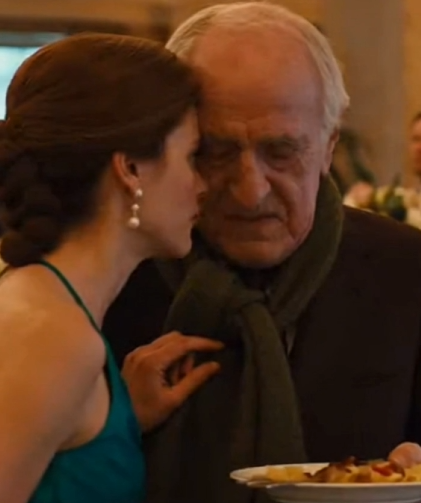
He looked at her with those pale blue eyes — the same eyes that had read her bedtime stories, cried at her graduation, and held nothing but sadness when she’d torn his scarf in front of three hundred people.
“Never forget that the most valuable thing you can own is your honesty,” he said. “You can lose money. You can lose a job. You can lose everything in this world. But if you keep your honesty, you can always rebuild.”
Jessica sat down next to him. She leaned her head on his shoulder.
“What about the scarf?” she whispered.
Walt reached into his pocket and pulled out the two torn halves. Someone had stitched them back together — not perfectly, not invisibly, but with careful, deliberate stitches that held the pieces in place.
“Richard had it repaired,” Walt said. “Said it was too important to throw away.”
He draped it around Jessica’s shoulders.
She didn’t flinch. She didn’t pull away. She touched the coarse wool, felt the rough stitches where the tear had been mended, and something inside her — something that had been broken for a very long time — finally began to heal.
“I love you, Grandpa.”
“I know, Jessie-bird. I know.”
The porch light glowed amber in the gathering dusk. The flag moved gently in the wind. And somewhere in Manhattan, in a glass tower on the forty-fourth floor, a framed piece of olive-green wool hung on the wall of the founder’s office, under a brass plaque that read:
“In honor of PFC Walter Kowalski — who carried a friend through the mud and never asked for anything in return.”