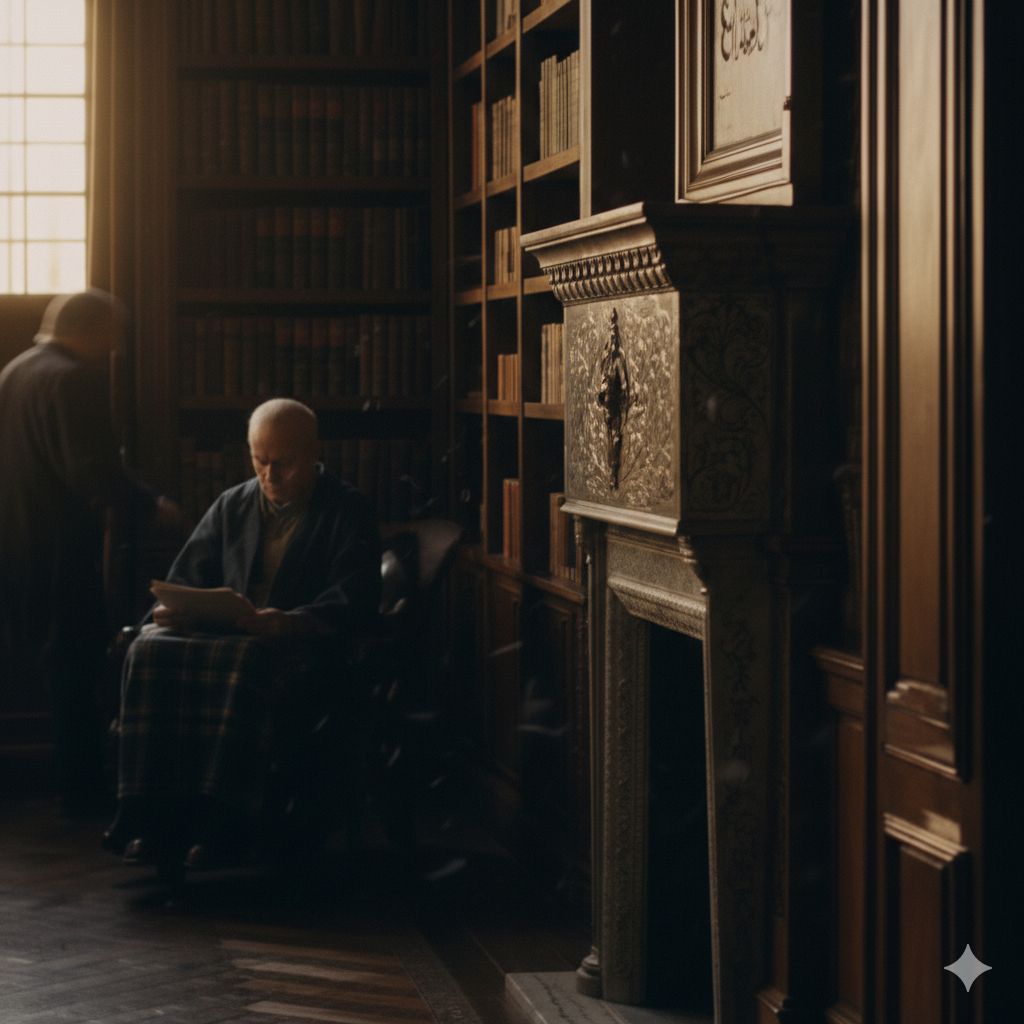
It started with a sound — or rather, the absence of one.
At 2:17 PM on a Thursday, Engine Number Two on the Meridian Air Cargo C-130 freighter screamed, shuddered, and went silent on the maintenance pad at Colton Regional Airfield.
Chief Engineer Bobby Harlan was under the wing when it happened. He felt the vibration in his teeth before he heard the grinding — that sickening, metallic shriek that every aircraft mechanic recognizes instantly: something fundamental had just broken.
“SHUT IT DOWN!” Bobby screamed, scrambling backward on the concrete.
The turbine coughed twice and died.
Bobby stood in the sudden silence, wiping grease from his face, and felt the hair on his arms stand up. He’d been turning wrenches on aircraft engines for 23 years. He knew what that sound meant.
Trouble. The expensive kind.
By 6 PM, the maintenance hangar looked like a war room.
Bobby and his team of four — Vince Deluca, Tammy Orozco, Keith Nguyen, and old Pete Massey — had the turbine spread across three work tables. Disassembled components laid out like an autopsy. Diagnostic screens flickering with bad news.
“It’s the locking ring,” Vince said, pointing with a screwdriver. “Somebody put it in backwards during the emergency teardown last month.”
“Which caused the bracket to take the vibration load it wasn’t designed for,” Tammy added.
“Which cracked the bracket,” Keith continued.
“Which pinched the wiring harness,” Pete finished.
Bobby stared at the destroyed bracket. The crack ran through it like a lightning bolt.
“Can we repair it?”
Four heads shook.
“It’s load-bearing,” Vince said. “You can’t weld a cracked bracket on a turbine assembly. It’ll hold for maybe ten flight hours, then it goes — and this time, it takes the wing with it.”
Bobby felt his stomach drop through the floor.
He found Director Grace Whitfield in her office at 7 PM, staring at a financial spreadsheet that looked like a crime scene.
“Give me good news, Bobby.”
He sat down. “I can’t.”
He explained: the turbine was dead. Not mostly dead, not wounded, not fixable with duct tape and optimism. Dead. The locking ring, installed backwards by the contracted emergency crew, had set off a chain reaction that cracked the mounting bracket, shorted the wiring harness, and warped two connection seats inside the housing.
“What’s it gonna cost?” Grace asked, already knowing she wouldn’t like the answer.
“Four hundred thousand. Minimum. Replacement bracket and locking ring from the manufacturer in Frankfurt. Six weeks for fabrication and shipping.”
Grace closed her eyes. “And every day that plane sits on my tarmac?”
“Forty-seven thousand in lost cargo revenue.”
She did the math in her head. Six weeks. Over $2 million in total losses, plus the $400,000 repair.
“We’re done,” she whispered.
At 11 PM, the engineering team filed their final assessment. Bobby signed it with a hand that didn’t quite shake but wanted to.
ASSESSMENT: Component non-repairable in field conditions. Recommend full bracket and locking ring replacement from OEM. Estimated cost: $400,000. Estimated downtime: 42 days.
Five signatures. Five experts. One unanimous conclusion.
“Go home,” Grace told them. “Get some sleep.”
Nobody argued.
The hangar went dark. The airfield went quiet. The dead plane sat alone on the tarmac under a sky full of stars, its open turbine nacelle gaping like a wound.
Nobody saw the boy arrive.
His name was Jake Harmon. He was twelve years old. He weighed eighty-three pounds. And he had a toolbox.
The toolbox was worth maybe ten dollars — if you were being generous. It was a military surplus ammo can that Jake’s father had converted, lining the inside with scraps of foam rubber and filling it with tools collected over years of garage-sale hunting. Wrenches that didn’t match. Screwdrivers with chipped handles. A set of socket extensions held together with electrical tape.
The toolbox was heavy. Heavier than it should have been for a twelve-year-old to carry three miles through the dark. But Jake carried it anyway, the metal handle cutting into his palm, his breath fogging in the October predawn cold.
He walked across the empty employee parking lot. He squeezed through the gap in the fence that he’d been using since he was nine — the same gap his father had shown him, laughing, saying, “Don’t tell your mother.”
His father.
Jake’s jaw tightened. He didn’t think about his father. Not now. Not when there was work to do.
He crossed the tarmac in silence, his worn sneakers barely making a sound on the concrete. The cargo plane loomed in the darkness, huge and dead and waiting.
Jake set down his toolbox, pulled out his flashlight — a cheap plastic one, batteries half-dead — and climbed up to the open nacelle.
He looked at the turbine.
“Hey, girl,” he whispered. “Let’s see what’s wrong with you.”
His father had been Daniel Harmon, Senior Engineer at Colton Regional Airfield for sixteen years.
Everyone called him Danny.
Danny Harmon could take apart a turbine blindfolded and put it back together by sound alone. He’d been an Air Force mechanic, then a commercial aviation engineer, then the best damn maintenance chief this airfield had ever employed. He knew every bolt, every seal, every tolerance in every engine that touched his tarmac.
And every day after school, from the time Jake was six years old, Danny would bring his son to the hangar and teach him.
“Listen,” Danny would say, pressing Jake’s small hand against a turbine housing. “You feel that? That’s the engine talking. Every vibration means something. You just gotta learn the language.”
They’d spend hours together — Jake handing tools, Danny explaining, both of them covered in grease by sunset.
“The trick isn’t brute force,” Danny told him once. “The trick is understanding. You gotta respect the machine. Work with it, not against it.”
Jake absorbed everything. By age eight, he could identify engine faults by sound. By ten, he could perform basic turbine maintenance. By eleven, Danny was letting him assist with full overhauls, their hands moving in synchronized precision like a surgical team.
Then Danny got cancer.
Pancreatic. Stage four. They caught it on a Tuesday, and Danny was dead by Christmas.
He left behind a wife who didn’t know how to cope, a mortgage they couldn’t pay, and a twelve-year-old son who knew more about aircraft engines than most grown men — and who had absolutely no way to prove it.
Jake didn’t cry at the funeral. He held his mother’s hand and stared at the flag-draped casket and felt something inside him harden into steel.
Afterward, life unraveled fast.
Jake’s mother, Linda, tried. She worked doubles at the diner. Then triples. Her health deteriorated. They lost the house. Moved into a two-bedroom apartment on the bad side of town. Jake watched his mother shrink — not just physically, but spiritually. Like the light behind her eyes was dimming a little more each month.
He tried to help. Mowed lawns. Washed cars. Sold lemonade. Fixed neighbors’ appliances.
But it wasn’t enough. It was never enough.
The only thing that made Jake feel alive was engines. When he worked on a machine, his hands remembered what his heart tried to forget — his father’s voice, patient and warm, saying, “Listen, Jakey. The engine’s talking.”
He kept his father’s toolbox under his bed like other kids kept baseball gloves.
Jake heard about the turbine failure at school.
Tommy Niles, whose mom worked in the airport admin office, mentioned it at lunch. “Big plane broke. My mom says it’s gonna cost like a million dollars.”
Jake’s ears perked up. “Which engine?”
“I dunno, man. The spinny one.”
“They’re all spinny ones, Tommy.”
After school, Jake rode his bike to the airfield fence and watched from a distance as the engineers worked. He could see the open nacelle. He could see the turbine components laid out on tables.
And he could see the problem.
Even from 200 yards, watching through his father’s old binoculars, Jake spotted it. The locking ring was reversed. It was sitting wrong — he could tell by the angle of the retaining bolts. His father had taught him to recognize that specific error because it was, in Danny’s words, “the most dangerous mistake a lazy mechanic can make.”
Jake watched the engineers shake their heads, pack up their tools, and walk away.
He watched the lights go off in the hangar.
He looked at the dead plane.
And he made a decision.
At 3:45 AM, Jake slipped out of the apartment.
His mother was asleep on the couch, the TV flickering, an unpaid electric bill on the coffee table beside her. Jake covered her with a blanket, picked up the toolbox, and left.
The walk was long. Three miles in the dark. The toolbox got heavier with every block.
By the time he reached the airfield, his right palm was blistered and his left arm ached. But he didn’t stop. He squeezed through the fence, crossed the tarmac, climbed up to the nacelle, and went to work.
The problem was exactly what he’d thought.
The locking ring was installed backwards — a mistake so basic it would have made his father furious. The reversed ring put the vibration load on the mounting bracket instead of distributing it through the housing frame, which cracked the bracket and pinched the wiring harness against the housing wall.
The engineers had declared it irreparable because they were looking at the symptoms — the cracked bracket, the shorted wiring — and not the cause. They wanted to replace parts that didn’t need replacing. They wanted to spend $400,000 fixing a problem that was, at its core, a $0 error.
Jake started with the locking ring.
He pulled it free — his small hands actually an advantage in the tight housing space — and flipped it. Reseated it. Aligned the retaining bolts.
Next, the wiring harness. The insulation was pinched but not breached. Jake carefully rerouted it through the correct channel, securing it with zip ties from his kit.
The bracket was the real challenge. It was cracked — Vince Deluca was right about that. You couldn’t weld a load-bearing bracket in the field. But Jake’s father had taught him something the engineers didn’t know: there was a reinforcement technique from the old Air Force manual — pre-digital, pre-computer, from an era when mechanics fixed things instead of replacing them.
Jake dug through his toolbox and pulled out a flat piece of steel he’d salvaged from a junked lawnmower last summer. He measured it against the bracket by feel, then used his hacksaw — slow, patient strokes in the dark — to cut it to size. He drilled two bolt holes using his father’s hand drill, aligned the reinforcement plate against the cracked bracket, and bolted it in place.
It wasn’t pretty. But it was precise. And when he tightened the final bolt and tested the bracket’s flex tolerance by pressing against it with his thumb, it held solid.
One hour and forty-seven minutes. That’s how long it took.
Jake sat back on his heels, wiped his forehead, and tilted his head toward the turbine. He grabbed the shaft and gave it a test rotation.
Smooth. Silent. Perfect.
He closed his eyes and listened.
He could almost hear his father’s voice: “That’s the sound, Jakey. That’s the sound of a healthy engine.”
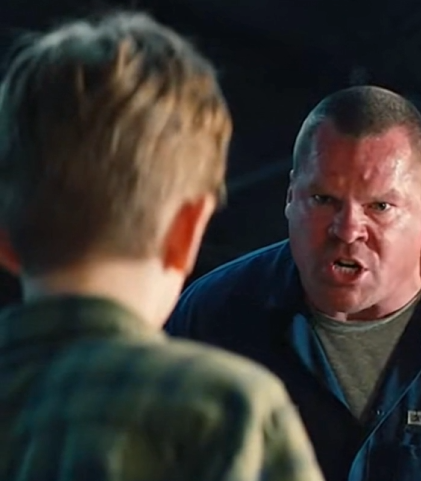
Bobby Harlan was the first to arrive.
He’d been unable to sleep, so he drove back to the airfield at 4 AM to stare at the dead engine one more time, as if sheer willpower might fix it overnight.
He saw the boy from fifty yards away and nearly called 911.
Then he got closer.
“What in the—”
The boy was inside the nacelle, making adjustments with the casual competence of a veteran mechanic. His movements were precise, unhurried, confident.
“HEY! KID!”
The boy didn’t react. He finished what he was doing — one last quarter-turn of a wrench — then pulled back and looked up.
Bobby stared into a grease-streaked face with eyes that were older than twelve. Way older.
“Step away from that engine,” Bobby said, his voice unsteady.
The boy stood up. He was tiny — the top of his head didn’t even reach Bobby’s shoulder. But his posture said everything his mouth didn’t. No fear. No apology. Just patience.
“Who are you? What did you do?”
The boy pointed at the turbine.
“You… you want me to check it?” Bobby asked.
The boy nodded once.
Bobby crouched. He grabbed the turbine shaft — the same shaft that had been frozen solid twelve hours ago — and turned it.
It moved like butter.
Bobby’s hands went numb.
“That’s… that’s not possible.”
The next twenty minutes were chaos.
Bobby radioed everyone. Vince arrived in sweatpants. Tammy showed up with her hair in a towel. Keith ran from the parking lot. Old Pete drove up in his truck, still eating a breakfast burrito.
They all saw the same thing: the turbine was working.
“Check the bracket,” Vince said.
Bobby shone his flashlight inside the housing and whistled through his teeth.
“Son of a… there’s a reinforcement plate on it. Hand-cut, hand-drilled, hand-bolted.”
“The locking ring,” Tammy said, crouching beside him. “It’s been flipped. It’s oriented correctly now.”
“Wiring’s rerouted too,” Keith added. “Clean work. Really clean.”
They all slowly turned to look at the boy.
He was sitting on his toolbox, wiping his hands on a rag, watching them with the calm expression of someone who’d expected exactly this reaction.
Director Grace Whitfield arrived at 4:27 AM, still in her coat over pajamas, looking like someone who’d been told the dead had risen.
In a way, they had.
“Bobby. Talk to me.”
Bobby was crouching by the turbine, shaking his head slowly, over and over, like a man trying to wake from a dream.
“It works, Grace. The turbine works.”
“How?”
“The kid fixed it.”
Grace looked at the boy. Small. Filthy. Calm as a pond at midnight.
“Who is he?”
Bobby stood up and ran a hand through his hair. “I don’t know. I don’t even know how he got in here.”
Grace walked up to the boy. He stood, meeting her eyes without flinching.
“What’s your name, sweetheart?”
“Jake.”
It was the first word anyone had heard him speak. His voice was quiet, steady, older than his face.
“Jake what?”
“Jake Harmon.”
The name hit the hangar like a thunderbolt.
Pete dropped his burrito. Tammy’s hand flew to her mouth. Vince sat down on a toolbox.
Bobby closed his eyes.
“Harmon,” he whispered. “Danny Harmon’s son.”
Grace felt the ground shift under her feet.
Danny Harmon. She remembered Danny. Everyone at this airfield remembered Danny. He’d been a legend — the best mechanic they’d ever had, a man who could listen to an engine the way a doctor listens to a heartbeat and know exactly what was wrong.
Danny had died four years ago. Cancer. The airfield had held a memorial. They’d lowered the flag. Grace had given a speech. And then, as things do, life moved on.
But Danny Harmon had a son. And that son was standing in front of her at 4:30 in the morning, covered in engine grease, having just repaired a turbine that five certified engineers had declared dead.
Grace knelt down so she was eye-level with Jake.
“Your dad was Danny?”
Jake nodded. His jaw was tight. His eyes were glassy.
“He taught you this?”
Another nod. Jake’s voice came out thick. “Every day after school. Since I was six.”
“Why are you here, Jake? Why tonight?”
The boy’s composure cracked — just for a moment, just a hairline fracture in that impossibly steady facade.
“Because my dad would’ve been here,” Jake said. “He wouldn’t have let you tear it apart and ship it to Germany. He would’ve said the problem was simple. He would’ve fixed it.”
Grace felt tears burning behind her eyes.
“So I fixed it,” Jake said. “For him.”
Nobody spoke for a long time.
Then Bobby Harlan did something that, in 23 years of working at Colton Regional Airfield, he had never done.
He took off his cap, walked up to Jake Harmon, and said, “Your father was the best mechanic I ever worked with. I see now that he passed it on.”
Then he shook the boy’s hand.
One by one, the others followed. Vince. Tammy. Keith. Old Pete, who had worked alongside Danny for twelve years and whose eyes were streaming unashamedly.
Grace stood up and pulled out her phone. She dialed the Chairman of the airfield board.
“Richard? It’s Grace Whitfield. I know it’s early. I don’t care. I need an emergency session. Today. Yes, today. Something happened that you need to hear about.”
Richard Cawley arrived at the airfield by 8 AM, expecting a disaster briefing. What he got was a resurrection.
Grace walked him through the sequence: the failure, the diagnosis, the $400,000 estimate, and then — Jake. She showed him the turbine, running perfectly. She showed him the reinforcement plate — hand-cut from scrap, precise as a factory part. She showed him the flipped locking ring, the rerouted wiring, the secured connections.
Cawley, who had been a Navy mechanic before going into airport administration, inspected the work himself. He spent ten minutes inside the nacelle with a flashlight, then came out and sat down on a tool cart.
“Who did this?” he asked quietly.
Grace pointed at Jake, who was sitting in the corner of the hangar, eating a granola bar that Tammy had given him. His toolbox sat between his feet. He looked small and out of place and completely at ease.
“That’s Danny Harmon’s boy,” Pete said from behind them. “Danny taught him everything.”
Cawley stared at Jake for a long moment. Then he stood up, walked over, and crouched beside the boy.
“Son, do you understand what you did tonight?”
Jake looked at him. “I fixed the locking ring. It was installed backwards. That caused the bracket failure. I reinforced the bracket and rerouted the wiring. It’s the same repair my dad did on Engine Four in 2019. He showed me the method.”
Cawley nodded slowly. “Your dad showed you the Air Force field manual technique?”
“Yessir.”
“The one they don’t teach anymore?”
“Yessir.”
Cawley let out a long, slow breath. He looked at Grace.
“Get the boy’s mother on the phone. I want to talk to her.”
Linda Harmon arrived at the airfield at 9:30 AM, terrified.
She’d woken up to an empty apartment, a missing toolbox, and a voicemail from the airport director asking her to come to the airfield as soon as possible. She’d spent the drive imagining police reports and juvenile detention.
What she found was her son, sitting in an office chair in the director’s conference room, surrounded by seven adults who were looking at him like he’d just walked on water.
“Mrs. Harmon,” Grace said, standing. “Please, sit down. Your son is fine. Better than fine.”
“What did he do?” Linda whispered, her face pale.
Grace told her.
Linda’s legs gave out. Bobby caught her elbow and guided her into a chair. She stared at Jake with an expression that traveled through shock, disbelief, pride, grief, and love in the span of about ten seconds.
“Jake…” she breathed. “You walked three miles in the dark with that toolbox?”
“It wasn’t that heavy,” Jake said.
Linda started crying. Not the quiet, dignified kind — the ugly, shoulder-shaking, gasping kind that comes from a place so deep it has no name. She pulled Jake into her arms and held him so tight he squeaked.
“He’s just like Danny,” Pete said quietly, and everyone in the room felt the truth of it settle over them like a warm, heavy blanket.
Richard Cawley didn’t waste time.
Within 48 hours, he convened a full board meeting. He presented the facts: the turbine failure, the $400,000 estimate, the 42-day projected downtime, and the reality that a twelve-year-old boy had solved the problem in under two hours with a ten-dollar toolbox.
“This young man saved this airfield somewhere between $1.5 and $2 million,” Cawley told the board. “And he did it because his father — our former Senior Engineer, Daniel Harmon — spent years teaching him a craft that we, apparently, have forgotten.”
The board voted unanimously.
They established the Daniel Harmon Memorial Engineering Scholarship — a full-ride fund that would pay for Jake’s education through high school and into a certified aviation maintenance program. Starting at age sixteen, Jake would have a paid apprenticeship at Colton Regional Airfield, mentored by Bobby Harlan and the engineering team.
They also approved the installation of a permanent memorial in Hangar C — the hangar where Danny Harmon had spent sixteen years keeping their fleet in the air.
The dedication ceremony took place on a Saturday, three weeks later.
The entire airfield staff attended. So did Linda, in a new dress that Grace had quietly arranged to be delivered to her apartment. And Jake, in clean jeans and a button-down shirt that he kept tugging at because he wasn’t used to clothes without grease stains.
They’d mounted a photograph on the hangar wall — Danny Harmon, smiling, standing next to a turbine with a wrench in his hand. Below it, a brass plaque read:
DANIEL HARMON
Senior Engineer, 2004–2020
His son fixed the turbine. We didn’t forget.
Grace gave a short speech. Bobby said a few words about Danny. Pete tried to talk and couldn’t — he just stood at the microphone, cap in hand, tears on his cheeks, until Tammy gently led him away.
Then it was Jake’s turn.
He walked up to the microphone. He was so short he had to stand on a step stool. He looked out at the crowd — mechanics, engineers, administrators, pilots, ground crew — and for a moment, his composure wavered.
Then he took a breath and spoke.
“My dad used to say that engines talk to you if you listen. He said the most important tool in any toolbox isn’t a wrench or a screwdriver. It’s patience.”
Jake paused. His eyes were bright.
“He also said that this airfield was his family. And he asked me to take care of his family after he was gone.”
Jake looked at the photograph on the wall. His father’s face, frozen in a smile.
“I’m trying, Dad.”
Linda found a job at the airfield two weeks later — administrative work in Grace’s office. Grace said the timing was coincidental. Nobody believed her. Nobody cared.
Bobby Harlan started a Saturday morning mentorship program in Hangar C. Jake was the first student. Within six months, there were twelve kids enrolled — children of mechanics, ground crew, janitors — all learning the basics of aviation maintenance from a man who’d rediscovered his own passion by watching a twelve-year-old boy fix the impossible.
The cargo plane flew again on the following Monday, right on schedule. The turbine performed flawlessly. It was still performing flawlessly a year later when the FAA inspector asked Bobby how the field repair had been executed.
Bobby pointed at Jake, who was sitting cross-legged on the hangar floor, teaching a ten-year-old girl how to identify engine sounds.
“Ask him,” Bobby said.
The inspector looked at the twelve-year-old. He looked at Bobby.
“You’re serious.”
“I’ve never been more serious about anything in my life.”
On the anniversary of Danny Harmon’s death, Jake went to the cemetery alone.
He sat beside his father’s headstone with the toolbox between his knees.
“The turbine’s still running, Dad,” he said. “Zero issues. Bobby says it’s the cleanest field repair he’s ever seen.”
He opened the toolbox and looked at the mismatched tools inside — each one chosen by his father, each one carrying a memory.
“I miss you every day,” Jake whispered. “But I hear you. Every time I put my hands on an engine, I hear you.”
He closed the toolbox, stood up, and walked home.
Behind him, the autumn wind moved through the cemetery grass, carrying with it the faint, distant hum of an engine running perfectly.