Richard Calloway couldn’t sleep anymore.
He’d pace the hallway outside Lily’s room at two in the morning, pressing his ear to the door, listening for anything — a murmur, a sigh, even a whimper in her sleep. Nothing. Just the sound of her breathing, slow and steady and completely silent.
Three years.
That’s how long it had been since the accident. One thousand and ninety-six days since Sarah’s car hydroplaned on I-87, flipped twice, and came to rest upside down in a drainage ditch. Sarah died on impact. Lily was pulled from the backseat with nothing but a small cut on her forehead.
She never spoke again.
Richard tried everything.
Dr. Melinda Cross, the pediatric neurologist at Mount Sinai, ran every test imaginable. MRIs. CT scans. Audiology workups. “There’s no physical damage,” she said, sitting across from Richard in her office with a clipboard balanced on her knee. “Her vocal cords are fine. Her hearing is perfect. This is psychological.”
“Then fix it,” Richard said.
“Mr. Calloway—”
“I don’t care what it costs.”
Dr. Cross folded her hands. “It’s not about money.”
But Richard couldn’t accept that. He’d built a $2.3 billion tech company from a dorm room. He’d solved problems that other people said were impossible. He’d fundraised, innovated, disrupted. There was no problem on earth that couldn’t be solved with enough resources.
He was wrong.
The therapists came and went like seasons.
Dr. Paul Whitfield, a speech-language pathologist from Johns Hopkins, spent three months at the Calloway estate. He tried play therapy. He tried picture exchange systems. He tried social stories with illustrated cards. Lily sat through every session quietly, her dark eyes tracking his movements, her small hands folded in her lap.
She never made a sound.
Dr. Susan Park flew in from Seoul. She specialized in selective mutism and had a success rate of 87%. She worked with Lily for six weeks.
Lily watched her. Lily sometimes drew pictures — abstract shapes, nothing identifiable. But she never spoke.
“She’s not choosing to be silent,” Dr. Park told Richard before she left. “She’s trapped. The trauma locked a door inside her, and she doesn’t have the key.”
“Then who does?” Richard asked.
Dr. Park shook her head. “I don’t know.”
After the eighth specialist failed, Richard fired the ninth one before she started.
He sat in his study that night and drank scotch until the room swayed. He stared at the framed photo on his desk — Sarah laughing on the beach in Montauk, holding baby Lily in one arm, her hair blowing sideways in the wind. They looked so alive it almost hurt to touch the glass.
“I can’t reach her, Sarah,” he whispered to the photograph. “She’s right there, and I can’t reach her.”
The birthday party was Helen’s idea.
Helen Drummond was Richard’s sister — fifteen years older, twice divorced, and the only person in the family who still said exactly what she thought.
“You’re turning forty-seven,” she said, leaning against the doorframe of his office. “Have a party. Invite everyone. Get out of this house before you lose your mind.”
“I don’t want a party.”
“I didn’t ask what you want. I’m telling you what you need.”
Richard looked up. “Helen—”
“Four hundred guests. The Grand Meridian. I’ll handle everything. You just show up and try not to look like you’re attending your own funeral.”
He didn’t plan to make the announcement.
It wasn’t written on any card or rehearsed in any mirror. It came out of him the way a sob comes — involuntary, uncontrolled, dragged from a place deeper than thought.
He was standing on the stage. Lily was beside him, her hand in his, her eyes on the floor. Four hundred people looked up at them — business partners, college friends, distant relatives, a few senators, and Helen, standing near the bar with a champagne flute and a worried expression.
Richard cleared his throat. Adjusted the microphone. He was supposed to thank everyone for coming.
Instead, he said: “My daughter hasn’t spoken in three years.”
The room went quiet.
“I’ve spent… I don’t even know how much. Millions. On the best doctors, the best therapists, the best everything. And nothing has worked.”
He paused. His jaw tightened.
“So tonight I’m going to do something desperate. Because I am desperate.”
He looked down at Lily. She didn’t look back.
“I’m offering one million dollars. Cash. Tonight. To anyone — anyone in this room, anyone on the street, anyone on this planet — who can make my daughter say one word.”
The murmurs started like distant thunder.
Helen put her glass down.
A woman in the third row put her hand over her mouth.
A man at the back table shook his head slowly.
And then the service entrance door burst open.
Marcus Reeves was nine years old and forty-seven pounds.
He lived at St. Benedict’s Group Home in Queens — a converted brownstone with twelve beds, nine boys, a housemother named Rosa who tried her best, and a set of rules Marcus broke on a regular basis.
Rule number six: No leaving the premises without permission.
Marcus was currently three miles from the premises.
He’d seen the flyer stapled to a telephone pole outside a bodega on his way home from school. Some gossip blogger had printed details about the Calloway birthday gala, including the rumor about the million-dollar offer. Marcus tore it down and shoved it in his pocket.
He wasn’t thinking about money.
He was thinking about the girl.
Marcus knew about silence.
His mother, Denise Reeves, had died of pneumonia in a hospital bed when Marcus was six. She was thirty-one years old. She didn’t have insurance. By the time she got to the ER, her lungs were so full of fluid that every breath sounded like someone trying to breathe through a wet towel.
Marcus was sitting in the hallway when she died. A nurse came out and told him. He didn’t cry. He didn’t scream.
He stopped talking.
For nineteen months, Marcus didn’t say a single word. The social workers wrote “selective mutism” in his file and moved on to the next crisis. The foster homes came and went — three in the first year alone. Nobody knew how to deal with a silent child. Nobody had the patience.
It was the airplane that brought him back.
The airplane was a toy his mother had given him on his fifth birthday. A small blue biplane with painted-on windows and a tiny propeller that spun if you blew on it. It cost $1.99 at the dollar store on Flatbush Avenue.
Marcus carried it everywhere.
In the third foster home, a boy named Devon tried to take it from him. Marcus didn’t speak, but he fought like a cornered animal. Devon needed four stitches. Marcus got sent back to St. Benedict’s.
After that, he kept the airplane in his inside jacket pocket. Close to his chest. Close to his heart.
One night, about seven months into his silence, Marcus was lying in bed at St. Benedict’s, holding the airplane up to the window so the streetlight caught the blue paint. And he started talking to it.
Not to anyone. Not to God or a therapist or a social worker. To the airplane.
“Mom,” he whispered. “I’m still here.”
That was the first word he’d said in nineteen months.
After that, it came back slowly. A word here. A sentence there. Within three months, he was talking again — quietly, cautiously, but talking.
He never told anyone what brought him back. He just held the airplane a little tighter.
The Grand Meridian was on 57th Street. Marcus took the bus.
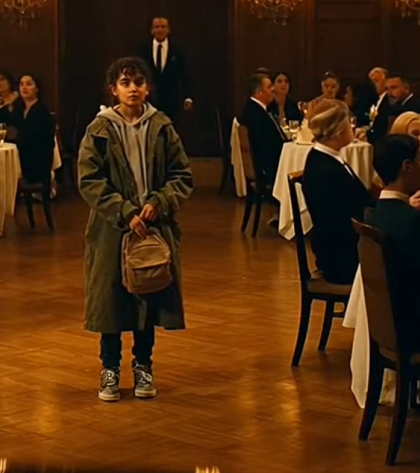
He stood outside the service entrance for twenty minutes, watching the catering trucks come and go. When a delivery driver propped the door open to carry in a rack of wine bottles, Marcus slipped through like a shadow.
The kitchen was a hurricane of noise and motion — chefs barking orders, plates clattering, the hiss of steam from industrial ovens. Nobody noticed a nine-year-old boy in a too-big jacket weaving through the chaos.
He followed the sounds of music and voices until he reached the door that opened into the ballroom.
The size of the room nearly stopped him.
Chandeliers the size of cars. Tables that stretched forever. People in clothes that looked like they’d been sewn from money itself. And on the stage, far away, a man holding a microphone and a little girl holding his hand.
Marcus took a breath.
He pushed through the door.
And he ran.
The guard at the kitchen entrance saw him first.
“Hey! HEY! Stop!”
Marcus didn’t stop. He’d been running from things his whole life — older kids, foster parents, dogs, bad neighborhoods. Running was the one thing he was genuinely good at.
He sprinted past the first row of tables. A woman gasped. A waiter stepped back, tray tilting, two champagne glasses sliding off and shattering on the marble floor. The sound was sharp and bright, like a starting gun.
“Security!” someone shouted.
Marcus weaved left. A guard reached for him — Marcus ducked right, using a chair as a pivot point, spinning around it like a dancer. The guard stumbled over a purse strap and went down hard.
The whole room was watching now. Four hundred faces turning, mouths open, some horrified, some confused, a few almost laughing.
Marcus could see Lily clearly now. She was maybe thirty feet away. White dress. Dark hair. Eyes on the floor.
He ran harder.
The second guard stepped into his path at the foot of the stage — a big man with an earpiece and a don’t-even-try expression. Marcus dropped low, slid on the polished floor like he was stealing second base, and popped up on the other side.
He was on the stage.
He was three feet from Lily.
The guard grabbed his shoulder from behind, fingers digging in hard enough to leave bruises.
Marcus winced.
On the stage, Richard Calloway looked down at this ragged, breathless child and felt something shift in his chest. He didn’t know what it was. Instinct, maybe. Or recognition. Or the simple, human awareness that this boy’s desperation was real.
He raised his hand.
“Let him go.”
The guard hesitated. “Sir—”
“Let. Him. Go.”
The hand released. Marcus rolled his shoulder, catching his breath.
Then he crouched down, slowly, until he was at Lily’s eye level.
She wasn’t looking at him. Her eyes were still on the floor. Her fingers were tight around her father’s hand.
Marcus reached into his jacket pocket.
He pulled out the airplane.
The blue paint was mostly gone. The propeller was stuck. One wing was bent at a funny angle from the time he’d dropped it running from a dog in East Flatbush. The decal on the side — the one his mom had pointed at and said “Look, baby, it says FLY” — was barely visible.
He placed it on the stage step between them, gently, like he was setting down something made of glass.
“Hey,” he said quietly.
Lily didn’t move.
“I know you can hear me,” Marcus whispered. “And I know you’re not gonna talk to me. That’s okay.”
He glanced down at the airplane.
“I didn’t talk either. After my mom died. Nineteen months. Everybody tried to make me. Doctors. Teachers. Foster parents. They all tried to pull the words out of me. But that’s not how it works.”
Lily’s fingers twitched on her father’s hand.
“You know what helped me? This.” He nudged the airplane with his finger. “My mom gave it to me. I used to talk to it at night when nobody was listening. I’d just tell it stuff. Stuff I couldn’t say to anyone else.”
His voice was barely audible now. The ballroom was so silent you could hear the ice melting in the cocktail glasses.
“I’d say, ‘Mom, I miss you.’ And the airplane didn’t say anything back, but that was okay, because I wasn’t really talking to the airplane. I was talking to myself. I was telling myself it was okay to miss her. It was okay to be sad. It was okay to not be okay.”
Lily’s eyes moved. Not up. Not yet. But sideways. Toward the airplane.
“You don’t have to talk to me,” Marcus said. “You don’t have to talk to anyone. But maybe…” He pushed the airplane an inch closer to her. “Maybe you could talk to this. When you’re ready. When it’s just you and the dark and you’ve got something you need to say.”
He stood up. Stepped back.
He was done.
The silence in the ballroom was absolute.
Richard stared at this boy — this skinny, dirty, uninvited child who had done something none of his millions could accomplish.
And then Lily moved.
She looked at the airplane. She looked at Marcus. She looked at her father.
Her fingers squeezed Richard’s hand.
Her lips opened — barely, like a crack in a dam.
“Papa.”
It was a whisper. A breath. Almost nothing.
Richard’s knees buckled. He thought he’d misheard. He stared at his daughter, eyes wide, mouth open, heart hammering.
“What?” he breathed. “What did you say?”
Lily looked at him. Her eyes were wet. Her chin trembled.
“Papa.”
Louder this time. Clear. Unmistakable.
Richard collapsed to his knees on the stage. He grabbed Lily and pulled her into his arms so tight she almost disappeared inside his jacket. His shoulders shook. His entire body shook. Three years of grief, fear, desperation, and hope poured out of him in a single, broken sob.
Lily wrapped her arms around his neck.
“Papa,” she said again, her voice muffled against his shoulder. “I miss Mommy.”
Richard couldn’t breathe. “I know, baby. I know. Me too.”
“She’s not coming back.”
“No. She’s not.”
“I was scared if I said it, it would be real.”
Richard pulled back, holding her face in both hands, tears streaming down his cheeks. “It is real, sweetheart. And we’re still here. We’re still here.”
The ballroom erupted.
It started with one person — a woman by the window who pressed both hands to her face and let out a sound that was half sob, half laugh. Then a man at the center table took off his glasses and wiped his eyes with the back of his hand. Then someone started clapping — slow, uncertain, like they weren’t sure if applause was appropriate for something this raw.
Then everyone was standing. Four hundred people on their feet, clapping, crying, some holding each other, some standing alone with tears running silently down their faces.
Helen Drummond stood by the bar with mascara running down both cheeks and a champagne glass she’d completely forgotten about tilting sideways in her hand.
“Well, I’ll be damned,” she whispered.
Marcus stepped back. Three quiet steps, away from the spotlight, away from the moment that belonged to a father and his daughter.
He put his hands in his pockets.
The airplane stayed on the step.
He’d carried it for three years. It was the most important thing he owned. And he’d just given it away.
He didn’t feel sad about it. He felt lighter. Like the airplane had been holding something inside him too — a weight he’d been carrying since his mother died — and setting it down had freed them both.
Richard looked up.
His face was a mess — red eyes, wet cheeks, nose running. He looked nothing like the polished billionaire who’d stood at that microphone thirty minutes ago. He looked like a father. Just a father.
He saw Marcus standing five feet away. Hands in pockets. No expression on his face except relief.
“Hey,” Richard said, his voice wrecked. “Kid.”
Marcus looked at him.
“What’s your name?”
“Marcus.”
“Marcus.” Richard wiped his face with his sleeve — a $4,000 sleeve, now ruined with tears and snot, and he couldn’t have cared less. “How did you know?”
Marcus shrugged. “Because the same thing happened to me.”
Richard stared at him for a long moment. Then he stood up, still holding Lily, and walked to the edge of the stage.
“Where are your parents?”
“Don’t have any.”
“Who brought you here?”
“The bus.”
Helen appeared at the foot of the stage. “Richard—”
“I heard him, Helen.”
Richard looked down at Marcus. He saw the torn jeans. The worn sneakers. The too-big jacket with one pocket now empty.
“Marcus,” he said slowly, “I offered a million dollars.”
Marcus shook his head. “I didn’t come for the money.”
“I know you didn’t. That’s why you deserve it.”
Marcus frowned. “I don’t want it.”
“Then what do you want?”
Marcus looked at Lily. She was peeking at him over her father’s shoulder, her eyes red but present — alive in a way they hadn’t been an hour ago. She was holding the blue airplane in her free hand.
“Can I have my airplane back someday?” Marcus asked. “After she’s done with it?”
Richard laughed. It came out broken and wet, but it was real. The first real laugh he’d produced in three years.
“How about this,” Richard said. “You come to dinner tomorrow night. You can check on it then.”
Marcus raised an eyebrow. “Dinner?”
“You eat dinner, don’t you?”
“At St. Benedict’s, dinner is at 5:30 and it’s usually some kind of pasta with mystery meat.”
“I’ll do better than mystery meat.”
Marcus almost smiled. Almost.
He came to dinner the next night.
Rosa from St. Benedict’s drove him. She was suspicious, protective, and completely overwhelmed by the size of the Calloway estate.
“This is a house?” she said, staring up at it from the driveway. “This is a museum.”
“It’s just big,” Marcus said. “Doesn’t mean anything.”
The door opened and there was Lily, standing in the entryway, holding the blue airplane.
She didn’t speak. Not yet. She’d said “Papa” three more times since the gala, but she was still rebuilding — brick by brick, word by word.
She held the airplane out to Marcus.
He shook his head. “You keep it.”
She looked at him. Then she turned around and walked into the house. After a moment, Marcus followed.
Dinner was roast chicken, mashed potatoes, and green beans. Normal food. Human food.
Helen was there. She poured Marcus a glass of apple juice and didn’t ask any questions. Richard sat at the head of the table and kept looking at Marcus like he was trying to solve a puzzle.
“Tell me about St. Benedict’s,” Richard said.
“It’s fine.”
“Fine?”
“There are twelve beds. Nine kids. Rosa makes sure we eat. The building’s cold in winter but we have blankets.”
“And school?”
“PS 141. I’m in fourth grade. I like math.”
Richard put his fork down. “Marcus, I want to do something. Not for you — for all the kids like you. Kids who’ve lost their parents, who’ve been through what you’ve been through.”
Marcus chewed his green beans. “Like what?”
“A foundation. Programs. Therapy that actually works. Not the kind where someone sits across from you with a clipboard and asks how you feel. The kind where someone who’s been through it sits next to you and just… understands.”
Marcus looked up. “You want me to help?”
“I want your opinion. You’re the only expert I’ve met who actually knows what he’s talking about.”
The Calloway Foundation for Children’s Voices launched six months later.
Richard put in ten million dollars of his own money. Helen ran the board. Dr. Park came back from Seoul to design the therapy program — this time based on a new model she developed after hearing Marcus’s story. She called it “Bridge Therapy” — pairing children who’d overcome trauma with children still locked inside it.
Marcus was the first bridge.
He didn’t give speeches. He didn’t do interviews. He just sat with kids — quiet, patient, present — and told them about the airplane. About the dark. About talking to something small and broken until you found your own voice again.
It worked.
Not every time. Not immediately. But more often than anyone expected.
A year after the gala, Marcus was sitting on the back porch of the Calloway estate, eating a popsicle and watching the sun go down over the manicured lawn that stretched out like a green ocean.
Lily came outside and sat next to him. She was talking now — not a lot, not to everyone, but to Richard, to Helen, and to Marcus. Always to Marcus.
“Marcus?”
“Yeah?”
“Are you going to stay?”
He looked at her. “What do you mean?”
“Here. With us. Papa said you could stay if you wanted.”
Marcus licked his popsicle. It was grape. His favorite.
“You want me to?” he asked.
Lily reached into her pocket and pulled out the blue airplane. She placed it on the step between them — the same way Marcus had placed it on the stage of the Grand Meridian, the night everything changed.
“Yeah,” she said. “I do.”
Marcus stared at the airplane. The paint was a little more chipped now. The bent wing was the same. But it was still flying, in its own way.
He picked it up. Held it in the light.
“Okay,” he said. “I’ll stay.”
Six months later, a judge signed the adoption papers.
Richard Calloway didn’t just give Marcus a room, a school, and three meals a day. He gave him a name.
Marcus Calloway.
The day it was official, Richard took both kids to the dollar store on Flatbush Avenue — the same one where Marcus’s mother had bought the airplane.
They walked the toy aisle together. Lily picked out a small red helicopter. Marcus picked out another blue airplane — same model, same $1.99 price tag, brand new.
Richard paid with a hundred-dollar bill and told the cashier to keep the change.
“Why two airplanes?” the cashier asked, confused.
Marcus held up the old one in his left hand and the new one in his right.
“This one,” he said, holding up the old one, “is for remembering.”
He held up the new one.
“And this one is for what comes next.”
Richard put his arm around both kids and walked out of the store.
The sun was setting over Brooklyn. The street was loud with traffic and music and people yelling in three languages. It was messy and beautiful and completely, perfectly alive.
Marcus looked up at Richard.
“Hey, Dad?”
Richard’s eyes went wide. It was the first time Marcus had called him that.
“Yeah?”
“Thanks for dinner.”
Richard laughed — the deep, chest-shaking kind of laugh that sounds like someone who just remembered what happiness feels like.
“Anytime, kid. Anytime.”