The first time Carol met Vanessa, she wore the wrong shoes.
She didn’t know they were the wrong shoes until she saw Vanessa’s eyes flick down to them — just once, just briefly, the kind of glance you’re not supposed to see and Carol saw anyway because she had spent thirty-two years watching people’s faces for information.
They were her good shoes. Black flats from DSW, two years old, still in excellent condition.
Vanessa wore heels that probably cost more than Carol’s refrigerator. She wore them with the ease of someone who had always had that particular kind of ease.
“Derek talks about you all the time,” Vanessa said, extending her hand.
Carol shook it. It was the grip of someone who had practiced gripping. “He talks about you too,” Carol said. “All good things.”
Vanessa smiled. “Of course.”
The restaurant was too loud and too dim and the menu had no prices, which Carol had learned was how you knew you were in real trouble. She ordered the second-cheapest thing she could identify and drank her water and watched her son.
Derek looked happy. He looked — polished. He had always been handsome in a quiet way, but now he gleamed a little. New haircut. Expensive watch. He held his fork differently.
She told herself: People change. That’s not loss. That’s growth.
She told herself that several more times over the next two years.
The wedding was in the Hamptons in June.
Carol flew in on a budget airline. She wore a blue wrap dress she’d bought at Macy’s specifically for the occasion. She sat in row three on the groom’s side, next to Derek’s college roommate, Ryan, who was kind to her in the way of people who know a situation is unjust but aren’t willing to say so.
At the reception, she was at table eleven. Near the kitchen.
She brought a card with five hundred dollars cash. She had saved it over four months, twenty to forty dollars a week, putting it in an envelope in her underwear drawer. She hadn’t told anyone. It was just what you did.
Vanessa opened the card, smiled the no-temperature smile, and set it beside a pile of other cards. “That’s so sweet, Carol.”
Derek was across the room, accepting congratulations. He caught her eye and waved. She waved back.
That was the most sustained contact they had for the rest of the evening.
She flew home the next morning, early, and stood in her kitchen in Columbus and said, out loud to nobody: “He’s happy. That’s what matters.”
She said it until it felt true enough to function.
After that, it was logistics.
Invitations that came too late to attend, or not at all. The holiday where she’d been told the dinner was Friday and arrived to learn it had been Thursday. The text she sent in December that read Merry Christmas, thinking of you both and received a reply four days later: Happy new year.
She adapted. She stopped expecting the calls. She stopped showing up uninvited. She learned the new shape of the relationship — peripheral, managed, existing only when it was convenient for someone else.
She got a cat. She got promoted at the insurance company to a supervisory role, which meant she could finally cut the restaurant shifts. She started sleeping eight hours a night for the first time in decades.
She was managing.
Then Ryan texted her in April: Hey, Carol. Just wanted you to know V is pregnant. I figured Derek would tell you but just in case.
Carol sat down at her kitchen table.
She didn’t cry. She pressed both palms flat on the table surface and breathed and let the emotion sort itself out. And what it sorted into wasn’t grief. It was something larger and warmer and more complicated.
She was going to be a grandmother.
That was structural. That was bone-level. That was not something Vanessa could manage, because it was not about Vanessa at all.
She called Derek. She kept it light. “Ryan mentioned — congratulations, sweetheart. I’m so happy for you.”
A pause. “Yeah. Thanks, Mom. It’s been crazy.”
“I bet. How’s Vanessa feeling?”
“Good. Tired. You know.” Another pause. “We’re keeping things pretty low-key.”
“Of course.” She kept her voice easy. “I’d love to see you both when it’s a good time.”
“Yeah. We’ll figure something out.”
She took that sentence and held it carefully, like something that might shatter.
She was not invited to the baby shower.
She found this out, again, from Ryan, who mentioned it in passing, who assumed she knew, who was embarrassed when he realized she didn’t. He texted afterward: Carol I’m so sorry. I shouldn’t have assumed.
She texted back: Please don’t worry. Not your fault.
She found the quilt at a craft fair in September. Yellow, cotton, with small white stars stitched in a pattern that repeated without feeling mechanical. She picked it up and felt its weight and thought: This is exactly right. She paid forty dollars for it and took it home and put it on the top shelf of the closet in the bag it came in.
She waited.
She didn’t call Derek about the shower. She didn’t ask why she wasn’t invited. She had learned, over these years, that asking why produced only versions of Vanessa’s answer, delivered in Derek’s voice, and she found she preferred the privacy of her own understanding.
Sometime in October, she got a card in the mail. Pre-printed, no personal note. We’re expecting! Baby arriving December. Vanessa & Derek.
She put it on the refrigerator, next to the Polaroid from 1992.
Ryan texted at 11:14 on a Tuesday night: They’re at Lenox Hill. Just so you know. I figured someone should tell you.
Carol read it standing at her kitchen counter in her pajamas, halfway through a cup of chamomile tea. She set the mug down. She looked at the Polaroid on the refrigerator. The enormous, unguarded smile.
She went and put on her navy dress.
She got the quilt from the closet.
She drove.
The highway was mostly empty at that hour. She had a podcast queued up and didn’t play it. She drove in silence, which she’s found, as she’s gotten older, is often the condition most suited to doing the things that matter.
She talked herself calm at the George Washington Bridge. She talked herself calm in the parking garage. She talked herself calm in the elevator, pressing four, watching the numbers change.
The corridor was cold and bright.
She saw him before he saw her.
Derek was standing in front of Room 412, one hand on the doorframe, facing away from her. Through the cracked door: balloons, laughter, a sound that — was that? Yes. A newborn. She could hear it even from here.
Her chest did something complicated.
He turned.
“Mom.” Not a greeting. An acknowledgment. The way you acknowledge an appointment you’d rather have canceled.
“Derek.” She held up the quilt. “I know you said low-key. I’m not staying. I just wanted to drop this off.”
He looked at the quilt.
She watched his face. She was watching for the window — the flash of softness she’d seen in glimpses, the boy underneath the polish. She saw it. Just for a second. Just a pulse of something behind his eyes that looked almost like: Mom.
Then Vanessa’s voice came through the door. Soft, inquiring. Something murmured.
The window closed.
“You need to go,” he said.
“Derek—”
“She doesn’t want you here.” His voice was dropping. Controlled. He was aware of the nurse at the far end of the corridor and was keeping this private. “You’ve never respected our boundaries. You need to leave.”
She felt the word boundaries like a thumbtack — not because it was wrong to have them, but because she recognized that it was Vanessa’s word, delivered in Vanessa’s syntax, from Derek’s mouth. She had watched his vocabulary change over three years and this was the particular change that hurt most — not the words themselves but the fact that they weren’t his.
“I respect your family,” she said. “I just want to—”
He was already moving.
She didn’t step back. She should have. She didn’t.
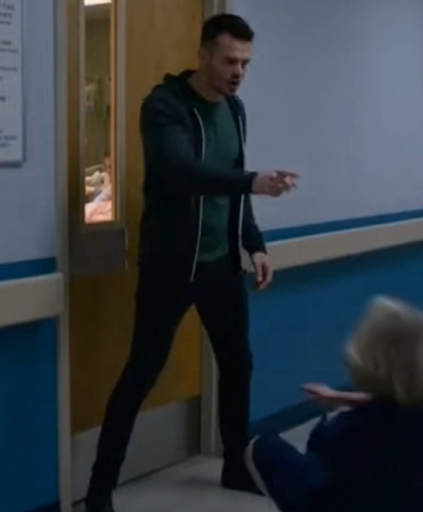
His hands hit her chest. She went backward. The wall was hard and real. She slid.
The quilt hit the floor. Her purse skidded left. Her shoes made that sound — the squeaking of cheap rubber on linoleum — that she would hear in her sleep for months.
She sat on the floor and looked up at him.
He was breathing harder than normal. His ears were red.
“You’re not welcome here,” he said. He was pointing at her. His finger was steady and deliberate.
Then he went back through the door and it slammed and she was alone in the corridor.
She heard the baby cry.
She listened. She sat on the cold floor and she listened and she memorized it — the pitch of it, the specific urgency of a newborn trying to make itself known in a world that was completely new. She memorized it the way you memorize something you know you might not get again for a while.
Then she got up.
She picked up her purse. She picked up the quilt. She straightened her dress.
She walked to the elevator and pressed one and went home.
Three weeks later, the hospital called.
The woman was polite, professional, clearly experienced at having awkward billing conversations. “We’re calling regarding the account of Vanessa Haines, Room 412, admitted December ninth. The outstanding balance of ten thousand, two hundred and forty dollars — we have you listed as the guarantor on file.”
Carol sat very still.
“Could you confirm your payment method, or would you like to set up a payment plan?”
“I’d like to understand,” Carol said carefully, “how my name came to be on this account.”
“You’re listed as emergency contact and financial guarantor for Derek Haines, who is the patient’s spouse. It appears the contact information was never updated.”
Ten thousand dollars. For a room she had been shoved away from. For a birth she had heard from the floor of the corridor.
“I see,” Carol said.
“Would you like to—”
“No,” Carol said. “I will not be paying this balance. You’ll need to contact Vanessa or Derek Haines directly. I’ll also be asking you to remove my name from the account. I’ll follow up with a written request.”
She stayed on the line long enough to get the billing department’s email address. She was very polite throughout. She thanked the woman for her time.
She hung up.
Then she went to her phone’s settings and changed her number.
She texted Ryan from the new number: New contact info. Don’t share it with Derek.
Ryan texted back: Understood. Are you okay?
She thought about it.
I will be, she sent back.
She did not hear from Derek for six months.
She did not reach out. She sent no texts. She did not follow Vanessa’s social media — she removed herself from all the accounts that would have shown her the child’s face and the child’s milestones, because she had decided she did not want to consume those things secondhand. Either she would know her grandchild or she would not. There was no comfortable middle ground.
She worked. She read. She saw her neighbor Barbara for dinner every other Thursday. She took up swimming at the community center at five-thirty in the morning, which turned out to be something she loved with a quiet ferocity that surprised her.
She missed the baby. She missed Derek — the earlier Derek, the boy in the Polaroid, the kid who’d called every Sunday. She let herself miss him without making it into a project.
In late May, on a Thursday morning, her new number rang.
She was at work. She let it go to voicemail.
She listened to the voicemail in the parking lot at lunch, sitting in her car with her salad container open and untouched on the passenger seat.
Derek’s voice. He sounded — different. Strained in a specific way she recognized not from adulthood but from childhood — the particular strain of a kid who has gotten into something too large for him and is scared.
“Mom. It’s me. I — I know. I know. Just — can you call me back? Please.”
She sat with the phone in her hands.
She called Barbara.
“He called,” she said.
Barbara, who had heard every chapter of this story over two years of Thursday dinners, was quiet for a moment. “What do you want to do?”
“I don’t know yet.”
“What do you need?”
She thought about it. “I need to know what happened before I do anything.”
“Then find out first. Everything else can wait.”
Carol thanked her and hung up.
She called Ryan.
Ryan told her in the direct, slightly uncomfortable way of men who are not natural deliverers of bad news but feel obligated to be honest.
Vanessa had been hospitalized. Not physically — or not primarily. She had been admitted to a psychiatric facility in White Plains three weeks earlier, following what Ryan called “a significant episode” and what Carol understood to mean a breakdown of some magnitude.
Derek had lost his job two months before that — a restructuring at the firm, Ryan said, though there was something in his tone that suggested the restructuring had been specifically targeted. The apartment in Tribeca had been Vanessa’s — or rather, her family’s — and with the hospitalization, the family had taken the lease back.
Derek was staying in Ryan’s spare room.
The baby — a boy, Ryan said, eight pounds one ounce, name was James — was currently with Vanessa’s mother, who was not equipped for full-time infant care and had already indicated she could not continue past the end of the month.
“He’s running out of options,” Ryan said. “And he knows it.”
Carol was quiet for a long time.
“Carol?”
“I’m here,” she said. “I’m just thinking.”
“He’s scared. He’s also — Carol, I think he knows what he did. I don’t think he’s figured out how to say it yet.”
“He doesn’t have to figure it out in advance,” Carol said. “He just has to actually say it. In those words.”
“I’ll tell him.”
“Thank you, Ryan.”
She hung up and sat in her car a while longer.
She thought about James. Eight pounds one ounce. A name she hadn’t known.
She thought about the floor of the corridor at Lenox Hill. She thought about the crying she had memorized. She thought about ten thousand dollars and a bill she hadn’t paid.
She thought about the Polaroid on her refrigerator.
She started her car.
Derek came to her apartment two days later.
Not to Columbus — she had driven to New York because she wanted to be in Ryan’s city, she wanted to be close to James, she wanted to be able to move quickly if the situation required it. She had gotten a reasonably priced room at an extended-stay hotel in Queens.
Ryan had given Derek the address.
He knocked at eleven in the morning.
She opened the door.
He looked like he hadn’t slept properly in weeks. His shirt was clean but his eyes weren’t. He had lost some of the gloss — the polish that Vanessa’s world had put on him — and underneath it was something that looked more like him. More like the boy in the Polaroid.
“Mom,” he said.
“Come in,” she said. She moved back from the doorway.
He sat on the edge of the hotel bed, hunched forward, hands clasped. She sat in the chair by the window.
She waited.
He opened his mouth. Closed it. Looked at his hands.
“I don’t know how to start,” he said.
“Start with the night at the hospital,” she said. Her voice was even. Not cold. Even.
He looked up. His eyes were red-rimmed. “Mom—”
“That’s where it has to start, Derek. Not with where we are now. That night.”
He held eye contact for a moment. Then he looked at the floor. “I shoved you,” he said. “I — I put my hands on you. And I said — I said things.” He stopped. “That was wrong. It was — it was wrong and I knew it was wrong when I was doing it.”
“Did you?”
“Yes.” His voice cracked on the word. “I knew it. I just — Vanessa was so — and I’d told myself — I told myself you were the problem. That you were always making things harder. And I — I built this whole — I talked myself into it. And then I did it and I—” He stopped again. Pressed his knuckles against his mouth.
Carol let the silence sit.
“I’m sorry,” he said. “I know that doesn’t — I know that’s not enough. But I am. For all of it. For the last three years. For not — for not being your son.”
She looked at him.
He was thirty-two years old. He was sitting on the edge of a hotel bed in Queens looking like something had taken him apart and he was only now realizing he needed to figure out how to reassemble.
She thought about the Polaroid. The fists. Already ready to argue.
“I have conditions,” she said.
He looked up quickly.
“I’m not reentering your life the way I was before. Available whenever, on whatever terms, grateful for whatever scraps I was given. That’s done.” She kept her voice steady. “I want to know my grandson. I want regular, scheduled, consistent time with him — not when it’s convenient for you, on a schedule we agree on in advance. I want to be treated as a member of this family. Not managed. Not accommodated. A member.”
He nodded. He was listening with his whole body, the way he used to when he was twelve and she was explaining something important.
“And one more thing,” she said.
“What?”
“You never put your hands on me again. Not ever. If that happens — we’re done. That’s not negotiable and I will not revisit it.”
“It won’t happen,” he said. “Mom, I swear to you—”
“I know,” she said. “I’m just saying it clearly so we both know it was said.”
A pause.
“Okay,” he said.
“Okay,” she said.
She went with Derek to collect James from Vanessa’s mother’s apartment in Midtown the following afternoon.
The building was a prewar co-op with a uniformed doorman and an elevator with brass fixtures. Vanessa’s mother — Eleanor, sixties, exquisitely maintained — opened the door with the particular expression of a woman who has been managing a situation for three weeks and is past the point of pretense.
James was in a bouncy chair in the living room.
Carol saw him and stopped walking.
Six months old. Round face. Dark hair that stuck up in every direction. He was gnawing on a teething ring with the intense, focused commitment of someone doing important work.
He looked up when she came in.
He looked at her.
He had Derek’s eyes. He had — she blinked, because this was unexpected — he had her jaw. The stubborn jaw she had seen in the Polaroid, which she had thought then was his father’s.
“Hi,” she said softly.
James considered her.
Then he took the teething ring out of his mouth, extended it toward her as an offering, and said: “Bah.”
Carol Haines — who had not cried in the corridor at Lenox Hill, who had not cried in the car on the drive home, who had not cried in the three-week silence after changing her number — sat down on Eleanor’s expensive rug next to James’s bouncy chair and cried.
She cried for about forty-five seconds. Then she wiped her face, took the teething ring, said “thank you very much,” and handed it back.
James found this hilarious.
They stayed in New York for two weeks.
Carol helped Derek find an apartment — a two-bedroom in Astoria, affordable, near a decent school. She did not pay for it. She did the research, made the calls, went to three showings, and was present when Derek signed the lease, which he signed with his own money from a new job he had started as a project manager at a mid-size firm.
She set up the nursery. She bought the furniture — that, she bought. Crib, changing table, the soft things. She put the yellow quilt in the crib.
Derek saw it and went quiet.
“I know,” Carol said.
“I’m sorry,” he said.
“I know,” she said again. “It’s in the crib now. That’s what matters.”
Vanessa came home from the facility six weeks later. Carol was not present for that — she had returned to Columbus by then, to her apartment and her cat and her swimming schedule. She and Derek spoke twice a week on the phone, scheduled Tuesday evenings and Sunday mornings. He sent photos. She responded to all of them.
When she visited New York in February, she had dinner with Derek and Vanessa.
It was not easy.
Vanessa was quieter than she had been. The management-precision had been sanded down by whatever she’d been through, and what was underneath was more human. Not warm, exactly. But human.
At the end of the dinner, Vanessa looked at Carol across the table and said, without ceremony: “I wasn’t fair to you.”
Carol held her gaze. “No,” she said. “You weren’t.”
“I don’t expect—”
“I’m not expecting anything,” Carol said. “I’m just here for James. Whatever we work out around that, we work out. But I’m not going anywhere.”
Vanessa nodded. She looked like she’d expected something harder and wasn’t sure what to do with something more direct.
“That’s fair,” she said.
“Yes,” Carol said. “It is.”
James turned one in December.
The birthday party was in the Astoria apartment — not lavish, just warm. Carol made the cake, which was lemon with buttercream frosting and a single candle. Derek’s college friends came. Ryan came. Eleanor came and was pleasant to Carol in the careful way of someone learning a new skill.
James wore a tiny paper crown and ate an amount of cake that was technically alarming.
Carol sat on the floor next to his highchair — she’d gotten good at getting down to floor level and back up again, a skill she was weirdly proud of — and fed him small pieces of banana while he alternated between the banana and his crown with the democratic appetite of a one-year-old.
He said Ma now, which he said to both Vanessa and Carol with equal enthusiasm and no particular distinction, and Carol had decided this was perfect.
At one point, Derek crouched down next to her.
He handed her a piece of cake on a plate. He sat cross-legged on the floor next to her, in the living room of his two-bedroom apartment in Astoria, watching his son investigate the physics of paper crowns.
“Thank you for coming,” he said.
“There’s nowhere else I’d be,” she said.
A pause.
“I know you drove three hours to the hospital,” he said. “That night. I know what that cost you.”
“It did cost me something,” she said. “But what I got back cost more to keep waiting for.”
He looked at her. She looked at James, who had succeeded in getting the crown fully off his head and was now examining it at extremely close range.
“I’m going to do better,” Derek said.
“I know,” she said.
She meant it.
James held out the crown to Carol.
She took it. She put it on her head. He applauded.
That was enough. For now, for this moment, it was exactly enough.