Walter
The eggs were perfect. That’s what Walter Briggs noticed first, the way he noticed it every Sunday — the edges just barely crisp, the yolks still soft, the butter pooled in the divots of the rye toast like liquid gold. He lifted his fork with a hand that was spotted with age but steady as steel, and he ate the way he did everything: slowly, deliberately, without wasting a single motion.
Rosie’s Diner hadn’t changed much since 1994. The vinyl seats were patched with duct tape. The Formica counters had burn rings from decades of coffee cups. The jukebox in the corner hadn’t worked since Clinton’s second term. But the eggs were still perfect, and the coffee was still hot, and the corner booth was still his.
Walter was ninety years old.
He’d fought in Korea. He’d held a frozen rifle in hands so numb he couldn’t feel the trigger, and he’d fired it anyway because the men behind him were counting on him. He’d come home, married Margaret, worked forty-two years at the grain elevator, buried his parents, buried his brother, buried his wife, and kept going — because that’s what Briggs men did.
The cane leaning against the table was hand-carved walnut with a brass eagle head. Margaret had given it to him on their fiftieth anniversary, six months before the cancer took her. He polished it every night before bed. It was the most valuable thing he owned.
Tina brought the cream pitcher without being asked. She was twenty-three, brown-eyed, overworked, and the closest thing Walter had to family on Sunday mornings.
“Looking sharp today, Mr. B,” she said with a smile.
“Always do,” he said, not looking up.
She laughed and moved on.
The door hit the wall so hard the bell flew off its mount.
Five men exploded into the diner like a detonation. Leather vests. Heavy boots. Chains looped through belt loops. Skull rings and tattoos and the stink of diesel and sweat. They didn’t walk in — they invaded.
The leader was the biggest man Walter had ever seen outside of a boxing ring. Bald. Massive. A thick, ragged scar ran from his earlobe down to the point of his chin, like someone had tried to split his face open and only made it halfway. His eyes were flat and gray, the color of dead fish.
He shoved a four-top table sideways with one arm. The legs screeched across the floor. A woman gasped. A child started crying.
“Listen up!” the bald man bellowed, his voice filling the diner like a foghorn. “We’re hungry, we’re thirsty, and we don’t like waiting.”
His crew fanned out behind him. One of them — a wiry kid with a mohawk and a nose ring — kicked a chair across the room. Another slid into a booth already occupied by an elderly couple and grinned at them until they scrambled out.
Tina’s tray clattered to the floor. She backed up against the coffee station, her face white.
The cook, Ray, ducked behind the grill and didn’t come up.
The leader scanned the room — a slow, predatory sweep, like a searchlight looking for something worth crushing.
His gaze landed on Walter.
He walked over with the heavy, deliberate steps of a man who had never once been afraid of another human being. Each boot fall shook the floor. He stopped at the edge of Walter’s booth and looked down.
Walter didn’t look up. He cut a piece of egg and put it in his mouth.
“Well,” the biker said, folding his massive arms across his chest. “What do we have here?”
Walter chewed. Swallowed. Cut another piece.
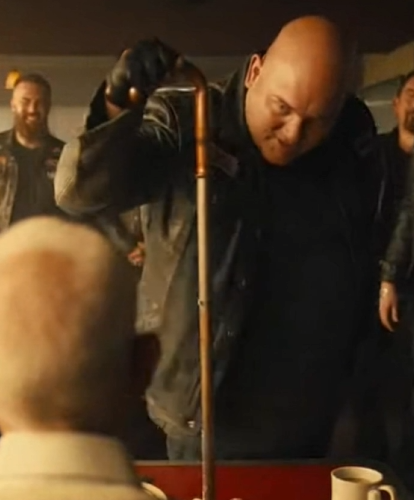
The biker reached across the table and picked up Walter’s cane. He held it up, examining it with theatrical interest, turning it in his thick fingers.
“Nice stick,” he said. “Your wife give you this?”
The other bikers had gathered behind their leader now. They snickered. One of them pulled out his phone to record.
The bald man gripped the cane in both hands and cracked it down on the table like a gavel. The sound was like a gunshot. The cream pitcher jumped, tipped, and spilled — a slow, white waterfall pouring off the edge of the table and into Walter’s lap.
Cold cream soaked through his pressed khaki pants. It dripped onto the vinyl seat. It pooled on the floor.
The bikers erupted in laughter.
“Oh man,” the one with the mohawk wheezed, “he’s not even gonna do anything!”
The leader leaned down, bringing his scarred face inches from Walter’s. His breath was hot and sour.
“What are you gonna do about it, fossil? Huh? You gonna cry? You gonna call somebody?”
Walter set his fork down.
He looked up — for the first time — directly into the biker’s eyes. The look lasted two seconds. Later, Tina would say it was the most unsettling thing she’d ever witnessed: the old man’s eyes weren’t scared, weren’t angry, weren’t pleading. They were calm. Absolutely, terrifyingly calm.
Walter reached into his breast pocket with two steady fingers and pulled out a small flip phone. It was a relic — a silver Samsung from 2006, scratched and worn, with a rubber band holding the battery cover on. He opened it, pressed one button — a speed dial — and held it to his ear.
“This is Walter,” he said, his voice barely above a whisper. “I’ve got a pest problem.”
He closed the phone.
The bikers laughed harder than before. The leader slapped the table. “He called pest control! The old man called pest control!” Tears of laughter ran down his scarred face.
Walter slid the phone back into his pocket, picked up his fork, and went back to his eggs.
Sixty seconds passed.
Then Tina felt it — a vibration in the floor, subtle at first, like a truck passing on the highway. Except it didn’t pass. It grew. The glasses behind the counter began to rattle. The coffee in Walter’s cup trembled, tiny concentric circles rippling across the surface.
A sound rose from the distance — low, guttural, and unmistakable. The deep, full-throated roar of motorcycle engines. Not one. Not five. Dozens.
The laughter died.
The bikers looked at each other. Something passed between them — a flicker of something they weren’t used to feeling.
The sound grew louder. Closer. The windows of Rosie’s Diner began to vibrate in their frames. The blinds buzzed against the glass. A condiment caddy rattled off a table and hit the floor.
The leader’s grin vanished. He strode to the front window and shoved the blinds aside.
And stopped.
The parking lot — the same dusty, half-empty lot where Walter’s old Ford pickup sat alone most Sundays — was being swallowed. Motorcycle after motorcycle rolled in, engines growling, headlights blazing in the morning sun. Twenty. Twenty-five. Still coming. Big machines ridden by big men with gray beards and weathered faces and leather jackets covered not in skulls and chains, but in military patches: unit insignia, campaign ribbons, American flags, and — on every single back — a large embroidered eagle clutching a rifle.
The Iron Patriots.
The biker at the window said nothing. He couldn’t.
The front door of Rosie’s Diner swung open.
The man who stepped through the doorway was enormous — six-foot-five, two hundred and seventy pounds, with a silver beard braided to his chest and arms that looked like they’d been carved from old-growth timber. His leather jacket bore the Iron Patriots’ eagle across the back, and above it, three words: SERGEANT AT ARMS.
His name was Dale Harmon, and he’d served two tours in Vietnam before most of the Scorpion Riders were born.
Behind him, one by one, the veterans filed in. They moved in silence — no shouting, no grandstanding, just the quiet efficiency of men who’d been trained to enter hostile territory and control it. They spread across the diner with practiced precision, filling every booth, lining every wall, blocking every window.
The last man in closed the front door behind him. He was shorter than the rest — a compact man in his sixties with close-cropped gray hair and reading glasses perched on his nose. He reached up, turned the deadbolt, and pulled the latch.
The click of the lock echoed through the silent room like the closing of a cage.
The five Scorpion Riders found themselves standing in the center of the diner, surrounded on all sides by twenty-five men who were not smiling.
Dale Harmon walked past them without a word. He went straight to Walter’s booth. He looked at the overturned cream pitcher. He looked at the cane lying on the table. He looked at Walter’s cream-stained pants.
His jaw tightened. The muscles in his neck corded like steel cables.
He turned slowly to face the Scorpion Riders’ leader.
“Which one of you touched his cane?” Dale said. His voice was quiet. That made it worse.
The bald biker was breathing hard now. He tried to puff up, tried to summon the bravado that had served him in a hundred roadhouses and truck stops.
“Look, man, we were just having some fun—”
“Which one of you,” Dale repeated, “touched his cane.”
One of the younger bikers pointed at his own leader. The leader shot him a murderous look.
Dale took one step forward. Just one. The bald biker took two steps back.
“That cane,” Dale said, “was a gift from his wife. She carved the eagle herself. She died seven years ago. You put your hands on it. You put your hands on the last thing he has of her.”
The diner was so quiet you could hear the grease popping on the grill.
“Now,” Dale said, “you’re going to pick up that cane. You’re going to hand it back to him. And you’re going to apologize. Not to me. To him.”
The bald biker’s eyes darted around the room, looking for an exit, looking for an angle. There was none. Twenty-five men. Every door locked. Every window blocked.
“Fine,” the biker muttered. He reached for the cane.
“With both hands,” Dale said. “Like it matters.”
The biker picked up the cane with both hands. He turned to Walter. The old man looked up from his eggs and met the biker’s gaze with those same calm, clear, terrifying eyes.
“I’m… sorry,” the biker said through clenched teeth.
Walter took the cane. He ran his thumb over the brass eagle. He nodded once.
“I accept your apology,” Walter said. “Now tell your boys to put the tables back.”
The Scorpion Riders, stripped of their swagger, began shuffling furniture back into place under the silent watch of twenty-five veterans. The mohawked one was trembling. Another one looked like he was about to throw up.
It might have ended there. It should have ended there.
But the bald leader, his face burning with humiliation, was not a man who accepted defeat. As he shoved the last table back into position, his hand moved — fast, practiced — to the back of his waistband.
Dale saw it first.
“Gun!” he barked.
The bald biker pulled a chrome .45 from his belt and swung it toward Dale in a single, panicked motion.
He never completed the arc.
Three veterans hit him simultaneously — one from the left, one from the right, and one from behind. The gun clattered to the floor. The biker went down hard, his face slamming into the linoleum with a crack that made everyone in the room wince. In two seconds, he was pinned, disarmed, and breathing through a split lip.
Dale kicked the .45 across the floor, where it spun to a stop against the jukebox.
“Tie him,” Dale said.
Two veterans zip-tied the leader’s wrists behind his back with the efficiency of men who’d done this a thousand times.
The other four Scorpion Riders dropped to their knees without being told. Their hands went up.
Tina finally moved. Her legs were shaking, but she picked up the phone behind the counter and dialed 911.
“Sheriff’s office,” she said, her voice cracking. “You need to get to Rosie’s Diner. Fast.”
Sheriff Tom Reeves arrived seven minutes later, his cruiser fishtailing into the lot, lights blazing. He was a broad-shouldered man in his fifties with a handlebar mustache and the calm demeanor of someone who’d seen it all — but when he walked through the unlocked door and saw twenty-five Iron Patriots standing shoulder to shoulder around five hog-tied bikers, even he stopped short.
“Walter,” he said, looking at the old man in the corner, “you want to tell me what happened?”
Walter wiped his mouth with a paper napkin. “Pest problem, Tom. These boys got a little rowdy.”
The sheriff looked at Dale. Dale handed him the .45.
“He drew on me,” Dale said. “Got three witnesses right there.”
The sheriff turned to the bald biker on the floor. “You pulled a gun in a public diner. On a Sunday morning. With families present.”
The biker spit blood. “You got no idea who you’re dealing with.”
“Enlighten me.”
The biker didn’t answer, but one of the younger ones — the mohawk, the one whose nerve had broken ten minutes ago — started talking. Fast.
“It’s Devlin,” the kid blurted. “Marcus Devlin. He runs the Scorpion cartel out of Tulsa. We’re just the advance crew. He’s got eighty riders. He’s already on his way here because we didn’t check in.”
The room went silent in a new way — not the silence of tension, but the silence of calculation.
Dale looked at the sheriff. The sheriff looked at Walter. Walter set his fork down.
“How long?” the sheriff asked the kid.
“Maybe two hours. He doesn’t wait. When we don’t report in, he sends everybody.”
Tom Reeves had been sheriff of Garfield County for eighteen years. He had twelve deputies. He had a town of four thousand people. And now he had an army of eighty outlaw bikers headed his way.
He stepped outside and made three calls. The first was to the state police — estimated response time, ninety minutes, probably more. The second was to the county emergency line. The third was to his wife.
“Don’t come into town today, honey,” he said. “I’ll explain later.”
He walked back inside. Every eye was on him.
“State boys are at least an hour out,” he said. “Maybe longer.”
Dale Harmon crossed his arms. “What do you need, Sheriff?”
“I need time. I need to get civilians off the main street. And I need people who know how to hold a line.”
Dale looked around at his men. Twenty-five veterans. Marines. Army Rangers. Navy corpsmen. Men who’d held lines in jungles and deserts and frozen mountains.
“You’ve got us,” Dale said.
Within thirty minutes, Garfield’s main street looked like a ghost town. The sheriff’s deputies had gone door to door, clearing businesses, sending families home. Rosie’s Diner was converted into a command post. Tina made coffee for forty men. Ray, the cook, pulled out sandwiches and water bottles.
The five Scorpion Riders were locked in the diner’s storage room, zip-tied to shelving units.
Dale and the sheriff stood at the counter, studying a hand-drawn map of the town.
“He’ll come in from the east, on Route 12,” Dale said, tapping the map. “Straight shot from Tulsa. Only one road in.”
“And one road out,” the sheriff said.
“Exactly.”
They positioned men at every intersection. Two veterans with military-grade binoculars climbed the water tower with walkie-talkies. Four more set up at the grain elevator overlooking the highway approach. The rest spread out along Main Street, using parked trucks and dumpsters as cover.
Walter Briggs finished his eggs, drank his cold coffee, and stood up. He reached under the booth — behind the duct tape where only he knew to look — and pulled out a small leather case. Inside was a Colt M1911, polished to a mirror shine, with a magazine that hadn’t been loaded in fifteen years.
He loaded it now.
“Walter,” Dale said softly, “you don’t have to—”
“I called it in,” Walter said. “My mess.”
Dale didn’t argue.
At 10:47 a.m., the lookouts on the water tower radioed down.
“Dust cloud. East on 12. Big one. Estimate sixty to eighty vehicles.”
The sheriff picked up his radio. “All units. They’re coming.”
The rumble hit first — a deep, bone-rattling vibration that rose from the asphalt like an earthquake. Then the sound: a wall of engine noise so loud it drowned out thought. And then they appeared at the crest of the hill — a black wave of motorcycles stretching across both lanes and the shoulders, bearing down on Garfield like a cavalry charge.
At the front rode a man on a matte black Harley with chrome skull accents. Marcus Devlin. He was lean, sharp-faced, with a salt-and-pepper goatee and wraparound sunglasses. Behind him rode his army.
They poured into town like a flood.
And found it empty.
Devlin slowed. His riders slowed behind him, engines idling, the collective growl filling the abandoned street. Something was wrong. He could feel it.
He stopped in front of Rosie’s Diner.
“Where are my boys?” he shouted. No one answered.
He killed his engine. Silence fell — the sudden, deafening kind that comes when a hundred motors cut at once.
And then the sheriff stepped out of the diner, alone.
“Marcus Devlin,” Tom Reeves said, his voice carrying the length of Main Street. “I’m Sheriff Tom Reeves. Your boys are in custody. They assaulted a patron and pulled a weapon in a public establishment. I suggest you turn your people around and ride back to Tulsa.”
Devlin pulled off his sunglasses and smiled. It was a thin, humorless smile — the smile of a man who counted on numbers and cruelty and had never been refused.
“One sheriff,” Devlin said, looking around at the empty street. “One little sheriff. You think I’m scared?”
“You should be,” the sheriff said.
On cue, twenty-five veterans stepped out from behind trucks, dumpsters, doorways, and storefronts. They lined both sides of Main Street, shoulder to shoulder, arms folded, faces granite.
The lookouts on the water tower stood up and made themselves visible.
The four men on the grain elevator did the same.
Devlin’s smile faded. His riders shifted on their bikes. The math was changing.
“Those are a lot of old men,” Devlin said, but his voice had lost its edge.
“Those old men held Khe Sanh,” the sheriff said. “They took Fallujah. They survived Chosin. You want to find out what they can do to a parking lot full of bikers?”
A long moment passed. Devlin’s eyes swept the rooftops, the alleys, the water tower. He was calculating — eighty against twenty-five, but twenty-five with the high ground, the cover, the training, and the look on their faces that said they’d been waiting for this fight their whole retirement.
“This isn’t over,” Devlin said finally, reaching for his handlebars.
He didn’t see Walter.
The old man had walked out the back door of the diner, circled through the alley, and now stood fifteen feet behind Marcus Devlin with the Colt M1911 pointed at the ground.
“Yes it is,” Walter said.
Devlin spun. His hand moved toward his waistband.
Walter raised the Colt and fired once.
The bullet took Devlin’s side mirror clean off his Harley. The chrome shattered and clattered across the asphalt. Devlin froze, his hand halfway to his gun, staring at the ninety-year-old man who had just put a bullet exactly where he’d intended it — a shot that said I could have ended you, but I chose not to.
“Next one’s not a warning,” Walter said. His voice was flat. His hand was steady.
Devlin looked at the destroyed mirror. He looked at the old man’s eyes. He looked at the Colt — a Korean War relic that had killed men on the other side of the world seventy years ago and was still perfectly capable of doing it again.
He let his hand drop.
“Mount up!” Devlin screamed at his riders. “Move! Now! Go!”
The scramble was immediate and total. Eighty motorcycles roared to life in a panicked, chaotic eruption of noise. Bikes collided. Men cursed. One rider dropped his machine trying to turn too fast. In less than two minutes, the army of the Scorpion cartel was streaming back down Route 12 toward Tulsa, their engines screaming, their egos shattered, and their leader riding at the rear with one missing mirror and a story he’d never live down.
The dust settled.
The street was empty again.
Sheriff Reeves holstered his weapon and let out a breath that seemed to drain ten years of tension. He turned to Walter.
“You could’ve killed him.”
“I’m ninety, not stupid,” Walter said.
Dale Harmon walked over and put a hand on Walter’s shoulder. “Good shot, old man.”
“Margaret taught me,” Walter said. “She said a man who can’t control where his bullets go doesn’t deserve to carry a gun.”
By noon, the state police had arrived. The five Scorpion Riders were loaded into transport vehicles. The bald leader, face swollen, wrists zip-tied, was shoved into the back of a cruiser. He said nothing.
The FBI field office in Tulsa was notified about Marcus Devlin and the Scorpion cartel. Three days later, federal agents raided four locations and seized enough evidence to put Devlin and his lieutenants away for decades.
Tina unlocked the front door of Rosie’s at 12:30. The regulars drifted back. The elderly couple who’d been scared out of their booth returned and ordered the biscuits and gravy. The young mother brought her toddler back in a clean outfit and took a window table.
Walter Briggs walked back to his corner booth. He sat down. He placed his cane — Margaret’s cane, with the brass eagle — gently against the table.
Tina brought him a fresh plate.
“Two eggs over easy, rye toast, and a fresh coffee,” she said, setting it down. Her eyes were red. She’d been crying. “On the house, Mr. B. Forever.”
Walter looked up at her. For the first time that morning — for the first time in maybe years — the corners of his mouth twitched upward.
“I’ll still tip,” he said.
He picked up his fork.
He ate his eggs.
And the diner hummed on, the way it always had, the way it always would — because some things, and some men, are built to last.