The bucket of dirty water hit my mother’s head at 2:47 PM on a Tuesday.
I know because I checked the time. Some part of my brain was already collecting evidence.
Let me start at the beginning.
My name is Marcus Cole. I’m forty-one years old. I sell medical equipment across the country. Forty weeks a year on the road: planes, hotels, rental cars. It’s good money. It bought us the house in Charlotte—four bedrooms, granite counters, a big backyard with a garden my mother loved.
Or used to love.
Three years ago, my mom had a fall. Broke her hip. Insurance covered most of it, but she couldn’t live alone anymore. “Move in with us,” I said. “Jess loves you. It’ll be great.”
My wife, Jessica, smiled that warm smile of hers and squeezed my mom’s hand. “We’ll be two peas in a pod, Linda.”
Mom smiled back. Nervous, but hopeful.
I left for a conference in Dallas four days later. The first text from Jessica came that night: “Your mom and I made lasagna! She’s already asleep. Love you!”
I smiled at my phone in a king-size hotel bed and thought: I married the right woman.
I was wrong.
The first year, things seemed perfect—from thirty thousand feet.
Jessica sent photos every few days. Mom in the garden. Mom reading in her chair. Mom having coffee on the porch. Every picture was bright and warm and domestic.
When I called Mom, she sounded fine. “Everything’s good, sweetheart. Jessica’s been wonderful.”
If I’d listened closer—really listened—I might’ve caught it. The way her voice had started to thin. The way she’d pause before saying “wonderful,” like she was choosing the word carefully. The way she always rushed to hang up.
But I didn’t listen. I was closing deals. Hitting quotas. Building a life that looked perfect on paper.
Meanwhile, the paper was rotting underneath.
I don’t know exactly when it started. Mom told me later it was gradual. Like a faucet that drips so slowly you don’t notice until the sink overflows.
The first week after I left, Jessica was sweet. Helpful. She cooked dinners and helped Mom with her physical therapy exercises.
The second week, the tone shifted.
“Linda, could you wipe down the counter? I’d do it, but my back’s acting up.”
“Linda, I left the laundry by the machine. Do you mind?”
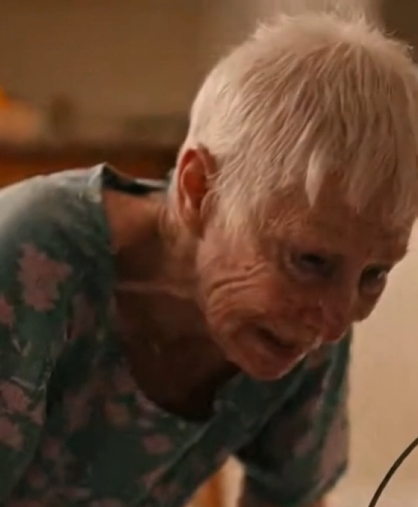
“Linda, the downstairs bathroom needs a quick scrub.”
Mom didn’t mind. She wanted to be useful. She’d always been the kind of woman who couldn’t sit still.
By month two, the requests became instructions.
“There’s a list on the fridge. I need all of it done by four.”
“The guest bathroom still has spots on the mirror. Do it again.”
“I told you—fold the towels in thirds, not halves. Are you even listening?”
By month four, the instructions became commands.
“You’re not sitting in the living room after six. I have friends coming over and I don’t want to explain why my mother-in-law is just sitting there.”
“Don’t touch the good china. Use the old plates in the back of the cabinet. Those are yours.”
“I’m hiding your arthritis medication in my room. You’ll get it when the chores are done. Not before.”
Mom told me all of this five months later, sitting in a doctor’s office, her hands wrapped in bandages, while a social worker took notes.
When I asked her why she never called me—why she never said a single word—she looked at me with those tired brown eyes and said the thing that broke me worse than anything:
“Because you love her, Marcus. And I wasn’t going to be the one who took that away from you.”
I had to leave the room. I couldn’t let her see me cry.
But that Tuesday—the Tuesday that ended my marriage—I didn’t know any of this yet.
I knew my flight landed early. I knew the cab smelled like pine air freshener. I knew the front door was unlocked and the house was quiet and something about the silence made my skin prickle.
I walked through the hallway. Set my bag down. Called out, “Mom? Jess?” Nothing.
Then I heard it. From the kitchen. Wet cloth on tile. And underneath—a sound so faint it was almost imaginary—a whimper.
I walked to the kitchen doorway.
And the world ended.
Mom was on the floor. On her hands and knees. Scrubbing tile with a soaking rag, her arthritic fingers swollen and purple, her gray hair plastered to her forehead with sweat. A bucket of brown water sat beside her. Her housedress was soaked through at the knees. She was crying without making a sound, biting her lip so hard I could see blood.
Jessica stood three feet away. Arms crossed. Cashmere sweater. Fresh highlights. Not a single crease on her anywhere. She was looking down at my mother the way you’d look at mud on your shoe.
“You missed under the island,” Jessica said flatly. “I’m not telling you again.”
Mom’s hands shook harder. “I’m trying—”
“Try faster.”
And then Jessica grabbed the bucket.
She picked it up with both hands—deliberately, almost casually—stepped forward, and poured the entire thing over my mother’s head.
The dirty water hit Mom like a wave. She gasped—this horrible, strangled sound—and collapsed forward onto the tile. Her arms flew over her head. Her body curled into a ball. She was shaking so hard the water on the floor rippled around her. Her clothes were drenched. Her hair was plastered flat.
She looked so small. So broken. So alone.
Jessica threw the bucket aside. It clanged across the tile like a hollow bell. She pointed down at my mother—my seventy-two-year-old, trembling, soaking-wet mother—and screamed:
“You want to sit around all day? You want to eat my food and live in my house and do NOTHING?”
My suitcase dropped from my hand. It hit the floor with a crack that echoed through the house like a gunshot.
Jessica spun around. Her mouth was still open from screaming. Her eyes went wide.
“Marcus! Oh my God, baby, you’re—”
I didn’t hear the rest. I was already moving.
Three steps across the kitchen. That’s all it took.
I grabbed Jessica by the shoulder. She tried to smile. That reflex—that automatic, bright, fake smile she’d been perfecting for three years—flickered across her face like a dying lightbulb.
“Babe, it’s not what it looks—”
“Get out.”
“Marcus, she wanted to help, she—”
“GET. OUT.”
I turned her toward the hallway. She dug her heels in. Grabbed the doorframe.
“You can’t just—Marcus, stop, you’re overreacting—”
I pried her fingers off the frame. She fought. She screamed. She called me crazy, ungrateful, psychotic. I pushed her through the front door. She stumbled on the porch steps, caught herself, and spun around with mascara running down her face.
“This is MY house too! You can’t—”
I slammed the door. Locked it. The deadbolt clicked like a period at the end of a sentence.
Then I ran back to the kitchen.
Mom was exactly where I’d left her. On the floor. Curled up. Shaking. Soaking wet. She hadn’t moved an inch.
I dropped to my knees beside her. The tile was cold and wet and I didn’t care. I pulled off my jacket and draped it over her shoulders.
“Mom. Mom, I’m here.”
She didn’t look up.
“Mom, please. It’s me. It’s Marcus.”
She lifted her head. Slowly. Like it weighed a thousand pounds. Her face was red and blotched and streaked with dirty water and tears. Her eyes—God, her eyes—they looked at me with this expression I will never forget. Not relief. Not anger. Shame.
She was ashamed.
“I’m sorry,” she whispered. “I’m sorry, I didn’t want to bother you—”
I pulled her into my arms. She grabbed the front of my shirt with both fists and buried her face in my chest and shook. She shook like she’d been cold for three years and was only now feeling warmth.
“You have nothing to be sorry for,” I said. My voice was steady. My hands were not. “Nothing. Do you hear me? Nothing.”
She cried. I held her. The kitchen dripped around us.
That night, I took Mom to the emergency room.
The doctor’s face told me everything before the words did.
“Your mother has bruising on both wrists consistent with grabbing and restraining. She has inflammation in both knees from prolonged kneeling on hard surfaces. Her arthritis has significantly worsened—likely from untreated symptoms over an extended period. She’s underweight. Mildly dehydrated.”
He paused. Looked at me. Looked at Mom, who sat on the exam table in a hospital gown, staring at her hands.
“Mr. Cole, I’m required to ask. Has your mother been experiencing… abuse?”
Mom flinched. I put my hand on hers.
“Yes,” I said. “And I didn’t know.”
The truth came out in pieces over the next two weeks. Like pulling nails from a board, one at a time.
Mom told me about the lists on the fridge. About scrubbing floors on her knees every day. About hand-washing laundry because Jessica didn’t want her “touching the machine.” About being banned from the living room after 6 PM. About eating in the kitchen alone while Jessica hosted dinner parties in the next room.
About the arthritis medication.
“She hid it,” Mom said quietly, sitting at my kitchen table in a new apartment I’d rented two days after the incident. “In her closet. She said I could have it when the work was done. Some days, the work was never done.”
I put down my coffee cup because my hands were shaking too hard to hold it.
“What about the stairs?”
Mom went quiet. She looked at the table.
“Mom.”
“She made me carry the groceries up from the garage. All of them. Every week. She said it was ‘good exercise.'”
“And your hip? Your fall?”
“I fell on the stairs once. Carrying bags. I couldn’t breathe. I lay there for—I don’t know, maybe ten minutes.” She paused. “Jessica came downstairs. She saw me. She stepped over me and went to the kitchen.”
My blood was ice. “She stepped over you?”
“She was on her phone. She didn’t look down.”
I called my buddy Dan, who ran an IT company, and asked him to help me pull the security camera footage. Jessica didn’t know I’d installed cameras three years ago—little ones, hidden in smoke detectors and picture frames. I’d set them up after a break-in scare and then forgot about them. The cloud storage had been running the entire time.
Dan pulled three years of footage in one afternoon.
We watched the first clip together, sitting at his desk. It was eight months old. Timestamped 3:17 PM.
My mother was lying at the bottom of the staircase. Flat on her back. One hand clutching her chest. Her mouth was open, gasping. She wasn’t moving.
Jessica walked into frame. She looked down at my mother. She paused for maybe half a second. Then she stepped over her—over her body—and walked to the kitchen.
The camera caught her pulling out her phone. Dan zoomed in on the text. It went to me. It read:
“Mom’s having a great day! We’re about to go sit in the garden. 🌻”
Dan turned to me. His face was gray.
“Marcus,” he said. “There’s more.”
There was more.
Hours of it. Hundreds of clips. Jessica screaming at my mother. Jessica snatching food from her plate. Jessica locking her out of the bathroom. Jessica standing over her while she scrubbed, hands on hips, tapping her foot, checking the time.
One clip showed Jessica yanking my mother’s arm so hard Mom cried out and nearly fell. Another showed Jessica dumping a plate of food on the floor and pointing at it: “Clean it up.”
I watched four hours of footage. Then I went to the bathroom and threw up.
The next morning, I called a lawyer named Grace Fielding. She was recommended by Dan’s wife, who’d described her as “a bulldog with a briefcase.”
Grace didn’t blink when I showed her the footage.
“How long has this been going on?”
“At least three years.”
“Does your wife know about the cameras?”
“No.”
“Good. Does she have legal counsel?”
“I don’t know. I don’t care.”
“Mr. Cole.” Grace leaned forward. “I understand your anger. But we’re going to do this right. We’re going to file for divorce. We’re going to submit the footage as evidence. And we’re going to make sure your wife leaves this marriage with exactly what she deserves.”
“Which is?”
“The minimum the law allows.”
Jessica called eighty-seven times in the first week. I didn’t answer once.
She left voicemails. The first few were frantic—”Marcus, please, let me explain, it’s not what you think.” Then angry—”You’re making a HUGE mistake. You’ll regret this.” Then bargaining—”I’ll change, I swear, I’ll go to therapy, I’ll do anything.” Then cold—”My lawyer will be in touch.”
I changed the locks.
The divorce took four months. Grace Fielding earned every penny of her fee.
Jessica’s lawyer tried to argue that the videos were obtained without consent. Grace had them authenticated, timestamped, and entered into evidence before the judge could finish his coffee.
Jessica’s lawyer tried to claim the footage was “taken out of context.” Grace played the clip of my wife stepping over my gasping mother at the bottom of the stairs and then texting me that everything was “great.”
The judge stared at Jessica for a long time. She stared at the table.
The ruling was straightforward. Jessica got the minimum allowable under state law. No alimony. No claim to the house. She was escorted from the courtroom by her lawyer, who looked like he wanted to be somewhere else.
In the hallway, Jessica grabbed my arm.
“You threw away everything,” she hissed. “For what? For your mother?”
I looked at her hand on my sleeve. I removed it.
“Yes,” I said. “For my mother.”
I sold the Charlotte house. I couldn’t walk into that kitchen again.
Mom and I moved to a small apartment near the river in Asheville. Two bedrooms, a balcony, a little patch of grass where she could garden. The first week, she kept apologizing. For everything. For the dishes. For the space she took up. For existing.
“You don’t have to apologize anymore, Mom.”
“I know. I’m sorry. I mean—”
She stopped. Laughed. A tiny, nervous laugh. But real.
I started working from home. Three days in the office, two remote. My boss grumbled, but when I explained the situation, he went quiet and said, “Take whatever time you need.”
Mom started physical therapy. Three times a week, a woman named Pat came to the apartment and worked with her—stretching her hands, strengthening her knees, helping her walk without wincing.
“Your mother’s tough,” Pat told me one afternoon while Mom was napping. “Whatever she’s been through, she’s not going to let it define her.”
I nodded. I couldn’t talk about it yet without my voice cracking.
Month one: Mom still flinched when I raised my voice—even to yell at the TV during a football game. I learned to keep the volume down.
Month two: She started eating in the living room instead of the kitchen. The first time she sat on the couch to watch the evening news, she looked at me like she was asking permission. “This is your home, Mom,” I said. “Sit wherever you want.”
Month three: She walked to the garden store down the block by herself. Came back with a bag of soil and two packs of seeds. “For the balcony,” she said quietly.
Month four: She made pot roast. Real pot roast. From her old recipe. It was the best thing I’d ever eaten.
Month five: She started calling her friend Dottie again. They’d talk for an hour, sometimes more. I could hear her laughing through the bedroom wall—real, full-throated laughter. The sound made me sit down on my bed and close my eyes and just breathe.
Month six.
I was in the kitchen. I’d been trying to make toast. Somehow—don’t ask me how—I burned it so badly the smoke alarm went off. The bread was black. The butter had melted into a puddle. The kitchen smelled like a campfire.
Mom came shuffling in, wrapped in her bathrobe, and stared at the smoking toaster. Then at me. Then at the charred bread.
She pressed her lips together. Her eyes crinkled. And then she laughed.
Not a polite laugh. Not a nervous laugh. A real, full, from-the-belly laugh that filled the kitchen and spilled into the hallway and made the morning light seem brighter.
She laughed until she had tears in her eyes—good tears, the kind that come from something breaking open that’s been shut for too long.
“Oh, Marcus,” she said, wiping her eyes, still giggling. “You’re a wonderful man. But you are a TERRIBLE cook.”
I looked at the toast. I looked at her. And I started laughing too.
We stood there in that tiny kitchen, surrounded by smoke and the smell of burnt bread, laughing together like it was the easiest, most natural thing in the world.
And it was.
Jessica called one more time, three weeks after the divorce was finalized. It was late. I was sitting on the balcony, watching Mom’s tomato plants grow.
I answered. I don’t know why.
“What do you want, Jessica?”
Silence on the line. Then: “I just wanted to say… I know what I did.”
I waited.
“I don’t know why I did it. I just—she was there, and you were gone, and I was angry about something and I—I took it out on her. And then it became… normal.”
“It was never normal.”
“I know.”
More silence.
“Don’t call again, Jessica.”
I hung up. Deleted the number. Went inside. Mom was asleep on the couch with a gardening magazine on her chest, the TV murmuring low, and a half-empty mug of chamomile tea on the side table.
I draped a blanket over her shoulders—gently, the way she used to tuck me in thirty-five years ago—and turned off the light.
The End.