The gate at O’Hare was chaos at seven-fifteen in the morning.
Lines backing up from the boarding door. A family wrestling a stroller. A man in a fleece vest arguing with the gate agent about a carry-on that was plainly too large.Grant Holloway walked past all of it.
He had priority boarding. He had status. He had, in practical terms, a different relationship with airports than most people — a smoother, faster, more frictionless version of the same physical space.
He handed his boarding pass to the agent with the practiced efficiency of a man who does this constantly and has long since stopped saying good morning.
He walked down the jet bridge.
He ducked through the aircraft door.
He turned left.
Always left.
“Good morning, Mr. Holloway,” said the flight attendant — a young woman with precise posture and a name tag that said Claire. “Can I take your jacket?”
“I’m fine,” he said, not unpleasantly. He was never unpleasant. He was efficient.
He found 2A. Stowed his bag. Sat down. Spread his jacket across his lap. Opened his laptop and pulled up the deck he’d been working on for three weeks.
The pitch for the Meridian Group acquisition.
Forty slides. Two hundred and sixty-eight million dollars in implied valuation. His name on the recommendation. His name on the deal.
His name, finally, on the wall.
He read the executive summary for the sixth time this week and felt the same satisfaction he always felt when a thing was exactly where it was supposed to be.
He was exactly where he was supposed to be.
The champagne arrived without his asking. Claire had remembered. Of course she had.
He took a sip. Read another slide. The cabin filled around him.
Then Dorothy sat down.
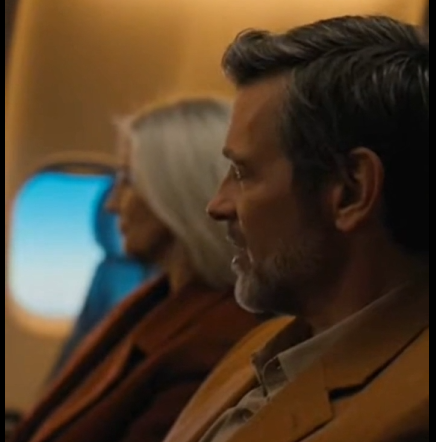
He noticed her before she was fully in her seat.
The coat, first. Burgundy wool, good quality once, old now. Worn soft at the collar and cuffs in the way that things get worn when they are used and not just displayed.
Then her hands, settling her bag. Then her posture — straight, deliberate, utterly unhurried.
She sat down. Buckled her belt. Folded her hands.
She did not look at him.
Grant looked at her.
He felt the scratch of it immediately — that particular low-grade irritation of a thing that doesn’t fit. Like a word used incorrectly in a sentence. Like a note that’s almost in tune.
He went back to his deck.
He read the same sentence three times.
He told himself it didn’t matter. He told himself he had bigger things to think about. He told himself that in four hours he would be shaking the hand of the man who was going to change the shape of his career, and that this — whatever this was, this ambient wrongness beside him — was irrelevant.
He believed himself for about seven minutes.
The flight attendant came through the cabin. Grant had a second champagne. He didn’t particularly want it. He ordered it because it was his section and the champagne was there and those were the rules of this particular territory.
The woman beside him asked for water.
She said please and thank you with the automatic warmth of someone for whom courtesy was simply a natural state. Not a performance. Just: manners.
Grant watched the interaction from his peripheral vision.
The flight attendant smiled at her — a real smile, not the professional one — and moved on.
Dorothy looked out the window.
The ground crew was doing its work below. A man in ear protection waved someone in. A belt loader moved in slow arcs across the tarmac.
Dorothy watched with quiet interest, as though the ordinary mechanics of departure were something worth attending to.
Grant looked at her looking at it.
And felt, rising in him, the specific, hot, unnamed thing that was not quite contempt and not quite disgust but was their close cousin — the thing that says: you are out of place, and your not knowing that is itself a problem.
He put down his champagne.
He exhaled.
He leaned toward her.
“You don’t belong up here.”
It came out quieter than he’d planned. Low and even and almost casual, the way remarks come out when they’ve been forming for long enough to find their shape.
He expected her to react immediately.
He expected the flinch — the subtle collapse inward, the searching glance, the reaching for the bag that signals surrender.
Instead, Dorothy turned.
Her motion was unhurried. She took her time with it, the way you take your time when you have decided that nothing this man does entitles him to your urgency.
She turned, and she looked at him.
Her eyes were gray-blue and clear and utterly level.
She said nothing.
Grant felt the silence like something physical. Like the absence of the expected.
“I’m not trying to be rude,” he said, adjusting, reaching for something smoother. “I just — there’s been mix-ups before with the fare classes, and you’d want to make sure—”
“My ticket is fine,” Dorothy said.
Her voice was quiet. Not sharp. Not defensive. The voice of a woman stating a fact that requires no defense because it is simply a fact.
“I’m sure you think that,” he said. “But I’ve been on this route a long time, and the check-in agents sometimes—”
“My ticket is fine,” she said again.
Same tone. Same pace. Like the second time a river passes the same stone.
Grant felt his jaw tighten.
The woman looked at him for another moment — patient, clear, unimpressed — and then turned back to the window.
She folded her hands.
She looked at the tarmac.
As though he had been a minor weather event and had now passed.
At the edge of the galley curtain, Claire stood very still.
She had heard all of it.
She had, in nine years, learned to make quick and accurate assessments of situations that could escalate, and her assessment of this one was: the man in 2A was not finished.
The woman in 2B was not going to fold.
This was going to require attention.
She stepped forward, smile in place, voice bright and warm and carrying just enough professional authority to act as a gentle pre-empt.
“Mr. Holloway, is there anything I can get you?”
He looked up. His jaw was still tight.
“No,” he said.
She turned to Dorothy. “And for you, Mrs.—”
“Just Dorothy is fine,” the woman said. “I’m perfectly fine, thank you, dear.”
Claire nodded. Moved on.
Behind her, she heard the man shift in his seat.
They were wheels-up over Lake Michigan when Grant started talking again.
He had spent the climb to altitude staring at his laptop, jaw working slightly, champagne untouched.
Dorothy had watched the skyline rise and then disappear behind cloud cover and then opened the small notebook she kept in her bag and began writing something in a neat, unhurried hand.
Grant glanced at the notebook.
He glanced at her hands.
Something about the act of her writing — the quiet, purposeful, utterly private act of it — pressed on the same nerve.
“Where are you headed?” he asked.
Dorothy looked up. “New York.”
“Business or pleasure?”
She considered the question with a faint interest, as though it had some small merit.
“A meeting,” she said.
“What kind of meeting?”
She looked at him now with something that was almost, but not quite, amusement.
“The kind where I give my opinion,” she said, “and people pay attention to it.”
She returned to her notebook.
Grant stared at the side of her head for a moment.
Then he made a mistake.
“Look,” he said, and his voice had changed — lower now, harder, the courtesy stripped off and something more honest showing beneath it. “I don’t know what someone told you about how this works, but people in this section — we have a certain—” he searched for the word — “professional profile. There are expectations. The airline has—”
“Are you the airline?” Dorothy asked pleasantly.
He blinked. “What?”
“Are you a representative of the airline?” Same pleasant tone. “Because I’ve seen my ticket and my boarding pass and the seat assignment, and they all appear to be in order. If you are a representative of the airline and you have a concern about my documents, I’d be glad to review them with you.”
She looked at him with her head slightly tilted.
“Are you a representative of the airline?”
Grant looked at her.
“No,” he said.
“Then I think we’re fine,” she said, and returned to her notebook.
At that point, something shifted in Grant Holloway.
It was the shift that happens in people who are accustomed to winning small interpersonal moments when they realize they are not going to win this one.
It was ugly and fast and not his best quality.
He picked up his phone.
He opened the camera.
He pointed it, very clearly and deliberately, at Dorothy.
“I’m documenting this,” he said. “For the airline. So they can see—”
“So they can see what?” Claire said.
She had appeared again, silently, from the galley. She stood in the aisle, hands folded in front of her, voice calm and completely controlled.
Grant looked up.
“There’s clearly a seating issue,” he said. “I’m documenting it.”
“What seating issue?” Claire asked. “Can you describe the issue for me?”
“This woman—” He stopped. Tried to find language for it that would sound objective. He couldn’t.
“This passenger,” Claire said carefully, “is in seat 2B on Flight 1147 from Chicago to New York. She boarded with a valid boarding pass. She has a premium fare ticket issued in her name. There is no seating issue.”
She paused.
“I’d ask you to put your phone down, Mr. Holloway.”
He stared at her.
“I’d also ask you to be aware that other passengers in this cabin are also taking an interest in this situation,” Claire said. Her voice was still professionally smooth, but there was something steel-edged under the smoothness. “I’d ask you to consider how you’d like this portion of your flight to be remembered.”
Grant looked, for the first time, at the cabin around him.
The woman in 3B had put her magazine down.
The man in 1A had turned slightly in his seat.
The person in 4A had stopped the movie on their tablet.
The woman in 2C across the aisle was not reading her book.
They were all watching him.
Not with aggression. Not with the wide-eyed entertainment of people watching a scene.
With the quiet, steady, documenting attention of people who have decided that this is important.
Grant looked down at the phone in his hand.
He realized, in a slow and nauseating way, what it looked like.
Dorothy had not reacted to any of it.
She had not looked at Claire during the exchange. She had not looked at the other passengers. She had written three more lines in her notebook and then capped her pen and set it on her tray table.
Now she looked at Grant.
“Can I ask you something?” she said.
He blinked. “What?”
“Why does it bother you?” she said. “My being here.”
He opened his mouth. Closed it.
“I’m not asking to embarrass you,” she said. “I’m genuinely curious.” And she did seem curious — not hostile, not triumphant, not performing anything. Just: curious.
Grant said nothing.
“I’ve been sitting in this seat since we boarded,” Dorothy said. “I haven’t taken anything from you. I haven’t spoken to you unprompted. I’ve asked for water. I’ve been writing in my notebook.” She paused. “And something about that has been, for some reason, intolerable to you.”
She looked at him with genuine interest.
“Why is that?”
Grant looked at her.
For a moment — just a moment — something real moved across his face. Something that wasn’t anger or calculation or performance.
Something that recognized itself being seen.
Then it closed again.
“I don’t have to explain myself to you,” he said.
“No,” she agreed. “You don’t.”
She picked up her pen. Opened her notebook.
“I just think,” she said, still looking at the page, “that the things that bother us most about strangers are usually more about us than about them.”
She began writing.
Grant stared at the side of her head.
Claire, still standing in the aisle, made no attempt to fill the silence.
Nobody did.
The flight landed at LaGuardia at ten-forty-two.
Grant Holloway sat in his seat as the plane taxied to the gate, laptop closed, champagne long gone, jaw still tight.
He had not spoken again for the rest of the flight.
Neither had Dorothy.
She had finished whatever she was writing. She had eaten the fruit plate the flight attendant brought her. She had looked out the window as they came in over Jamaica Bay — the water flat and silver, the bridges threading across it, the city rising in gray geometry against the pale sky.
She had seemed, Grant noted with a frustration he couldn’t entirely explain, genuinely pleased to see it.
He pulled out his phone to check his messages as they taxied.
Seventeen emails. Three texts from his assistant with prep notes for the Meridian meeting. One from the firm’s managing partner: Good luck today. Don’t blow it.
He put the phone away.
The plane stopped. The seatbelt light went off.
Grant stood, pulled down his bag, and moved toward the exit with the practiced efficiency of a man who has done this a hundred times.
He didn’t look at 2B.
He walked off the plane.
Dorothy came off the jet bridge at her own pace.
She walked through the terminal the way she walked through everything — steady, unhurried, looking at things with interest: the moving walkways, the light coming through the tall windows, a child waving at a plane from the floor-to-ceiling glass.
Her phone buzzed. She answered it.
“I’m on the ground,” she said. “Yes. I’ll be there by noon.” She listened. “Thank you for arranging the car.”
She ended the call.
A man in a dark suit was waiting at the terminal exit with a sign.
The sign said: Dr. Margaret Whitfield — Mayor’s Office of Public Health.
Dorothy walked toward him.
Grant’s meeting with the Meridian Group did not go the way he had planned.
He sat in the conference room on the thirty-eighth floor of a building that did, in fact, smell like money and ambition, and he delivered his pitch with the precision and confidence of a man who had rehearsed it for three weeks.
The Meridian people listened.
They asked questions. Good questions — the kind that meant they were engaged, that they were taking it seriously.
Grant fielded them smoothly.
He thought, for forty-five of the sixty-minute meeting, that it was going well.
Then the senior partner — a woman named Henderson, late fifties, silver-haired, the kind of person who has been in enough rooms to not need to perform being in them — paused.
She looked at him over her reading glasses.
“I have to ask,” she said. “Are you the Grant Holloway who was on the Flight 1147 out of Chicago this morning?”
He felt the question land in his chest before he understood it.
“I’m sorry?”
“There’s a video,” Henderson said. “It’s been circulating since about noon. You’re in first class. There’s a woman seated next to you.”
She set her reading glasses on the table.
“It’s quite a video,” she said.
Grant didn’t watch it until he was in the car back to his hotel.
He sat in the back seat and pulled up Twitter on his phone.
The first result had four hundred thousand views.
The caption read: Senior executive on flight to New York spends two hours harassing elderly seatmate. She never loses her composure. He loses everything else.
He pressed play.
The video was from 3B. Angle slightly forward and to the left. It captured the profile of his face, his leaned posture, the clear and deliberate direction of his words.
It captured all of it.
The first remark. Claire’s intervention. The phone he’d raised to record her. The question Dorothy had asked him, clearly and calmly, while the whole cabin watched.
Why does it bother you?
And his silence.
His face.
The closing again.
The video was forty-seven seconds long.
He watched it four times.
By the next morning, the story had a second chapter.
A journalist had identified Dorothy.
Not from the video — Dorothy had given no name, carried no visible identification. But someone in the cabin had recognized her. And once one person recognized her, the rest was inevitable.
Dr. Dorothy A. Whitfield.
Former Dean of the School of Public Health at the University of Chicago. Author of three nationally recognized studies on health equity in underserved communities. Recipient of the Robert Wood Johnson Foundation Award. Appointed three months ago as the chief advisor to the Mayor of New York City’s new health initiative.
A woman who had spent forty years making decisions that affected the health and safety of hundreds of thousands of people.
A woman in a burgundy coat, on a morning flight, writing in her notebook, asking for water.
The articles wrote themselves.
Grant Holloway was sitting in his hotel room eating a room service breakfast he couldn’t taste when his phone rang.
It was David Reardon. Managing partner. The man who had texted him don’t blow it fourteen hours ago.
Grant answered.
“I need you to listen,” David said, “and not talk yet.”
“David—”
“Not yet.”
A pause.
“I’ve had three calls this morning. Two of them were from the Meridian Group. One was from HR. The Meridian Group is pulling the meeting. They said they’ll revisit the acquisition discussion in the new year with ‘a different point of contact.’ Do you know what a different point of contact means?”
Grant said nothing.
“It means not you,” David said. “They saw the video. Valerie Henderson called me personally. She said — and I’m quoting — ‘we don’t think this reflects the values our organization needs in a partner relationship.'”
Grant was staring at the window. The New York skyline. The river in the middle distance, gray and flat.
“What about HR?” he said.
“HR wants a meeting. Today. When you get back.” David exhaled. “Grant. What were you thinking?”
“She was — I thought she was in the wrong section—”
“She was Dr. Dorothy Whitfield.”
“I didn’t know that.”
“You didn’t need to know that,” David said. His voice had lost its careful professionalism. “Grant. You didn’t need to know who she was. That was never the point.”
Silence.
“Be in my office at nine tomorrow,” David said. “We’ll talk about the path forward. If there is one.”
The call ended.
Grant sat for a long time with the phone in his hand.
Through the window, the city did what cities do — moved and hummed and carried on entirely without reference to him.
He sent her an email that evening.
He had to work to find it — it was in the university’s faculty directory, forwarded through a public department page. He sat for twenty minutes with a blank message open, trying to find the beginning of it.
He had never written an apology he actually meant before.
He wasn’t sure he knew how.
He started three times and deleted all three.
The first was too formal. The second was too long and explained too much of his reasoning — which, he recognized when he read it back, sounded more like a defense than an apology.
The third was two sentences.
Dr. Whitfield — I behaved badly on the flight this morning. I’m sorry.
He sat with it for a while.
He added one more line.
You asked me a question I couldn’t answer. I’ve been trying to answer it since.
He sent it before he could reconsider.
He did not expect a reply.
He got one at eleven-fifteen that night.
Mr. Holloway — thank you for writing. Apologies that are specific and self-aware are rare. I received this one as it was meant.
A line break.
For what it’s worth: the question has an answer. You’ll find it when you’re ready. Most people do.
— D.W.
The meeting with David Reardon lasted ninety minutes.
It did not go the way the Meridian meeting was supposed to go.
At the end of it, Grant was on administrative leave, pending an internal review. The deal was formally reassigned to another partner. The Meridian acquisition — his name, his deal, his wall — was going to happen without him.
He walked out of the building into the sharp Chicago wind and stood on the sidewalk for a long moment.
The city moved around him. Taxis. People in coats leaning into the wind. A food cart at the corner, steam rising from a metal drum.
He stood there until the cold found its way through his jacket.
Then he walked to his car.
He sat in it without starting it.
He thought about the flight. He thought about the look on Dorothy’s face — not angry, not satisfied, not triumphant. Just: patient. Just the look of a woman who had been in that moment before and had learned, across the many times of being in it, how to simply remain.
He thought about the video.
He thought about what it showed.
Not a monster, he had decided after watching it four times. Not a villain.
Just a man who had decided, based on a coat and an age and a small bag, that a person was less than she was.
Just a man who had been wrong.
He started the car.
He drove home.
The Meridian Group acquisition closed in February.
Grant Holloway’s name was not on it.
He spent two months on administrative leave and then, by mutual agreement with the firm, transitioned out. He took a position — smaller, quieter, lower floor — at a mid-market advisory firm in the suburbs. Less prestige. Better hours. A team of four people who seemed, genuinely, to like each other.
He was not sure yet how he felt about all of it.
He was trying to be honest about that.
He had been, since October, trying to be more honest about a number of things.
On a Tuesday in February, he was on a flight from Chicago to New York.
Economy. Middle seat.
He had not sought out first class. He was not sure whether that was principle or humility or just adjustment. Possibly all three.
The man in the window seat fell asleep before they were off the ground. The woman in the aisle seat was reading something on a Kindle, tilted slightly away from him to protect the screen.
Grant sat in the middle and looked at the seat-back in front of him.
He thought about the question.
Why does it bother you?
He had been thinking about it for four months. He had not fully answered it yet. But he was closer.
He thought it had something to do with fear. The specific fear of a man who has built his identity entirely on being above the level — the level of ordinary things, ordinary people, ordinary discomfort — and who cannot, when confronted with evidence that the level is imaginary, tolerate it.
He thought it had something to do with mirrors.
He was still thinking about it when the flight attendant came through with the cart.
“Water, please,” he said.
He said please automatically, without thinking about it.
He sat with that for a moment.
Then he said, to no one in particular, “Thank you.”
The woman in the aisle seat looked up from her Kindle.
“Talking to yourself?” she said. Not unkindly.
“A little,” he said.
She nodded, as though this was a reasonable and familiar activity, and went back to her book.
Grant looked out past her, past the window, at the cloud cover below — white and flat and enormous, the whole surface of it lit bright by a sun that was up there somewhere, above it all, steady and completely indifferent to everything beneath it.
He was quiet for the rest of the flight.