The campus looked exactly like its brochure.
Red brick, green lawns, iron lampposts that someone had decided looked more historical than they actually were. Maplewood University, Evansville, Indiana. Population: eleven thousand students and one transfer who hadn’t told anyone anything important about himself.
Ethan Ross set his last box down on the floor of room 214, straightened up, and looked out the window at the east quad.
He was twenty years old. He had driven seven hours from Columbus. He had a regional boxing championship in a box under his bed — packed between a winter coat and two pairs of running shoes — and he had made a precise decision not to tell anyone about it.
New chapter. New identity.
He was studying sports science and psychology. He’d been training since he was fourteen. He was 34-2 in competitive bouts, held a Sports Master classification under the American Boxing Federation, and had finished second at nationals the previous year because of a split decision that three of his five coaches still disputed.
None of that was relevant here.
Here he was Ethan Ross. Transfer student. Quiet. Polite. Forgettable.
He unpacked his books first.
His roommate was a pre-med junior named Darius Webb, who seemed relieved that Ethan was not a party person and immediately explained that he himself went to sleep at ten-thirty and appreciated reciprocal courtesy.
Ethan told him that was completely fine.
He meant it.
Orientation was three days of information he mostly already knew. He found the library on day one, the gym on day two — noting with professional interest that the equipment was good, the hours were long, and most critically, the serious free weight area was empty before 6 AM. He’d start there. Early. Alone.
He found the east lawn on day three, by accident, walking back from the registrar.
It was a flat stretch of grass along the eastern edge of the main quad, catching afternoon sun, slightly removed from the main foot-traffic paths. There were a few trees. A bench nobody seemed to use.
He sat down. He watched two students throw a frisbee. A professor walked past without looking at him.
He felt, for the first time since he’d packed his car, something close to peace.
He pulled out his phone and watched twenty minutes of Thursday football replays.
This would be his spot.
He spent the first two weeks building the quiet life he’d come here to build.
Classes in the morning. Lunch at the dining hall at 11:15, before the rush. Library from one to four. East lawn on Thursdays from two to four when his afternoon seminar was cancelled for the semester due to an instructor conflict.
He trained every morning at 5:45. The gym was empty. He did three miles on the track, then shadow work in the mirror room, then bag work with his own hand wraps because he didn’t want questions about the gloves. He was careful. He was always careful.
Nobody knew him. Nobody looked at him twice.
He was doing it. He was actually doing it.
The quiet life. The new chapter.
And then he noticed Tyler Brent.
Tyler Brent was a junior. He played club football — not the varsity team, which everyone knew but nobody said out loud — and he lived in the dorm across from the athletic building, which gave him a particular territorial confidence about the east side of campus.
He was about six-one, maybe two-twenty, with the particular swagger of someone who’d been the biggest person in every room they’d ever been in until recently, and hadn’t fully adjusted to the recalibration.
He had a group. They were always around him — three guys named Carter, Wade, and a tall kid everyone just called “Sticks” who laughed at everything Tyler said at a half-beat delay, like he was reading from a script.
On his first Thursday on the east lawn, Ethan had noticed Tyler’s group walking across the quad at about 3 PM. Tyler had looked over at Ethan the way people look at things they might come back to.
Ethan had looked back.
Tyler had moved on.
Second Thursday, Tyler had slowed down while passing. “You park here every week?” he’d called over.
“Yeah,” Ethan said.
“Okay,” Tyler said. Like it was a negotiation he’d just agreed to conditionally.
Third Thursday, Tyler walked over with Carter and stopped six feet away.
“You’re the transfer, right? What’s your name?”
“Ethan.”
“Ethan what?”
“Ross.”
Tyler turned to Carter and said something that made Carter laugh. Then they walked away.
Ethan had watched a field goal attempt and drunk his tea.
He’d thought: three more escalations before this becomes a problem. Possibly four.
He was wrong. It was two.
The fourth Thursday was when it started in earnest.
Ethan had arrived at his usual spot at 2:10. He’d set his backpack on the grass, sat cross-legged, opened his phone, and poured the first cup from his thermos.
The game was good — a replay of a late-season matchup with a defensive coordinator whose zone coverage schemes Ethan found genuinely interesting.
He was forty minutes in when Tyler arrived with all three.
Carter, Wade, and Sticks. Full attendance.
“He’s here again,” Tyler announced, as though discovering a weather event.
Ethan watched a nickel package adjustment.
“Bro is obsessed with this lawn.” Tyler stood over him, casting a shadow across the phone screen. “You know there are, like, actual places to sit on campus? Benches? Chairs?”
Ethan took a sip of tea.
“I’m talking to you.”
“I know,” Ethan said.
A pause. That wasn’t the expected response. Expected: silence, or nervousness, or a defensive explanation.
“So why aren’t you answering?”
“I did answer,” Ethan said. “You told me there are chairs. I heard you.”
Carter snorted — once, reflexively — then stopped when Tyler looked at him.
Tyler crouched down to eye level with Ethan. This was a tactical move. Ethan recognized it as an attempt to remove the height advantage Tyler had given up by sitting.
“You think you’re funny?”
Ethan looked at him for the first time. Direct. Calm. The kind of calm that takes years to develop.
“No,” Ethan said.
Tyler held eye contact for three seconds. Something flickered in his face — Ethan would have called it recalibration. The mental equivalent of a fighter adjusting their stance when they realize the range is different than expected.
Tyler stood back up.
“Alright,” he said. And walked away.
Ethan returned to the football game.
He thought: two more Thursdays.
It was the sixth Thursday.
Ethan arrived at 2:05. The afternoon light was good — that particular October gold that makes everything look more cinematic than it is. He set up his spot. Opened the thermos — green tea, still hot from the dining hall, poured into a stainless steel container that kept it warm for four hours.
He pressed play on the game.
He was aware of Tyler’s group before they were ten feet away. He’d been tracking the sound of their approach since they came around the corner of the athletic building — the particular rhythm of Tyler’s walk, the specific pattern of Carter’s laughter.
He kept his eyes on the screen.
Tyler stopped behind him. Ethan heard the group fan out slightly — Carter to the left, Wade and Sticks to the right. They were arranging themselves the way people arrange themselves for an audience.
“The tea guy,” Tyler announced. “Every single Thursday.”
Ethan said nothing.
“What is that, green tea? That’s the saddest thing I’ve ever seen. You’re at a college football campus and you’re drinking green tea alone.”
Ethan watched the cornerback jump a route.
“You know what this looks like from across the quad? This looks like a guy who doesn’t have a single friend on this entire campus. Is that accurate? Do you have any friends?”
Nothing.
“He doesn’t talk much, does he,” Tyler said to his group. Performing now. “It’s like he’s in his own little world. Hey.” He leaned down and snapped his fingers in front of Ethan’s face.
Ethan didn’t blink.
Tyler straightened up. He looked at the thermos sitting on the grass beside Ethan’s knee.
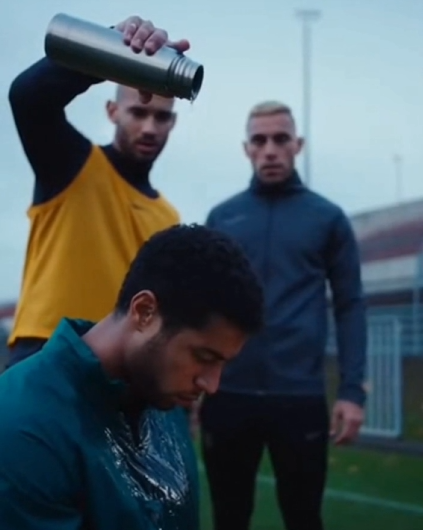
He picked it up.
Ethan felt the absence of its weight.
“What’s even in here? Let me see.” Tyler unscrewed the cap. Sniffed it. Made a face for his audience. “Bro. It’s just green tea. This guy comes out here every Thursday and drinks green tea alone and watches football on his phone. That’s the most—”
He tilted the thermos.
The tea came down in a slow, deliberate arc. It hit the crown of Ethan’s head and spread outward — warm, not hot, running in four distinct channels down his skull. Over his temples. Down the back of his neck. Soaking into his gray hoodie at the collar.
A thin stream ran along his jaw and dripped off his chin.
The sound it made was very quiet.
Ethan did not move.
He did not flinch. He did not gasp. He did not look up. His hands, resting on his knees, remained completely still.
He watched the quarterback take a snap.
Carter made a sound that might have been the beginning of a laugh. It stopped.
Wade said nothing.
Sticks had gone very quiet.
Tyler was standing above Ethan, holding the empty thermos, and the silence was the wrong shape. The wrong texture. This was not the silence of someone who was afraid or humiliated or frozen with shame.
This was something else.
Ethan reached up — slowly, unhurried — and wiped the tea from his left eyebrow with the back of his hand. He looked at the moisture on his knuckles. He looked at the football game.
He set the phone down on his knee.
And then he looked up at Tyler Brent.
Tyler had expected rage. He’d expected tears, maybe. He’d expected defensive posturing or a scramble to stand up or a voice that cracked when it tried to sound tough.
He did not expect this.
Ethan’s face was completely neutral. Not suppressed anger. Not embarrassment burning under the surface. Just — absence of reaction. The way a door doesn’t react when you knock on it.
“You want to fight me,” Ethan said. It wasn’t a question.
Tyler blinked. “What?”
“That’s what this is.” Ethan’s voice was the same volume as a conversation. No performance in it. “You want to fight me and you’re waiting for me to give you a reason that doesn’t make you look like the one who started it.”
The silence had weight now.
“After school,” Ethan said. “Parking lot behind the athletic building. Four-fifteen.”
Tyler opened his mouth.
“Bring whoever you want,” Ethan said. “I don’t care.”
He reached out and took the empty thermos back from Tyler’s unresisting hand. He screwed the cap back on. He set it beside his knee.
He looked at his phone screen.
He pressed play.
Tyler stood there for seven seconds. Ethan counted them. Then Tyler made a sound — a short laugh, mostly exhale, that his group took as permission to laugh too. They walked away toward the athletic building, taking the laugh with them like a prop they were done using.
Ethan watched the rest of the quarter.
He thought: four-fifteen.
Good.
Word travels fast when there’s nothing else to travel on.
By 3:30 PM, there were at least thirty students who’d heard some version of “that quiet transfer kid challenged Tyler Brent to a fight behind the athletic building.” The versions varied considerably in detail but agreed on the basic framework.
Most of the versions found Tyler and his group funny. The quiet kid who sat alone and drank green tea had apparently lost his mind.
Ethan’s organic chemistry lab partner, a junior named Priya Desai, caught him in the hallway at 3:45.
“Ethan.” She looked concerned. “I heard something.”
“Okay,” he said.
“Is it true? You said something to Tyler Brent?”
“I told him where to meet me,” Ethan said.
Priya stared at him. “Tyler Brent is literally two hundred and twenty pounds. He’s on the club football team.”
“I know.”
“Do you know him? Do you have, like—” She lowered her voice. “Are there people coming with you, or—”
“I don’t need people,” Ethan said.
Priya looked at him for a long moment. Her expression went through several phases — concern, skepticism, and something else that she couldn’t quite name. Something about the way he’d said it. Not bravado. Not the fake calm of someone trying to convince themselves.
Just fact.
“Be careful,” she said.
“I will,” he said.
He walked toward the athletic building.
The parking lot behind the athletic building was a wide stretch of cracked asphalt that caught the last of the October sun at a low angle, turning everything gold and slightly orange.
Tyler was already there.
Carter, Wade, and Sticks were with him. And he’d brought two additional people — a pair of juniors named Brad and Dominic who played in the same club football circle.
Six total.
Ethan arrived at 4:13, alone, with his backpack over one shoulder and his thermos — now refilled with water from the bathroom, because he was thirsty — in his left hand.
He looked at the six of them.
“You brought your whole team,” he said.
“I didn’t need to,” Tyler said. “But you know. Just in case you brought yours.”
“I didn’t bring anyone.”
Tyler looked at the empty space behind Ethan. Something crossed his face that might have been confusion. “You serious?”
“Yeah.”
Ethan set his backpack down on the hood of a nearby car, gently, so as not to scratch it. He set the thermos next to it. He unzipped his hoodie and hung it on the side mirror.
Underneath, he was wearing a plain white t-shirt. The cold October air hit his arms.
The arms were not what Tyler had expected.
Competitive boxers don’t look like bodybuilders. They don’t have the geometric muscle mass of someone who trains for appearance. What they have is more functional — lean, dense, with a particular quality in the shoulder and forearm musculature that, if you knew what you were looking at, told you something very specific.
Carter made a small noise.
Tyler looked at Ethan’s arms and had the first genuine moment of uncertainty he’d experienced in a long time.
“Look,” Tyler said, and his voice had shifted slightly. The performance quality had dropped. “I wasn’t going to actually—this was just, you challenged me, so—”
“I know,” Ethan said.
“So we can just, like—”
“You want to walk away,” Ethan said. “That’s fine.”
A pause.
“I’m not walking away.”
Ethan looked at him. “Then let’s not waste each other’s time.”
There was a crowd forming at the edge of the parking lot. Ethan hadn’t noticed when it arrived. Twenty people. Maybe more. Students who’d heard and come to watch the quiet transfer kid get destroyed.
Tyler looked at the crowd. He couldn’t walk away now. Not with that many people watching.
He looked back at Ethan.
“Alright,” he said. He put his jacket on a car hood and squared his shoulders and came forward with the particular confidence of someone who’d been in a dozen fights that started with someone significantly bigger than them backing down immediately.
Ethan stood still.
Tyler closed the distance between them. He cocked his right hand and swung.
The swing was fast, by normal-person standards.
By the standards of someone who had spent five years analyzing punches at sixty percent slow-motion, studying the mechanics of the wind-up, the weight shift, the telegraphing in the shoulder before the arm extended — it was a slow, well-advertised movement with its final coordinates visible approximately 0.4 seconds before arrival.
Ethan slipped it. Head movement, clean and minimal — two inches to the left, so the fist passed close enough for him to feel the air disturbance on his ear.
Tyler stumbled forward with the momentum.
The crowd made a sound.
Tyler turned around. His face had changed.
“How did you—”
He swung again. Harder. This time with his body behind it.
Ethan slipped the other way. Roll-under, weight shift, two steps back.
Tyler’s fist met nothing.
The crowd was fully silent now.
Tyler swung a third time. Ethan caught his wrist — the same motion he’d practiced ten thousand times in the gym — redirected the momentum, and used Tyler’s own forward drive to position him.
Then he stopped.
He let Tyler’s wrist go.
He stepped back.
He waited.
“Who are you?” Tyler said. His voice had lost something. The performance was completely gone now.
“Nobody,” Ethan said.
Tyler swung again, this time from fear rather than strategy, a wild right that would have been effective against someone standing still.
Ethan was not standing still.
He slipped it completely, stepped inside the arm’s extension, and threw one punch.
Left hook. Short. Compact. The geometry of it was perfect — weight behind it, shoulder rotation, the hip engagement that multiplied force by a factor that physics described very plainly.
It connected against Tyler’s jaw at approximately one-third of Ethan’s full capacity.
Tyler Brent went down.
Not slowly. Not dramatically. Straight down, knees first, then sideways, with the specific physical quality of a person whose legs have simply been turned off.
He hit the asphalt and stayed there.
The crowd was absolutely silent.
Ethan stepped back. He checked Tyler’s breathing — visible chest movement. Good. He looked at Carter, who had not moved. At Wade, who had taken three steps backward without appearing to realize it. At Brad and Dominic, who were very still.
He walked to the car hood. He picked up his thermos. He put his hoodie back on.
He looked at the people standing at the edge of the parking lot.
He looked at Tyler, who was beginning to sit up, hands on the asphalt, head hanging.
“You should think about transferring,” Ethan said. His voice was even. Not angry. Not satisfied. Just direct. “Not because of me. Because of what you do to people who can’t do what I just did.”
Tyler looked up at him. His jaw was going to be stiff for a week. His eyes were wet — not from crying, just from the body’s involuntary response to a concussive moment.
“There are people you do this to who can’t defend themselves,” Ethan said. “Think about that.”
He picked up his backpack.
He walked across the parking lot.
He walked through the crowd, which parted.
He walked back toward his dorm.
Priya was waiting by the east entrance of Harrison Hall.
She looked at him as he approached — at his face, calm and intact, at his hands, at the way he was walking.
“You’re fine,” she said. It was partially a question.
“I’m fine,” he said.
“What happened?”
He thought about how to answer that. He looked at the east quad, where the October light had gone fully orange now, the last twenty minutes of sun before the streetlights came on.
“He’s fine too,” Ethan said. “He’ll be stiff tomorrow. Nothing serious.”
“Did you—were you trained? Like, did you—”
“Yes,” Ethan said.
“What kind of trained?”
He looked at her. He considered the new chapter, the quiet life, the deliberate forgettability.
“Boxing,” he said. “Competitive. For five years.”
Priya stared at him.
“You sat there and let him pour tea on you,” she said slowly. “Knowing you could—”
“I wanted to give him a chance to not be a person who does that,” Ethan said. “In front of people. He had options.”
Priya was quiet for a moment.
“He didn’t take them.”
“No,” Ethan agreed. “He didn’t.”
She looked at him for a long time.
“Why didn’t you tell anyone you could box?”
“Because it’s not who I am here,” Ethan said. “I’m a student. I’m studying sports science. I want to be a physical therapist eventually.”
“Boxing is just—”
“Something I know how to do,” he said. “That’s all.”
Priya nodded slowly. “Okay,” she said.
“Okay,” he agreed.
He held the door open for her. They walked inside.
Tyler Brent did not get expelled. That was never the point.
He transferred to a different housing block at the start of November, which meant his daily territory no longer included the east quad. This was apparently his decision. Nobody had asked him to.
Carter developed a habit of looking the other way when he passed Ethan in the hallway. Not from fear, Ethan thought — or not only from fear. Something closer to embarrassment. The particular shame of having laughed at the wrong moment in front of the wrong person.
Wade had actually introduced himself properly three days after the parking lot. “I’m Wade,” he said, stopping Ethan after class. “I know you know that. I just—I wanted to say I’m sorry about the tea thing. That was messed up.”
“Thank you,” Ethan said.
“You were really calm,” Wade said. “I don’t know if that made it better or worse.”
“Probably both,” Ethan said.
Wade had laughed, short and genuine, and moved on.
Priya started sitting with him on Thursday afternoons sometimes. Not always — she had her own Thursdays, her own routines — but sometimes she would come with her laptop and sit in the same patch of grass and work on biochemistry problem sets while Ethan watched football.
“Do you actually like football,” she asked one Thursday. “Or is it like a camouflage thing.”
Ethan considered this seriously. “Both,” he said. “The defensive schemes are genuinely interesting. The rest is mostly calming.”
“Calming,” she said.
“Something about watching it. The patterns. It’s repetitive in a good way.”
Priya looked at him for a moment. “You’re a very specific kind of weird,” she said.
“I know,” he said.
She returned to her problem set. He returned to the third quarter.
The campus was quieter in January, the way campuses always are in the first two weeks after break — everyone adjusting back, settling into rhythms, remembering which version of themselves they’d been before December.
Ethan came back from Columbus carrying the same amount of boxes he’d left with. He ran a new boxing route before 6 AM his first morning back. The gym was empty. The bag sounded right.
He sat on the east lawn Thursday afternoon at 2:05. The January sun was cold and white but still there. He had a new thermos — his old one had developed a leak at the seal. He poured green tea.
He pressed play on a replay.
Nobody came to bother him.
He sat in the pale January light and watched football and thought about defensive coverage shells, and somewhere in the middle of the third quarter he thought about Tyler Brent and the parking lot and the particular look on Tyler’s face when he’d gone down — not rage, not humiliation, just shock. The shock of a fundamental assumption proving false.
He thought: I hope that lands somewhere useful for him. I genuinely do.
He drank his tea.
He watched the fourth quarter.
He was, in the quiet particular way he had built for himself, completely at home.
He told his mother about the boxing in February, during a video call.
Not about Tyler. Just about the training — that he was still doing it, still going to the gym before sunrise, still keeping the rhythm of it even without the competition.
“Are you happy there?” she asked.
He thought about the east lawn. The angle of the winter sun. Priya working next to him in silence.
“Yeah,” he said. “I think I am.”
She smiled. He could see it wasn’t entirely without worry — she knew him, knew the hands, knew the history. But it was a real smile.
“Good,” she said. “That’s the whole thing, you know. That’s the whole thing.”
He thought: yes. That’s exactly right.
He put the phone down.
He packed his bag for tomorrow’s early run.
He thought about a fourth-down conversion he’d seen in the replay — a particular route combination he wanted to diagram in his notebook.
He went to sleep at ten-fifteen.
The quiet life was holding.