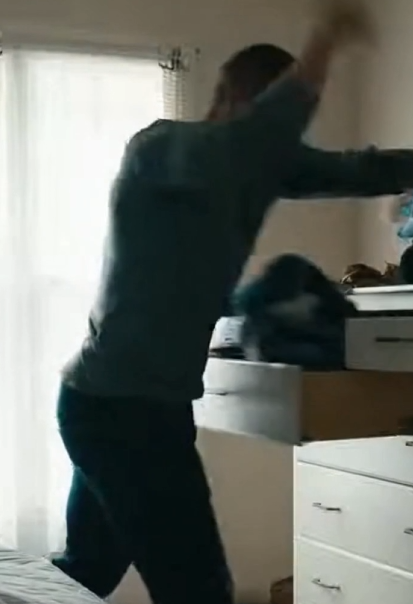
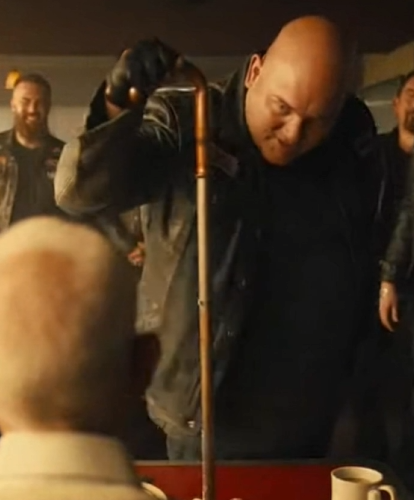
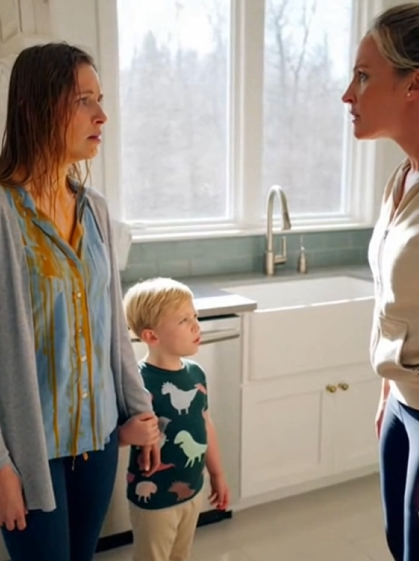
The Tuesday morning Lily Torres fell down the north staircase at Westbrook University, her father was already in the building.
He had come to drop off her forgotten retainer case, which she had left on the kitchen counter and texted him about at 8:47 AM with three crying emojis.
Michael Torres was a labor attorney. He drove a practical sedan. He wore the same style of gray coat every day from October through March. He was not a man who made scenes.
He had the retainer case in his coat pocket when he heard the sound from the north corridor.
He knew it was his daughter before he saw her.
He didn’t know how. He just did.
The north staircase of the north building had a reputation that was strictly oral — passed from student to student in the form of directions, warnings delivered in lowered voices, careful redirections by sophomores who remembered being freshmen and learning the hard way.
Jake Whitmore was a junior. Pre-business. His father ran a mid-size landscaping company and sat on a local chamber of commerce board and had donated eleven thousand dollars to the Westbrook facilities fund over two years. Not enough to matter officially. Just enough to matter informally.
Jake had understood the informal kind of mattering since he was fifteen.
He was tall, athletic, with a face that photographs well — a detail that had always worked in his favor in a world that makes quick decisions based on appearances.
He was not visibly cruel. That was the precise, technical truth of him. His cruelty was geometric. It was the right angle at the right time. The shoulder at the top of the stairs. The foot in the corridor. The comment that was technically a question, delivered just loud enough for an audience, just quiet enough for deniability.
Connor Briggs was his chief instrument. Broad-shouldered, heavy-footed, with the particular obliviousness of someone who has been told all his life that he is good-natured. He believed this about himself. He believed the shoulder at the top of stairs was good-natured too. That it was a joke. That falling was an overreaction.
Davis and Seth were satellites. They added mass. They laughed. Without the laughter, Jake’s operations would have lost half their charge.
Together, they had been running their particular economy of humiliation for fourteen months.
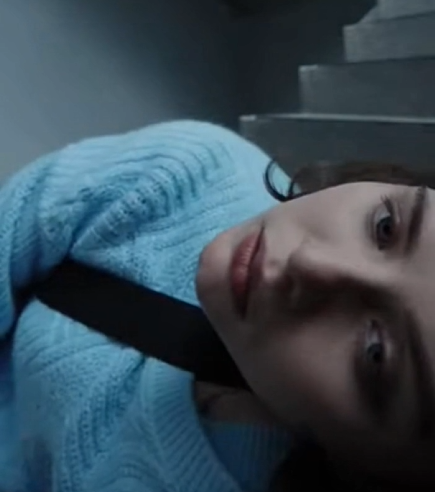
Lily Torres was a second-year architecture student.
She was twenty years old, paint-stained, quiet in large groups, articulate in small ones, with a habit of carrying two sketchbooks — one for assigned work, one for everything else.
She had been on Jake’s radar for a month and a half.
It had started, as these things often start, with something so small it barely qualified as an event.
She had been eating lunch at a four-person table and Jake’s group had wanted the table and she had not immediately gathered her things when he stood there waiting.
She had looked up and said, politely, “I’m still eating.”
He had looked at her for three full seconds before taking another table.
That was it. That was the origin point.
Since then: her name said in corridors with a particular weight. A photograph of her sketchbook’s cover page, posted and then deleted but screenshotted. A comment in a shared lecture hall about her shoes.
Small. Precise. Geometric.
This morning, she was late because she had stayed up until two AM working on a studio project and slept through her first alarm.
She came through the north entrance at 11:09, backpack on, both sketchbooks under her left arm, coffee in her right hand, brain still partially asleep.
She hit the north staircase.
She saw them at the top.
She made the calculation that Lily always made — turn around and lose twelve minutes, or keep walking and maybe it’ll be nothing.
She kept walking.
She made it six steps up.
“Lily,” Jake said, from the landing above, not moving. “Running behind?”
She didn’t answer.
She made it eight steps.
Connor came down from above, not hurrying, just descending at a rate that left her one step of clearance.
She pressed to the right side of the stairs.
His shoulder connected with her left arm — the one holding both sketchbooks — at a downward angle with enough force that the sketchbooks went one direction and her center of gravity went another.
She grabbed for the railing.
She was two inches from the railing.
The fall was seven steps.
She hit the bottom landing on her hip, her right shoulder, the side of her knee. The coffee exploded sideways. Both sketchbooks slid open across the floor, pages spreading.
She lay there.
The ringing in her ears was very loud. The ceiling tile above her was water-stained in the shape of something that almost looked like a bird.
From above, she heard Connor say, in a voice of authentic, crafted concern: “You okay?”
She heard Jake: “Watch where you’re going next time.”
She heard laughter — just a breath of it, Davis’s particular register.
She tried to push herself up. Her wrist sent an immediate, clear message about that plan.
She tried with the other arm. That one worked. She got to a half-sitting position.
Then she heard the north entrance door open.
Michael Torres had been ten feet from the base of the north staircase when he heard the fall.
He covered those ten feet in three seconds.
He saw his daughter on the floor — hair across her face, wrist held at an angle that made something inside him go very cold and very still — before he saw anything else.
He crouched in front of her.
“Hey,” he said quietly. “Look at me.”
She looked at him. Her eyes were wet but she wasn’t crying yet — she was still in that suspended moment before the body decides what to do with what just happened.
“Is your neck okay? Can you turn your head for me?”
She turned it. “Dad—”
“Your head. Did your head hit anything?”
“My shoulder. And my knee. And my wrist feels—”
“Okay.” He ran two fingers along the back of her skull carefully. Nothing gave. “Okay.”
He helped her into a full sitting position.
Then he stood up.
He turned toward the staircase.
Jake was at the top of the stairs, Connor one step below him, Davis and Seth further back. They had the arrangement of boys who are trying to look like they are simply standing somewhere that happens to be near something that happened.
Michael looked at them.
He had spent twenty years in a field that required reading rooms. He read this one in approximately four seconds.
He did not raise his voice.
“Come down here,” he said.
His voice was quiet. Conversational. The kind of voice that does not need volume because the authority in it is load-bearing.
Nobody moved for a moment.
“I won’t say it twice,” Michael said.
Connor looked at Jake. Jake’s face had done something it had never done in front of witnesses before — it had become uncertain. Not frightened. Not yet. But uncertain.
They came down the stairs.
All four of them. Slowly. In single file.
They arranged themselves at the bottom of the staircase in front of Michael Torres, who stood at five-eleven in a gray coat with his hands at his sides and his face showing absolutely nothing.
He looked at them for a moment.
“You’re going to pick up everything that fell,” he said. “You’re going to put it back in her bag. And then you’re going to carry her to the student health center.”
Jake’s jaw moved. “We didn’t—”
“I watched it from the corridor,” Michael said. “The camera above that staircase has been recording since 2022. I counted the angles when I walked in.”
He let that sit.
“You’re going to carry her to the student health center,” he said again. “Not walk beside her. Carry her. Because that knee should not be taking weight right now. And you’re going to do it without a word of complaint or a single expression I don’t like. Do you understand me?”
Silence.
“Do you understand me.”
Not a question. Not anymore.
“Yes, sir,” Connor said, quietly, in a voice that had been stripped of everything it usually contained.
They carried her.
Jake held her left side. Connor held her right. Davis walked ahead to hold doors. Seth carried her bag with both hands and did not meet anyone’s eyes.
The route from the north staircase to the student health center was through the main corridor, past the cafeteria, past the administration wing.
It was 11:17 AM.
The main corridor was full.
Every student who saw them stopped.
Nobody said anything. Nobody needed to.
Lily kept her eyes forward and her jaw set and did not say a word to any of them for the duration of the walk, which took four minutes and felt, to Jake Whitmore, approximately like a geological era.
Michael Torres walked three steps behind.
He did not say anything else.
He didn’t have to.
Dr. Annette Walsh, the student health physician, was a woman with the manner of someone who has heard everything and responds to nothing with surprise.
She checked Lily’s wrist — a mild sprain, not a break, but close enough that the phrase “one more inch of torque” entered the conversation — and her knee, and the side of her skull.
“You’ll want imaging on that wrist to confirm,” she said.
“I’ll take her,” Michael said.
He was standing in the doorway of the exam room. The four boys were in the waiting area chairs, not talking, not on their phones, simply sitting in the particular silence of people who have had the social contract explained to them from a direction they hadn’t expected.
“Dad,” Lily said, from the exam table.
He looked at her.
“Don’t do anything that—”
“I’m going to speak to Dean Patterson,” he said. “That’s all.”
She looked at him.
“That’s all,” he said again, and his voice was gentle, and she believed him, and she also knew, because she had known this man her whole life, that “that’s all” from Michael Torres was more consequential than a great deal from most other people.
Dean Sarah Patterson had been in the Westbrook administration for nine years.
She had handled, in that time, seventeen separate complaints involving Jake Whitmore’s group. Each complaint had been processed. Each had been filed. None had resulted in formal disciplinary action above a written warning, which lived in a folder and had no actual effect on anything.
She knew, privately, about the donation history.
She had never once made a direct connection between the two facts. She had told herself that each case had simply not met the threshold.
Michael Torres arrived in her office at 12:04 PM and declined to sit down.
“I want to show you something,” he said.
He had requested footage from campus security between arriving at the health center and walking to the administration building. He had made the request in writing, via email, with the specific camera number, the specific time range, and the specific university policy citation that required the footage to be preserved and accessible to the parent of a student involved in a documented incident.
He had the acknowledgment receipt on his phone by the time he walked into Patterson’s office.
“The footage exists,” he said. “I have the receipt. My daughter has a sprained wrist, a bruised knee, and a contusion on her shoulder from this morning. The boys responsible are currently sitting in the student health center waiting room because I told them to stay there.”
Patterson looked at him.
“I’m giving you the opportunity to handle this correctly,” he said. “I would prefer that. A formal police report, an attorney of record, and a civil suit — those are time-consuming for everyone. They also become public, and public cases involving a university that has seventeen prior complaints in a file attract a particular kind of attention.”
He set his phone down on her desk so she could see the email receipt.
“I would like you to call the parents of those four students,” he said. “I would like you to show them the footage. And I would like you to explain to them, clearly, that their options are voluntary withdrawal or the full formal process. I would recommend framing it as a choice.”
She looked at his phone. She looked at him.
“I don’t think you’re asking me to do anything illegal,” she said.
“I’m not,” he said. “I’m asking you to do your job.”
The parents came that afternoon.
All four sets. They sat in the conference room adjacent to Patterson’s office — the kind of room with a long table and no natural light and chairs that are slightly too uncomfortable to allow anyone to settle in.
Michael Torres was not in the room. He had made the specific request that he not be present, because his presence would make it about him, and this needed to be about the footage.
Patterson played the footage.
Four minutes and eleven seconds of the north staircase. Timestamp 11:07 to 11:11. Four cameras, two angles.
The room watched it.
The room watched it a second time, because Patricia Briggs, Connor’s mother, said she needed to see it again.
After the second viewing, nobody said anything for almost forty-five seconds.
Then Connor’s father, a man named Dale who worked in commercial real estate and had the look of someone who makes quick decisions for a living, said: “What are the options.”
Patterson explained the options.
She used the language Michael Torres had suggested — framing it as a choice.
There was a brief, muted argument between Jake’s parents about whether to involve their own attorney.
Jake’s father, the man with the eleven-thousand-dollar donation, said they should consult before deciding anything.
Patterson said he was welcome to consult. She said the footage would be preserved and the formal process would begin within forty-eight hours if she didn’t have written confirmation of voluntary withdrawal from all four students.
She said this calmly, with her hands flat on the table.
Jake’s father looked at the tablet where the footage had played.
He looked at his son’s face on the screen — that half-smile, that sovereign unhurry, exactly at the moment Connor’s shoulder connected with Lily’s arm.
He didn’t say anything else about the attorney.
The withdrawal forms came back within thirty-six hours.
All four.
Jake Whitmore. Connor Briggs. Davis Howard. Seth Nakamura.
Voluntary academic withdrawal. Effective end of current semester.
No press release. No announcement. No assembly.
Just four names removed from the enrollment system and four sets of items collected from four dorm rooms and four cars exiting the Westbrook campus parking structure on a Wednesday afternoon.
Lily Torres heard about it from a text message. She was sitting in the kitchen of the apartment she shared with two other architecture students, her wrist in a brace, a sketchbook open on the table in front of her with a project she’d been working on before everything happened.
She read the text.
She looked at the sketchbook.
She picked up her pencil with her left hand, which was not her drawing hand, and made a slow, careful line on the paper that was not quite right but was in the right direction.
Then she put the pencil down and called her father.
He picked up on the second ring.
“Hey,” she said.
“Hey,” he said.
“How’d you know the camera angles?” she asked.
A brief pause. “I counted them when I walked in.”
“You really counted them in—”
“I’ve been doing this for twenty years, Lily.”
She was quiet for a moment.
“Did you know,” she said, “that I was taking the south stairs every day? For four weeks?”
He didn’t answer immediately.
“I suspected,” he said finally.
“Why didn’t you say something?”
Another pause. Longer this time.
“Because I was waiting for you to,” he said.
She looked out the kitchen window at the campus water tower visible over the roof of the building across the street.
“I should have told you earlier.”
“Yes,” he said. “You should have.”
Neither of them said anything for a moment.
“The wrist feels better,” she said.
“Good.”
“The sketchbooks weren’t damaged.”
“Also good.”
“I drew something just now. With my left hand. It’s terrible.”
“Can I see it?”
“No,” she said. “Absolutely not.”
He laughed, and she laughed, and the sound of it filled the kitchen in a way that felt, specifically, like something being returned.
Three weeks later, Lily walked through the north entrance of the north building on a Tuesday at 11:10 AM.
She took the north stairs.
She did not press herself against the wall.
She did not check over her shoulder.
At the top of the stairs, she turned and walked to her materials seminar.
The corridor was just a corridor.
The stairs were just stairs.
In the spring semester, a new bulletin board went up outside the Dean’s office.
It listed the university’s formal bullying and harassment reporting process, with a phone number, an email address, and a QR code that took you to a digital form with a field for location, time, and camera reference number.
Nobody announced it. It just appeared one morning, laminated, pinned to the corkboard.
Students noticed it. They didn’t say much about it.
But the following semester, three complaints were filed using the new form.
All three were processed within a week.
All three resulted in formal disciplinary action.
Word traveled, the way word travels.
The north stairs went back to being stairs.