The morning of the wedding, Margaret Carter burned her fingers on the oven rack.
She pulled her hand back. Pressed her fingers against her apron. Waited a second for the sting to pass, and then went right back to checking the ganache.
It had to be right.
This was the one thing she could do. The one concrete, visible, touchable thing she could contribute to the day her son James was getting married.
She had not been allowed to help with anything else.
Not the venue. Not the flowers. Not the catering. Not the seating chart, though she’d offered. Not the ceremony program, though she’d mentioned she’d been a proofreader for twenty-two years and had a very good eye.
Danielle Walsh — soon to be Danielle Webb — had handled all of it herself, or with her mother, or with the event coordinator she’d hired, or with the apps she’d subscribed to, or with the detailed spreadsheet she apparently maintained on her laptop that tracked every single variable of the day.
Margaret had been given one job: show up, smile, and stay out of the way.
She had decided, quietly and privately, that she would also bring a cake.
She had texted James about it in February.
“I was thinking I might bake something? For the reception? My mother’s fudge recipe — you’ve always loved it.”
He had written back: “Mom that would be amazing she’ll love it.”
She’d taken that as a yes.
She had not asked Danielle directly. In retrospect, she understood this had been an error. At the time, she had simply assumed that James’s mother bringing James’s favorite cake to James’s wedding was the kind of thing that went without saying.
She had been wrong.
James Webb was thirty-one years old, six feet tall, and had his mother’s eyes.
He had his father’s habit of going quiet when things got tense, which Margaret had spent twenty-odd years finding frustrating in his father and now found, in her son, equally frustrating but for different reasons.
He was a good man. She believed that without reservation.
He was also, when it came to Danielle, a man who had made a decision very early in the relationship to prioritize peace. Margaret could respect this in the abstract. She could not always respect it in practice.
“She’s just particular,” he’d told her once, on the phone, in the careful tone he used when he was managing two things at once.
“Particular is fine,” Margaret had said. “I’m particular. I have opinions about pie crust.”
“She’s more particular than pie crust, Mom.”
“How much more particular?”
He’d paused. “Let’s not get into it.”
They hadn’t gotten into it.
Danielle was thirty-two and worked in brand strategy. She was precise, capable, and visually intelligent in a way that Margaret genuinely admired, even when it also made her nervous. She had the ability to assess a room — any room — and identify, within seconds, every element that was not quite right.
She was also, Margaret had noticed, a person who experienced small deviations from her plans as large ones.
This was not a character flaw. Margaret tried very hard to remember that. Some people needed structure. Some people built their sense of security around control. She had read enough to understand this about personalities.
What she had failed to fully account for was what happened when that person was marrying her son.
The cake came out beautifully.
She knew it when she saw it. Three tiers. Dark ganache, smooth as glass. Gold leaf she’d applied with a small brush and a steady hand and considerable concentration. She had photographed it in her kitchen before boxing it and the photo had made her feel the specific quiet pride of someone who has worked hard at something and produced exactly what they intended.
She had carried it to the car in two sections. She had driven to the Whitmore Grand Ballroom going four miles under the speed limit and gone over the speed bump at the entrance with the focused attention of a surgeon.
She had dressed in the venue bathroom: the pale blue chiffon with the pearl buttons, her best earrings, the heels she’d worn to exactly three events in the past five years.
She’d looked at herself in the mirror.
She’d thought: This is a good day. This is going to be a good day.
The Whitmore Grand Ballroom was, she had to admit, extraordinary.
The ceiling was thirty feet high, draped in sheer white fabric that caught the afternoon light and turned it gold. The round tables were dressed in ivory and sage, with towering floral arrangements of white roses and eucalyptus. The dance floor was polished marble. The chairs had been tied with ribbon.
It looked like Danielle’s vision board. She had seen the vision board once, over James’s shoulder, on his laptop. She had said nothing except “beautiful,” and she had meant it.
Two hundred and fourteen people filled the room. Margaret recognized faces — her sister Linda at Table 6, waving, already on her second champagne. James’s college roommate Derek, who had put on weight and seemed happy about it. James’s boss and the woman James said was either his boss’s wife or his boss’s very confident girlfriend, they’d never been sure.
It was warm. It was loud with the good kind of noise. The string quartet was playing something upbeat that she associated with expensive restaurants.
Margaret moved through the room with the cake, heading for the dessert table near the far wall.
She was smiling.
She had no reason to stop smiling.
She had maybe twenty feet to go.
She heard the heels first.
Fast and sharp on the marble. Coming from the left.
She turned and saw Danielle.
The dress was remarkable — fitted ivory lace with a chapel train that moved behind her like something alive. Her hair was up, pearl pins holding dark curls in place. She looked exactly like a bride in an ad for a bridal magazine, which was almost certainly intentional.
But her face was doing something the ad had not accounted for.
Her eyes were locked on the cake.
“Margaret.” Her voice was not loud yet. It was very controlled, which was somehow worse.
“Danielle. You look absolutely—”
“Is that chocolate?”
Margaret paused. “It is. My mother’s recipe. James has always—”
“I said berry cake.”
“I know. James said it would be fine when I—”
“James said—” Danielle stopped. Something moved through her expression. “You asked James. Not me.”
“I thought—”
“You thought.” Danielle’s voice was rising and tightening at once, like a key being turned too far in a lock. “You thought that asking James was the same as asking me. Even though this is my wedding. Even though I have been planning this for fourteen months. Even though I explicitly—explicitly—said berry cake, Margaret. White layers. Berry compote. I showed you a photo. In November.”
“You showed me a photo of the flowers.”
“I showed you BOTH.”
The nearest guests had gone quiet. A small radius of silence was spreading outward through the room.
Margaret kept her voice steady. “I just wanted to bring something from our family. His favorite.”
“His favorite.” Danielle said it like it was in a foreign language. “His favorite. Right. Not what I want. His favorite.” She shook her head. “This is exactly—this is exactly what I mean. This is what always happens. Every conversation, every decision, it’s what you want, what James grew up with, what your family does. And my wants are just—” her voice cracked, “—just decoration.”
“That’s not fair, Danielle—”
“You know what’s not fair? I have been trying to build a life with your son. I have been trying to build something that feels like mine. And every time, there is someone there to remind me that I am a guest in someone else’s story.”
Around them, the silence had spread significantly. Eight, ten tables within earshot had noticed. The string quartet was still playing but it felt far away.
Margaret looked at her son’s new wife.
Danielle’s hands were shaking.
She could see it. The fine tremor in the fingers. The way her breath was coming faster than normal.
She recognized it not as cruelty. As something else. As a person at the end of something.
She said, gently, “Then let me take the cake back to the kitchen. We don’t have to serve it. It doesn’t matter.”
“It DOES matter,” Danielle said.
“Okay,” Margaret said. “Then tell me what you need.”
“What I needed was the berry cake I asked for.”
“I understand. I’m sorry I didn’t—”
“Don’t apologize like that. Don’t do the nice voice.”
“I’m not—”
“You ARE. You do the nice voice when you’re upset and you want me to feel like I’m being unreasonable. I know the voice, Margaret. I’ve been hearing it for—”
She stopped.
Took one breath.
And then something seemed to break.
“Every single thing I want gets IGNORED,” she said, and her voice was not controlled anymore. “Every single thing I plan gets second-guessed or overridden or just—just done differently because someone in your family knows better. And today of all days—TODAY—”
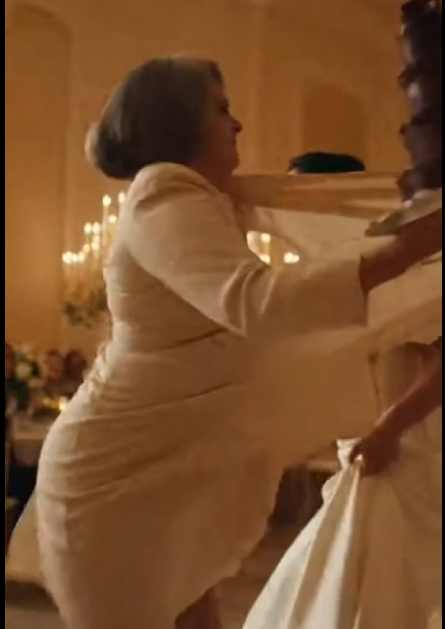
Her hands came up.
Margaret saw them.
Did not move in time.
The front of the pale blue chiffon gave way with a sound like a seam ripping along the world.
The pearl buttons flew in all directions, hitting the marble floor, spinning, rolling under tables, landing near the feet of guests who were now standing, who were now fully watching, whose champagne glasses had stopped moving halfway to their mouths.
Margaret gasped and grabbed the cake.
The box lurched.
She caught it. Barely.
The room was absolutely silent.
Two hundred and fourteen people staring at a bride, and a woman in a torn dress, and a cake that had almost fallen, and the specific quality of horror that only settles over a crowd when they realize what they just witnessed was not an accident.
Danielle stepped back.
She looked at her hands like they belonged to someone else.
The fury had gone out of her face. What was left was something Margaret couldn’t immediately name. Shock, maybe. Or the look of someone who had driven off a road and was sitting in the wreck, very still, understanding for the first time that it had happened.
“I—” she started.
She didn’t finish.
The sound of footsteps.
James was crossing the floor from the far side of the room. He had seen it. Or enough of it. His face was set in the particular expression that Margaret recognized from arguments she had watched him navigate all his life — closed off, jaw forward, the face he made when he had already decided something and was walking toward the consequences.
He stopped between them.
He looked at his mother.
He looked at Danielle.
Then he said, to Margaret: “Mom, you should go.”
The words hit her the way the buttons hitting the floor hadn’t.
She heard them and for a moment they didn’t make sense. She turned them over in her mind the way you repeat a sentence in a foreign language, trying to find the meaning.
You should go.
“James,” she said.
“It’s fine,” he said, and his voice was doing the managing thing. The thing she had noticed and said nothing about for eight months. “It’s okay. We’ll talk tomorrow. But right now—”
“She just tore my dress,” Margaret said.
“I know.”
“In front of everyone.”
“I know, Mom.”
“And you want me to leave.”
He looked at her.
She looked at him.
She waited for it. For the moment he would step out of whatever he was doing. For the person she had raised — the person who knew right from wrong before he was five years old, who had, at age seven, returned a dollar to the convenience store because the cashier had given him too much change, who had told his girlfriend in high school, in front of her, that she was being unkind to his mother and that he needed her to stop — to show up.
James Webb put his hand on his mother’s elbow.
“I’ll call you tomorrow,” he said.
There are things that can happen in a marriage that don’t heal.
James would not understand this yet. He was thirty-one and in love and standing in the most expensive room he’d ever paid for and he was trying to survive the next four hours.
Margaret understood it.
She understood it because she had been in a marriage. She had watched her own mother in a marriage. She had seen what a person can become when they make, one time too many, the decision that their own values are less important than the avoidance of immediate conflict.
She looked at her son.
She looked at Danielle, who was holding herself very still behind James’s shoulder, her face blank in the way of someone who is waiting to find out what it costs.
She looked at the room. Two hundred and fourteen people, all watching. Her sister Linda with her hand over her mouth. James’s college roommate Derek looking at his shoes. The photographer, who had stopped pretending he wasn’t photographing.
She set the cake down on the nearest table.
She smoothed the front of her torn dress with both hands.
“All right,” she said.
She picked up her purse.
She walked, with her shoulders back and her head level, through the parted crowd, past the tables with their perfect centerpieces and their champagne glasses and their little place cards written in calligraphy, toward the doors.
She didn’t run.
She didn’t cry.
She went to the car.
She sat in the driver’s seat for a long time without starting the engine.
She called Linda at 5:47 PM. Linda answered on the first ring.
“I saw everything,” Linda said. “I’m coming out.”
“Stay,” Margaret said. “Enjoy the dinner. Tell me about it later.”
“Marg—”
“I’m okay.”
She was not entirely okay. But she was not going to fall apart in the parking lot of the Whitmore Grand Ballroom. That was a decision she made clearly and consciously. Some things you can choose about yourself.
She drove to the hotel where she’d booked a room for the weekend.
She ordered room service.
She watched television without seeing it.
She did not answer when James called at 11:15 PM.
He called again the next morning at nine.
She was dressed and had had coffee and was sitting in the small chair by the window with her hands folded in her lap like a woman waiting for a verdict she already knew.
She answered.
“Mom.” He sounded exhausted. Wrung out. Like he hadn’t slept.
“James.”
“I need to—I’m sorry about last night. I didn’t handle it well.”
“No,” she agreed. “You didn’t.”
A pause.
“Danielle wants to apologize to you,” he said. “She knows what she did was wrong.”
“Does she.”
“She does, Mom. She was overwhelmed and she—things have been really hard for her with the planning and the family stuff and she just—she got to a breaking point. She knows that’s not an excuse.”
“It isn’t,” Margaret said.
“I know.”
“She tore my dress, James. In front of two hundred people. At your wedding. The dress I bought for this day.”
“I know.”
“And then you asked me to leave.”
The silence on the line had weight.
“I know,” he said, and his voice cracked slightly on the word. “I know. I’m sorry. I was trying to—I thought if you stayed it would—I don’t know what I was thinking. I was wrong. I’m telling you I was wrong.”
“Okay,” she said.
“Can you—can we come over? Both of us? She wants to say it to your face.”
Margaret looked out the window.
The hotel was on a ridge and she could see, in the distance, the hills going green in early June.
“Yes,” she said. “Come over.”
They came at noon.
Danielle was out of the wedding dress. She was in jeans and a gray shirt and she looked like what she was: a woman who had been through something and knew it.
She sat across from Margaret in the hotel room’s small sitting area, hands folded in her lap.
She looked at Margaret’s face.
Then at Margaret’s hands.
Then back up.
“I don’t have a good reason,” she said.
“Okay,” Margaret said.
“I have explanations. I have things that led up to it. But they’re not reasons. They don’t make it okay.”
“They don’t,” Margaret said.
Danielle’s jaw tightened. She nodded once, like someone accepting a verdict.
“I lost control of myself,” she said. “In public. On the worst possible day for that to happen. In a way that hurt you physically. And I’m sorry. I’m—” her voice caught, “—I’m genuinely, truly sorry, Mrs. Carter. I’m ashamed of it.”
Margaret looked at her.
She looked at her son, who was sitting on the edge of the second chair with his hands between his knees, watching both of them.
“The dress can be repaired,” Margaret said finally.
Danielle blinked.
“The buttons are probably still on that floor, or someone swept them up and has them. The seamstress I use has been working with fabric for forty years. She can fix it.” She paused. “The dress can be repaired.”
“Okay,” Danielle said carefully.
“What cannot be repaired so easily,” Margaret said, “is my son looking me in the eye and telling me to leave.”
She turned to James.
He met her gaze. And for a moment — just a moment — she saw the seven-year-old who had returned the dollar to the cashier. Who knew, before she’d said a single word, what was right.
“I know,” he said.
“I need you to know that if something like this happens again — to me, or to anyone in front of you — I need you to be the person I raised. Not the person you were trying to be last night.”
“Mom—”
“I’m not angry, James. I’m telling you what I need.”
He swallowed.
“I need you to be the person who knows what’s right and does it even when it’s hard.” She kept her voice even. “You’ve always known how to do that. Even as a little boy. You just have to choose it.”
He looked at her for a long moment.
Then he leaned forward.
Put his arms around her.
And held on.
She stayed an extra night at the hotel.
Linda came over on Sunday afternoon and they ordered pizza and watched old movies and didn’t talk about the wedding until the second movie, when Linda said, quietly, “You handled that with so much class, Marg. I want you to know that.”
“I burned my fingers on the oven rack Saturday morning,” Margaret said.
“I know. I saw the message you sent me.”
“I still thought it was going to be a good day.”
“It was still going to be a good day,” Linda said. “Just not the kind you expected.”
Margaret thought about this.
She thought about the cake, which she had left on the table, and which Linda confirmed had actually been served and had been, by multiple accounts, the best thing on the dessert table.
She thought about Danielle’s face when she’d said I’m ashamed of it. She had believed her. Not because she had to. Because it was true.
She thought about her son.
She thought about who he was. Who he could be. Who she had raised him to be, and the gap between those things and last night, and whether the gap was permanent or whether it was something a person could cross back over.
She thought it was crossable.
She had to believe that.
Three weeks later, Danielle called her.
Not James. Danielle.
“I’ve been thinking about what you said,” Danielle said. “About it not being a reason. Just an explanation.”
“Yes,” Margaret said.
“I’ve been thinking about it a lot. And I think—” she stopped. Breathed. “I think I’ve been doing that for a long time. With a lot of things. Explaining. Not taking responsibility.”
Margaret was quiet.
“I made an appointment,” Danielle said. “With a therapist. I’ve never done that before. I’ve always thought I was too—I don’t know. Able to handle things.”
“That’s brave,” Margaret said. And she meant it.
Another pause.
“James didn’t ask me to call you,” Danielle said. “I want you to know that. He doesn’t know I’m calling.”
“I appreciate that.”
“I just—” Danielle’s voice changed. Went smaller. Less like a brand strategist and more like a person. “I want to start over. If that’s something you’d consider. I know I don’t have a right to ask.”
Margaret looked out her kitchen window.
The garden was coming in. She’d planted tomatoes in May and they were starting to climb.
“I’ll consider it,” she said.
“Okay,” Danielle said.
“Danielle.”
“Yes?”
“I’m going to have you and James over for dinner sometime this summer,” Margaret said. “I’ll cook. You can tell me what you’d like.”
A silence.
Then, very quietly: “I’d like that.”
“I’ll ask about dietary restrictions first,” Margaret said. “And I’ll ask you specifically. Not James.”
Danielle made a sound that might have been a short, surprised laugh. “Thank you.”
“You’re welcome,” Margaret said.
She hung up.
She stood in her kitchen for a moment.
She looked at the stove.
Then she went to the pantry and got the cocoa powder down from the shelf.
Not for anyone. Just for herself.
She was going to bake something.
Six weeks after the wedding, the dress came back from the seamstress.
Linda had, in fact, picked up eleven of the fourteen pearl buttons from the floor of the Whitmore Grand Ballroom on the night of the wedding, scooping them into her clutch purse with the quiet efficiency of a woman who knew they would be needed.
The seamstress had found buttons to match the other three.
She had re-stitched the seam with a thread so precisely matched that you could not tell, unless you knew, where the tear had been.
Margaret hung the dress back in her closet.
She stood and looked at it for a moment.
Then she closed the closet door.
Some things can be repaired.
That was the lesson. Maybe the only one that mattered.
Some things can be repaired, if the people holding the pieces are willing to do the work.
She went back to the kitchen.
The tomatoes were ready.
She started cooking.