The Dog Who Saved a Fortune
Jake Mercer was broke.
Not the romanticized kind of broke — not “struggling artist” broke or “between jobs” broke. Just flat, relentlessly, twenty-six-year-old broke. Two months behind on rent. A fridge with a bottle of hot sauce, a partial bag of rice, and three eggs. A used car that started maybe seventy percent of the time.
The one thing Jake had — the one good, uncomplicated thing — was Biscuit.
Biscuit was a four-year-old golden retriever mix Jake had adopted from the county shelter on a whim eighteen months ago. The dog was ridiculous: too big for the apartment, too energetic for Jake’s lifestyle, and completely incapable of not being happy. Every morning, Biscuit got him out of bed. That counted for something.
It was a Thursday morning in early November.
Gray sky. Cold enough to see your breath. Jake’s sneakers were the thin canvas kind, not made for cold, not made for much of anything except looking decent at the bar. He wore a faded army-green jacket and had exactly one dollar and forty cents on him.
They took the back trail — the one that wound behind the old Pearson Industrial Park on the east side of town. The park itself had been abandoned for three years. Nobody walked there except people like Jake, who just needed somewhere to go.
Biscuit was ahead on the leash, nose down, working the morning.
Jake had his earbuds in. Some podcast about passive income he kept starting and never finishing. He was half-listening, mostly just watching his breath cloud in the cold air.
Biscuit stopped.
Jake kept walking two steps before the leash snapped tight.
“Biscuit, come on.”
The dog didn’t look up. He was at the edge of the trail, near the old drainage ditch that ran along the fence line. His nose was pressed against the ground. His tail was low — not wagging, which was wrong. Biscuit’s tail was always wagging.
“Biscuit.”
The dog started digging.
Both front paws, going hard, throwing black soil backward. The earth there was soft — softer than it should have been. Jake registered this somewhere in the back of his mind without really processing it.
“Hey.” Jake pulled the leash. “Hey, stop.”
He reached into his jacket pocket and pulled out the plastic grocery bag he always carried for cleanup. He waved it near Biscuit’s face. The crinkle sound usually did the trick.
Biscuit yelped and stumbled back.
And then he sat down in the dirt and began to howl.
Jake had never heard Biscuit howl. Four hundred and something days with this dog, and he’d never heard him make that sound. Long. Low. Broken. Like something had gone wrong inside him.
Jake’s earbuds came out.
He looked at the ground.
The hole Biscuit had made was maybe eight inches deep, ten inches wide. But something was wrong with the surrounding earth — it was darker, softer, different from the compacted soil even two feet away. Jake crouched down, frowning.
He almost didn’t see it.
But then he did.
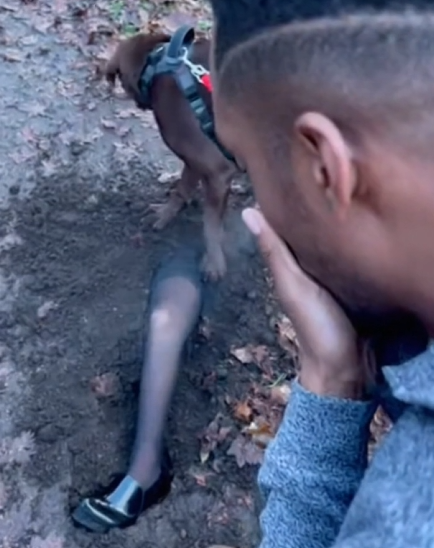
At the edge of the hole, barely exposed, partially hidden by the overturned dirt — the toe of a shoe. Black leather. A low heel. Size seven maybe.
With a foot inside it.
Jake’s brain didn’t process it immediately. He looked at it the way you look at an optical illusion — knowing something is wrong but still seeing it incorrectly. He reached forward without thinking, brushed away a layer of dirt, and saw the ankle. The lower leg. Stockinged. Still.
He stood up so fast he nearly fell backward.
“Oh God.”
Biscuit kept howling.
“Oh God, oh God.”
Jake pulled his phone out. His hands were shaking enough that he mistyped his passcode twice.
He called 911.
“911, what’s your emergency?”
“I — I found a body.” His voice didn’t sound like his voice. “I found — I think — my dog was digging and I found a woman. She’s buried. In the dirt.”
“Sir, what’s your location?”
He looked around wildly. “Behind Pearson Industrial. The trail behind the old park on Alcott and Route 9. By the old drainage fence.”
“Stay on the line. Stay where you are. Don’t touch anything.”
“I’m not — I’m not touching it. She’s not moving.”
“Units are on the way. Can you tell me if you see any breathing?”
Jake looked at the leg. The impossible stillness of it.
“No,” he said. “No breathing.”
Biscuit had stopped howling. He sat pressed against Jake’s leg now, trembling.
The police arrived in eleven minutes.
Two patrol cars, then a third. Then detectives. Then a van from the county medical examiner’s office.
They taped off the area with yellow crime scene tape. They asked Jake to move back, then farther back, then to stand next to a patrol car. A detective named Roach — fifties, gray beard, the kind of face that had seen too much — took Jake’s statement with a notebook.
“Walk me through it again.”
“I’ve told you three times.”
“Fourth time.”
Jake told him again. The dog started digging. He tried to stop him. He saw the shoe. He called.
Roach nodded at each point, writing things down. “You ever walk this trail before?”
“Every morning.”
“You notice anything unusual yesterday? Day before?”
Jake thought. “No.”
“Anyone else on the trail?”
“Never. That’s why I come here.”
Roach closed his notebook. “We’re going to need your information. You’ll need to come in and make a formal statement.”
“Of course.” Jake looked past him at the scene. The team was working the soil carefully now, expanding the excavation. “Who is she?”
“We don’t know yet.”
“Is it — was it recent?”
Roach looked at him. Not unfriendly, just cautious. “We’re investigating.”
Jake sat on the curb with Biscuit and waited. He waited for two hours.
The body was that of a woman.
That was all they told him that day.
But that evening, the local news ran a segment. A woman named Catherine Whitmore-Ellis had been reported missing eleven days ago by her family. Age 58. Founder and retired CEO of Whitmore Ellis Capital Group, a private equity firm based in Boston and New York. Net worth estimated at 1.3 billion dollars.
She had last been seen leaving her vacation home in the Hudson Valley.
Jake watched the segment on his laptop in his apartment, Biscuit asleep on the floor beside him.
“Billionaire,” he said aloud to no one.
He stared at the screen for a long time.
Over the next two weeks, the story unfolded fast.
The police confirmed the body was Catherine Whitmore-Ellis. They confirmed she had not died naturally. A suspect was identified — a former business associate with financial motive — and arrested within ten days. The case became national news.
Jake was called “the Good Samaritan Dog Walker” in one headline.
He gave interviews to three outlets, all of which he did on his building’s front steps because his apartment was embarrassing. He wore the only clean button-down he owned.
“I wasn’t trying to be a hero,” he told each of them. “Biscuit found her. I just called.”
Biscuit sat beside him in every photo.
He was not prepared for the call.
Three weeks after the discovery, Jake’s phone rang from a number he didn’t recognize. New York area code.
“Is this Jacob Mercer?”
“Yeah.”
“My name is Patricia Holloway. I’m the lead attorney for the Whitmore-Ellis estate. I’d like to schedule a meeting with you at your earliest convenience.”
Jake looked at the cracked plaster on his ceiling. “Okay.”
“Would tomorrow work? We can cover your travel to New York. We’ll arrange everything.”
“What’s this about?”
A pause. Professional, careful.
“It would be better to discuss in person, Mr. Mercer. But I can tell you that the family wants to meet you.”
They put him in a car service. An actual black car with a driver who didn’t talk.
Jake wore his one good jacket — the same army-green canvas one from the morning he found her — because it was that or the button-down, and the button-down now smelled faintly of stress sweat.
The office was on the 38th floor of a building in Midtown Manhattan. The kind of office that had actual art on the walls. Not prints. Art. The kind of carpet that cost more per square foot than Jake’s monthly rent.
Patricia Holloway was small, sixties, silver-haired, and moved like someone who had spent forty years being the most competent person in every room.
“Mr. Mercer.” She shook his hand firmly. “Thank you for coming.”
“Of course.”
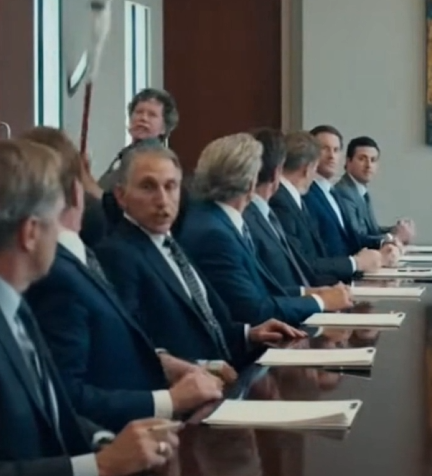
She led him to a conference room where three people waited.
A man in his late thirties — lean, dark suit, the kind of posture that came from private school. He introduced himself as Carter Whitmore-Ellis, Catherine’s son.
A woman roughly the same age, dark blazer, tired eyes. Her daughter, Renata Whitmore-Ellis.
And another attorney, younger, with a leather portfolio.
“Please sit down,” Carter said.
Jake sat.
There was a moment of silence. The kind that had weight.
“I want to say first,” Carter began, “that what you did — what you and your dog did — we understand it was just instinct. You weren’t thinking about us. You weren’t thinking about anything except doing the right thing.”
Jake nodded.
“Our mother was missing for eleven days,” Renata said. Her voice was controlled. “Eleven days of not knowing. And I know that — I know that what you found is hard. I know what you saw. And I’m sorry you had to see it.”
Jake hadn’t thought about that part. The leg. The shoe. The stillness.
“I’m sorry for your loss,” he said, because he meant it.
Carter folded his hands. “I want to be direct with you, Mr. Mercer. Our mother’s estate — her will, her holdings, her company — everything was predicated on a declaration of death. Without a body, without confirmation, the legal process could have taken years. Seven years minimum for a presumption-of-death filing, during which time the estate would have been frozen, the company leaderless, the charitable foundation she spent thirty years building unable to act.”
Jake listened.
“You gave us closure,” Renata said. “You gave us our mother.”
Patricia Holloway placed a document on the table and slid it toward Jake.
He looked at it.
He looked at the number.
“Ten million dollars,” Patricia said. “The family has authorized a gratitude payment of ten million dollars, tax-accounted. This is not a legal obligation on our part. It is a choice the family is making of their own accord. There are no conditions attached beyond a standard confidentiality clause regarding the specifics of this meeting.”
Jake looked at Carter.
Carter looked back steadily.
“We know it doesn’t — it can’t — replace anything,” Carter said. “It won’t fix what happened. But you made it possible for us to bury our mother properly. To have justice. To move forward. We felt it had to be acknowledged.”
Jake looked at the document.
He looked at the number again.
His hands were flat on the table. Completely still. Which surprised him, because his chest was doing something complicated.
“I don’t —” he started. Stopped. Started again. “I just called 911.”
“You stayed,” Renata said quietly. “You stayed for two hours in the cold with your dog and you didn’t leave. The detective told us that.”
Jake didn’t say anything for a moment.
“Biscuit found her,” he finally said.
Carter allowed himself something almost like a smile. “Is that the dog’s name?”
“Yeah.”
“The family would like to make a separate donation in Biscuit’s name to the county animal shelter where you adopted him.”
Jake nodded slowly. He didn’t trust his voice.
Patricia pushed a pen toward him.
He looked at the document one more time. Ten million dollars. Twenty-six years old. Two months behind on rent. Three eggs and hot sauce.
He picked up the pen.
He signed it.
He took the car service home.
He paid his landlord two months’ back rent that evening, in cash, which he had to pull from three different ATMs because of daily limits, which made him laugh for the first time in a long time.
He bought Biscuit a steak from the butcher shop on the corner — the real kind, behind the glass case.
He sat on the floor of his apartment while Biscuit demolished the steak, and he leaned back against the couch, and he stared at the cracked plaster ceiling, and he breathed.
He thought about Catherine Whitmore-Ellis.
He thought about the eleven days her family hadn’t known.
He thought about Biscuit — about that morning, about the howl, about the dog pressing against his leg in the cold.
He’d adopted Biscuit on a whim.
He thought about that.
Six months later:
Jake moved into a two-bedroom apartment on the other side of the city — nothing lavish, but clean, warm, a place with actual windows.
He paid off his car. He enrolled in a program to get his EMT certification — something he’d been thinking about for years without acting on.
He wrote a personal check to the Alcott County Animal Rescue for fifty thousand dollars and mailed it with a note that just said: In honor of Biscuit.
He still walked the trails in the morning.
Different trails now. Nicer ones. Ones with good light and clean air and other people on them.
Biscuit still dug at things.
Jake still tried to stop him.
But he always looked now. Just in case.