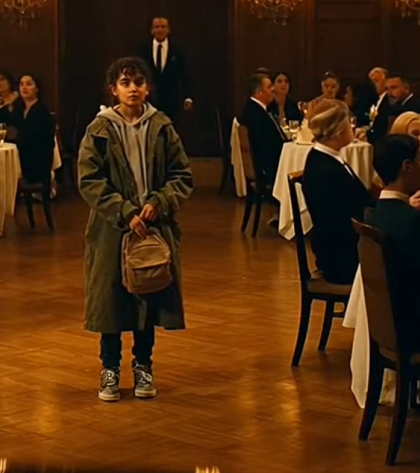
The Day He Stood
The morning it happened, Arthur Webb woke up the same way he woke up every morning — slowly, carefully, aware of the exact position of every part of his body the way a man in a wheelchair learns to be aware.
Seventy years old. Still here.
He reached for the grab bar above his bed, pulled himself to sitting, and did the thing he had been doing secretly for eight weeks: pressed both feet flat to the floor and pushed.
He stood for eleven seconds. Then his legs shook and he lowered himself back to the mattress and sat there in the grey October morning, breathing.
Next Saturday, he thought. Seven more days.
His son Derek’s voice came from downstairs. “Dad! You want breakfast or not? I’m leaving in an hour.”
“I’m fine,” Arthur called back. “I’ll make something.”
A pause. Then: “Fine.” A door closing. The sounds of a man preparing to leave.
Arthur Webb had been living in his son’s house for three years and five months. He had stopped counting the months at twelve and then started again because there was nothing else to count.
Before the stroke, he had been a high school history teacher for thirty-one years. He had coached the debate team. He had chaperoned every senior trip, including the disaster in Washington D.C. where Marcus Fielding had smuggled a ferret into the hotel. He had been the kind of teacher whose students came back decades later and told him he had changed their lives, and he had always deflected those compliments and they had always meant the world to him.
He had a daughter, Carol, who lived forty minutes away and called every Sunday, except Derek had changed Arthur’s phone plan without telling him and the calls stopped going through, and Arthur didn’t know that yet.
He had a son, Derek, who was forty-five, and who managed a regional chain of auto dealerships, and who had taken Arthur in when the stroke happened with such speed and apparent selflessness that the family had been grateful, and Arthur had been grateful, and it had taken eight months for Arthur to understand what he had moved into.
The government carer’s subsidy was $3,100 a month. It went directly to Derek’s account. Arthur knew this because he had managed his own finances for forty-three years and he had asked, once, carefully, to see the disbursement statements.
Derek had said: “I handle everything, Dad. You don’t need to worry about that.”
Arthur had not asked again.
His physical therapist’s name was Sandra Cho. She worked out of St. Catherine’s Rehabilitation Clinic, and she came to the house on Tuesdays and Thursdays, and she was, Arthur had come to understand, the one consistent good thing in his current life.
Sandra was thirty-eight, precise, with the particular quality of attention that the best physical therapists share with the best teachers — she was entirely present. When she worked with Arthur, she was working with Arthur, not with a patient file, not with a body, not with an insurance code.
She had been the one to first notice, fourteen months ago, that his leg response was slightly better than the charts predicted.
“How long have you been feeling that?” she asked one Tuesday, pressing carefully against the sole of his foot.
“A few weeks,” Arthur said. “Maybe more.”
Sandra looked at him for a long moment. “Arthur. This is significant.”
“I know.”
“We should document this. Talk to Dr. Reyes—”
“Sandra.” He said her name quietly. “Can we keep this between us for a little while?”
She studied him. She was good at reading people — came with the territory. “How long is a little while?”
“I have a birthday coming up. My son’s birthday. I’d like—” He stopped. Started again. “I’d like to surprise everyone.”
Sandra was quiet for a moment. Outside, the neighbor’s dog was barking at something.
“Okay,” she said finally. “But we do this right. We do it safely. And you tell me everything.”
“Everything,” he agreed.
That was fourteen months ago. Eight weeks ago, he had stood for the first time.
Derek had a woman he was seeing. Her name was Melissa, and Arthur had met her twice — once at dinner, where she had been perfectly pleasant and asked him thoughtful questions about teaching history, and once in the hallway at 7 a.m., where she looked embarrassed and Derek looked annoyed and Arthur had wheeled past them both with great dignity and said good morning to each.
Arthur did not dislike Melissa. He suspected she did not know what she had gotten into.
Today — a Saturday — Derek had announced at breakfast that they were all going to lunch. “Melissa wants to go to that Italian place on Fifth. You’re coming.”
Arthur had looked up from his coffee. “You want me to come?”
“You live here, don’t you?” Derek said, which was not the same as yes, I want you there, but was not quite a refusal either.
Arthur wheeled himself to the window and looked at the October sky — crisp, clear, the kind of Saturday his wife Ellen used to call a “gift day” — and he thought about Carol, who he hadn’t been able to reach in three months, and he thought about next Saturday’s birthday plan, and he thought: seven more days.
“I’ll come,” he said.
Fifth Avenue was crowded with the Saturday lunch crowd. The restaurant was four blocks from the parking garage, which meant four blocks of Arthur wheeling himself along the sidewalk while Derek and Melissa walked ahead.
At first they walked beside him. Then Melissa stopped to look in a shop window, and when she caught up, she naturally fell into step with Derek, and Arthur was two feet behind, and then four, and then half a block.
He didn’t say anything. He wheeled faster.
Derek glanced back once. His jaw tightened the way it did when he was calculating something. Then he looked forward again.
Melissa said something — Arthur couldn’t hear what — and Derek answered, and then both of them laughed, and Arthur looked at the sidewalk ahead of him and kept wheeling.
He was fine. He was always fine.
Except today, something was wrong with the rhythm of it — the distance felt longer, the wheels felt heavier, the October sunlight felt thinner than it should have. He had barely slept. He had been thinking about Carol, about the call that hadn’t connected, about the plan for next Saturday. He had been thinking about standing up and walking across a room.
He wheeled harder.
And then Derek stopped.
He stopped in the middle of the sidewalk and turned around, and Arthur saw his son’s face and recognized it — that particular compression of the features, that held-jaw patience-at-its-limit expression — and Arthur slowed, because when Derek looked like that, slowing down was usually the right response.
But today he hadn’t slowed down fast enough. Or hadn’t slowed down in the right way. Or had looked at his son with the wrong expression, or had simply existed in the wrong way at the wrong moment.
Derek walked back toward him. The crowd parted slightly — people in a hurry, people with places to be, people who weren’t paying attention yet.
“You’re killing me, Dad,” Derek said, low and tight. “She’s watching. Can you just—” He made a motion with his hand. Faster.
“I’m going as fast as I can,” Arthur said.
“Then go faster.”
Something moved in Arthur’s chest. He kept his face still. “Derek—”
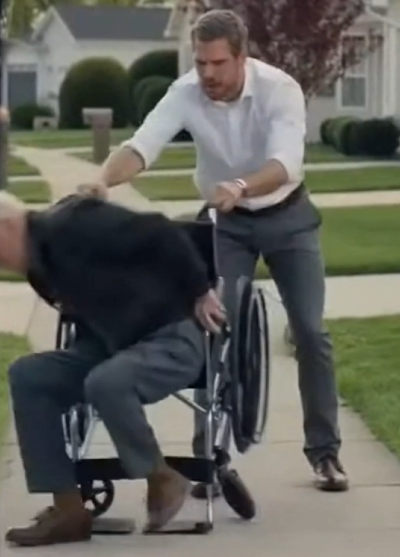
“You are embarrassing me.” The words came out clipped, final, the kind of sentence that closes a door. And then Derek’s hands were on the handles of the wheelchair — both hands, full grip — and he shoved.
Not to steer. Not to help. To move an obstacle.
The chair went sideways. Arthur’s momentum carried him over with it, and for one long second he was sideways in the air, and then he was on the pavement, his left arm taking the impact, his hip hitting the concrete with a sound he felt more than heard, and the chair was on its side two feet away.
The sidewalk was cold.
The sky above him was very blue.
“Oh my god—” Melissa’s voice.
“Sir, are you—” Someone else, closer.
“Don’t move him—” A third voice, from farther away.
Feet approaching. The sound of a crowd forming — that particular shift in ambient noise when people stop and redirect attention.
Arthur lay still for exactly three seconds. Then he assessed: left arm aching but functional. Hip hurt but nothing felt wrong. Head clear.
He turned his face toward the sky and he thought about Ellen, who had died eleven years ago and who he missed every single day, and he thought about Carol, and he thought about Sandra saying you’re so close, Arthur, you’re so close, and he thought about next Saturday’s party that Derek would throw to perform having a father, and standing up in front of everyone who had written him off, everyone who had drawn the box around him and labeled it permanent and walked on.
He thought: Seven more days.
And then he thought: No. Now.
His right hand found the pavement.
His left hand found it too.
He pressed. His arms shook. His shoulders burned with the effort of three years of work that wasn’t just physical therapy — it was stubbornness, it was grief, it was the particular refusal of a man who has been told no so many times by so many authoritative voices that no had stopped meaning anything to him.
“Sir, don’t try to—” A young man crouching beside him, reaching.
“I’m fine,” Arthur said. His voice came out steady. Surprising even himself.
He pressed harder. His right knee bent. His foot, in its rubber-soled therapy shoe, found the ground. He felt it — actually felt it — the pressure, the resistance, the earth pushing back.
His left knee bent.
Both feet on the ground.
“What is he doing?” someone said.
“Oh my god,” someone else said, different this time.
Arthur Webb put every remaining thing he had into his arms and his legs and the stubborn seventy-year-old machinery of his body, and he stood up.
He stood.
Both legs. No chair. No bars. No walls.
He stood on a sidewalk on Fifth Avenue in October sunlight while twenty-three people went completely silent.
Sandra Cho dropped her coffee cup.
She hadn’t known she would be here today. She’d been on her way to a friend’s place, cutting through Fifth, and she’d seen the chair go over and her whole body had gone cold and she’d already been moving when she recognized him — Arthur, oh no, Arthur —
And then he was standing.
Sandra had been a physical therapist for twelve years. She had seen remarkable things. She had seen a woman walk eight months after a spinal injury that everyone called permanent. She had seen a teenager regain motor function in a hand that had been written off.
She had never seen anything like this.
“Oh my god,” she said, out loud, to no one in particular. Her voice came out louder than she intended. “That’s — he had complete lower body paralysis. Complete. Oh my god.”
People were turning to look at her. She didn’t care.
Arthur was standing. Shaking. Both hands at his sides, fingers spread slightly for balance, like a man on a ship in mild weather. His face was — she had no word for it. Beyond anything she could describe. Like watching someone breathe after a minute underwater.
Derek Marsh had gone absolutely still.
He stood four feet from his father, and his face had gone through several rapid transitions — alarm when Arthur fell, reflexive concern, then a kind of aggressive neutrality when people started gathering, the face of a man calculating damage control.
Then Arthur started getting up, and Derek’s face stopped doing anything at all.
He didn’t move. He just watched. The woman beside him — Melissa — had her hand over her mouth.
Arthur stood, shaking, looking at his son.
When he spoke, his voice was quiet. The crowd went quieter to hear it.
“Three years,” Arthur said. “I have been working toward this for three years.” A pause. He steadied himself. “I wanted to surprise you at your birthday party next week.” Another pause. “I wanted to walk across the room to you.”
Derek said nothing. His throat moved.
“I worked in secret,” Arthur continued, “because I wanted to give you something that would make you happy. Because I am your father and that is what fathers do.” He breathed. “I kept the secret. I kept it through every session. Every day. Every hour in this chair.” He looked at his son, and his eyes were full, and his voice remained steady. “All I wanted—” He stopped. Swallowed. “All I wanted was one good moment between us.”
The sidewalk was completely silent.
Derek took a half-step forward. “Dad—”
“Derek Marsh?”
The voice came from the edge of the crowd. A woman in a grey blazer, badge already visible, phone out. She had the particular walk of someone with official authority — not aggressive, but completely certain.
“I’m Monica Reeves, Adult Protective Services. I’ve been investigating a complaint regarding your father’s care arrangement for four months.” She looked at Derek evenly. “I need you to come with me.”
The other man stepped forward almost simultaneously. He was in his fifties, heavy-set, in a dark jacket, and he spoke with the economy of someone who has made a lot of arrests and finds none of them interesting anymore.
“I’m Officer Paulson, Metro PD. Son, I need you to step aside.”
Derek looked from the social worker to the officer to his father and back. The calculation was happening visibly behind his face — the rapid inventory of options that always runs in a cornered person’s mind.
“This is a misunderstanding,” he said. “He fell. It was an accident.”
“Seventeen people recorded it,” Officer Paulson said, gently. “On their phones.”
Derek’s mouth closed.
Melissa, quietly, took one step away from him. Then another.
Sandra reached Arthur in four steps, her hands out, stabilizing. He took her arm — not leaning on it, just touching it — and they stood there together while the crowd held its breath.
“You should have told me you were this far along,” she murmured.
“Next Saturday,” he said. “I had a plan.”
“Clearly the plan changed.”
He laughed — a short, genuine sound, almost surprised. “Clearly.”
She was already thinking about the next phase of treatment. He would need ankle support, a proper walking assessment, the right kind of cane. She was already composing the call to Dr. Reyes.
But that was later. Right now, Arthur Webb was standing on Fifth Avenue in October sunlight and a crowd of strangers was watching him the way people watch things they will describe for years, and it was enough.
The formal arrest happened at the precinct, not on the sidewalk. Officer Paulson had taken Derek’s information and told him he was required to accompany them, which was a civil enough version of an arrest that Derek had gone along with it, perhaps still calculating, perhaps still believing it was manageable.
It was not manageable.
Monica Reeves had four months of documentation. Bank records showing the automatic transfer of $3,100 per month from the government disability carer’s account into Derek’s personal checking. Withdrawal logs showing none of it spent on medical supplies, equipment, in-home care, or anything Arthur-related. Texts between Derek and an associate referring to the “old man situation” as “the best passive income I’ve got.”
She also had Arthur’s medical records, obtained through a court order two weeks earlier, which documented fourteen months of significant and consistent neurological improvement — none of which had been disclosed to Adult Protective Services, none of which had altered Derek’s representation of Arthur as a dependent requiring full-time care.
Derek Marsh was charged with elder financial abuse, criminal neglect, and assault of a person over 65 (the chair push, filmed on seventeen phones). His attorney would later call the case “unusually well-documented,” which was attorney language for you have no defense.
The call to Carol went through at 4:17 p.m.
Arthur was in the emergency room — standard precaution after the fall, the attending physician wanted to check the hip — and Sandra had borrowed a phone from the nurse’s station and found Carol’s number in Arthur’s memory.
The call connected on the second ring.
“Hello?”
“Carol. It’s Sandra Cho, your father’s physical therapist. He’s okay — he’s fine — but I need to tell you some things.”
There was a silence on the other end. Then: “I’ve been trying to reach him for three months.”
“I know,” Sandra said. “He didn’t know why the calls weren’t going through. I’ll explain everything. But first—” She looked through the window at Arthur, who was sitting up on the exam table, talking to the attending physician, still wearing his coat. “He stood up today. On his own. In public. By himself.”
The silence on Carol’s end lasted for five full seconds.
Then Carol Webb began to cry.
She was there by 6 p.m. She came through the ER doors in a green jacket, moving fast, her eyes scanning the room, and then she found him — her father, sitting up in a hospital bed, looking older than she remembered but more himself than she had imagined — and she stopped walking.
Arthur saw her. His face did something complicated and simple at the same time.
“Hi, honey,” he said.
Carol crossed the room and sat beside him and took his hand and didn’t say anything, because there was too much to say and none of it was urgent right now.
“I had a plan,” Arthur said, after a moment. “For Derek’s birthday. I was going to walk across the room.”
Carol looked at her father. “What happened to the plan?”
“The plan changed.”
She laughed, slightly wetly. “Apparently.” She squeezed his hand. “Are you okay? Honestly?”
He considered this. “My hip hurts,” he said. “My left arm hurts. My feelings are—” He paused. “My feelings are complicated.”
“That’s allowed.”
“Yes.” He looked at the ceiling. “I think they’ve been complicated for three years and I’ve been calling them other things.”
Carol didn’t push. She sat with him while the nurse came in, while the doctor came back with results (hip bruised, not fractured; arm fine; all other vitals unremarkable for a seventy-year-old who had just stood up for the first time in three years), while the October evening went dark outside the ER windows.
He moved into Carol’s house two weeks later.
It was a three-bedroom colonial in the suburbs, with a first-floor bedroom that had plenty of space, a bathroom with grab bars already installed because Carol had added them when she’d hoped he might visit someday, a backyard with a paved path between the house and the garage that would be good for practicing.
Sandra rearranged her schedule to add a Thursday evening session.
The first day in Carol’s house, Arthur sat in his chair by the kitchen window and watched the yard. Carol put coffee in front of him without being asked. A dog — medium-sized, unclear parentage, relentlessly optimistic — put its chin on Arthur’s knee and looked up at him.
“That’s Biscuit,” Carol said. “He does that to everyone. Just push him away.”
Arthur put his hand on Biscuit’s head. The dog’s tail moved with great enthusiasm.
“He’s fine,” Arthur said.
The physical therapy sessions at Carol’s were different from the sessions at Derek’s. At Derek’s, Arthur had worked in the spare room, door closed, careful about sound, storing everything — the parallel bars, the resistance bands, the small victories — in a silence that was necessary and sad. At Carol’s, the sessions happened in the backyard, in the kitchen, twice in the living room when it was raining. Carol watched sometimes, from the doorway, quiet, not making it into a thing.
The first session at Carol’s, Arthur stood from the wheelchair to the parallel bars and held for forty seconds. Then he shuffled left, three steps, and shuffled back.
Sandra made a note. Her face was professionally controlled.
“How’s the sensation?” she asked.
“Better than yesterday.” He stopped. “Actually — it’s better. Genuinely better.”
She made another note. “I think the adrenaline may have helped reset some neural pathways. I’ve seen it before in trauma-adjacent recovery — the stress hormone spike sometimes—”
“Sandra.”
“Yes?”
“Are you saying getting shoved off a sidewalk helped me walk?”
She looked at him. A beat. Then: “I’m saying the body is complicated and I don’t like easy explanations.”
“That’s a yes.”
“It’s a maybe.”
He laughed. The dog looked up from its place by the fence.
By February, four months after the incident, Arthur was walking twenty feet with a quad cane. By April, he was walking the length of the backyard without stopping. By May, he walked with Carol to the end of the block and back, which took fifteen minutes and required a rest at the neighbor’s garden wall, and was the finest fifteen minutes Arthur had experienced in four years.
Carol took a photo from behind — her father, the cane, the spring light on the sidewalk — and looked at it for a long time before she could put the phone away.
The legal proceedings against Derek moved slowly, as legal proceedings do, but moved. His attorney entered a not-guilty plea. The prosecution entered seventeen videos, four months of financial records, and Arthur’s medical documentation. The case was not complicated. Derek’s attorney proposed a plea arrangement in month three, which was accepted in month four.
Derek Marsh pled guilty to elder financial abuse (felony, Class C) and assault of a vulnerable adult (misdemeanor). He received thirty months’ probation, a $47,000 restitution order (three years of carer’s subsidy, repaid to Arthur), mandatory participation in a financial ethics program, and a permanent annotation on his record.
He lost his sales manager position. His dealership group terminated his contract.
Melissa had ended things the afternoon of the incident. She sent a text that said, simply: I think you know why. He did not respond.
Arthur was not in the courtroom for the sentencing. He had been asked, and he had thought about it, and he had decided he had other places to be.
He was in the backyard with Sandra. They were working on turns — pivoting without losing balance, the most technically demanding thing in ambulatory recovery. He was not good at turns yet. He would be.
“Left foot,” Sandra said. “Plant it. Now pivot.”
He pivoted. He wobbled. He caught himself.
“Good,” she said. “Again.”
He planted his foot. He pivoted. He caught himself with the cane.
“Again,” she said.
He planted. He pivoted. He didn’t wobble.
A long silence.
“Arthur,” Sandra said.
“I know,” he said.
“Do you want to—”
“In a minute.” He stood still, in the May sunlight, both feet on the ground. The dog was asleep by the fence. Carol was inside — he could hear the radio she always kept on in the kitchen, something soft and country.
He breathed.
He thought about Ellen, who had believed in him stubbornly and completely and who he would have loved to call right now.
He thought about the sidewalk on Fifth Avenue in October, and the cold concrete, and the blue sky, and the moment he had decided.
He thought: Three years.
He took a step forward. Then another. Then another.
He walked to the fence without the cane, and he stood there with his hand on the fence post, not for support but just to have something to hold, and he looked at the garden Carol had planted — tulips coming up along the fence, a mess of mint escaping its container, one stubborn rosebush that had been there before they moved in.
The dog opened one eye. Assessed him. Closed it again.
Arthur stood in the sun and breathed.
He had plans.