The fluorescent lights of St. Mary’s Emergency Department buzzed overhead like angry wasps. It was 9 PM on a Friday, and the waiting room looked like a disaster zone.
Forty-three patients. Sixteen chairs.
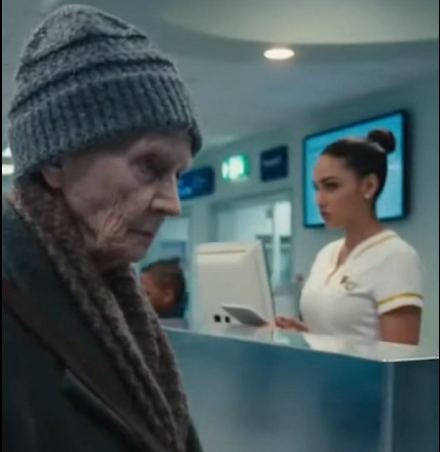
Margaret Hayes sat in the corner, her threadbare gray coat pulled tight around her shoulders. The coat had seen better decades—patches on patches, a safety pin holding the left pocket together. Her shoes were held together with duct tape. Her hair, once carefully maintained, now hung in gray tangles around her weathered face.
To anyone watching, she was just another homeless person seeking shelter from the February cold.
Nobody was watching.
“Next!” The voice cut through the chaos. Sharp. Young. Impatient.
A young nurse stood behind the registration desk. Ashley Morrison, twenty-five, blonde highlights fresh from the salon, designer scrubs that probably cost more than Margaret’s entire outfit. Her manicured nails tapped against the desk as she texted someone, barely glancing up.
An elderly veteran approached the desk, his Purple Heart pin catching the harsh light. “Excuse me, miss, I was told to—”
“Take a number and wait.” Ashley didn’t look up from her phone.
“But I’ve been waiting for—”
“I said wait.” Still texting. “We’ll call you.”
The veteran’s shoulders slumped as he turned away.
Margaret watched. Her sharp eyes missed nothing.
A Spanish-speaking mother approached next, her feverish toddler whimpering in her arms. “Por favor, my baby—”
Ashley rolled her eyes. “Does anyone here speak English? I can’t understand you.”
“Please, she very sick—”
“There’s a clinic for people like you. This is for emergencies.” Ashley turned to her coworker, loud enough for everyone to hear. “I swear, they don’t even try to learn the language.”
The mother’s eyes filled with tears as she retreated to her seat.
Margaret’s jaw tightened. But she stayed still. Watching.
An intern walked past—young, handsome, fresh out of med school. Ashley lit up like a Christmas tree.
“Dr. Bennett!” She leaned over the desk, suddenly animated. “Did you see the schedule change? Looks like we’re working the same shift tomorrow.”
He smiled politely. “Oh, yeah. Guess so.”
“Maybe we could grab coffee during break?” She twirled her hair. “Compare notes?”
While they flirted, an elderly woman with a walker stood at the desk, confused and forgotten. After five minutes, she gave up and shuffled back to her seat.
Margaret pulled a small tablet from her worn leather purse. The screen glowed softly. Time stamp: 9:47 PM. She’d been recording for forty-three minutes.
A man with chest pains approached the desk, his face gray with fear. “I think I’m having a heart attack—”
“Blood pressure cuff is on the wall. Check yourself.” Ashley didn’t even look up from reapplying her lipstick.
“But I don’t know how—”
“Figure it out. I’m busy.”
Margaret’s fingers tightened around her purse.
Twenty minutes later, an elderly couple approached. The woman helped her husband walk, his leg clearly injured.
“Please, we’ve been waiting over an hour—”
Ashley’s face twisted with annoyance. “Listen, we have real emergencies here. A twisted ankle can wait.”
“It’s not twisted, he fell off a ladder—”
“Unless bone is sticking out, you wait.” Ashley turned to another nurse, voice dripping with disdain. “Why do they always come to the ER for stupid shit?”
Margaret stood.
The movement was slow, deliberate. She walked through the crowded waiting room, past the bleeding and the suffering, toward the registration desk.
Ashley saw her coming and sighed dramatically. “Oh God, what now?”
Margaret stopped at the desk. Up close, her face was weathered, lined with exhaustion. Her clothes smelled of the street. Her hands trembled slightly.
“Please,” Margaret said softly. “I’ve been waiting—”
“Are you kidding me right now?” Ashley’s voice rose, loud enough that heads turned. “I don’t have time for this. Go wait with the other bums!”
Margaret didn’t move.
“Hello? Did you hear me? Go. Sit. Down. With. The. Other. Homeless. People.” Ashley waved her hand dismissively, already turning back to her phone.
Margaret’s eyes flickered with something dangerous. But she simply nodded.
She turned and walked back to her seat in the corner.
And she waited.
10:47 PM.
Margaret had been sitting in that corner for exactly one hour and forty-three minutes. Her tablet screen showed a continuous recording—every ignored patient, every cruel comment, every moment Ashley chose vanity over duty.
She watched Ashley ignore an elderly man having a panic attack because he “looked unstable.”
She watched her refuse to help a woman who couldn’t read the intake forms.
She watched her spend fifteen minutes on Instagram while a teenage boy with a suspected concussion waited for someone to even acknowledge him.
Then Margaret stood again.
This time, something was different. Her movements were no longer slow or pained. Her shoulders went back. Her spine straightened. Her step became firm and purposeful.
She walked toward the registration desk, and people moved out of her way without knowing why.
Ashley was texting Dr. Bennett, giggling at something on her screen. She didn’t notice Margaret approaching until she was right there.
“I told you to—” Ashley looked up, annoyed.
Margaret reached into her worn leather purse.
Her fingers closed around something metal.
She pulled out a rectangular plaque, about six inches wide. Brass. Heavy. Official.
She raised it high.
And SLAMMED it against the glass partition.
The sound cut through every conversation, every alarm, every cry. Like a gunshot in a library.
The registrar next to Ashley gasped, her hand flying to her mouth.
Ashley spun around, her phone clattering to the desk.
The plaque was pressed against the glass, the engraving clearly visible:
DR. ELIZABETH MARGARET GRAY
MD, PhD
CHIEF OF MEDICINE
1985-2020
Ashley’s face went from tan to paper-white in less than a second.
“What—” Her voice came out as a whisper.
Margaret—Dr. Gray—held the plaque there, steady and unwavering. When she spoke, her voice had changed. No longer soft or trembling. Clear. Authoritative. The voice of someone who’d commanded this department for thirty-five years.
“My name is Dr. Elizabeth Gray. I founded this emergency department in 1985. I was Chief of Medicine for thirty years.”
Ashley’s mouth opened and closed, but no sound came out.
“I retired three years ago,” Dr. Gray continued, her eyes boring into Ashley like surgical lasers. “But the Board of Directors invites me back once a year for a quality assessment. They call it the Compassion Audit.”
She pulled her tablet from her purse, setting it on the desk. The screen showed Ashley’s face in perfect clarity, time-stamped and dated.
“I’ve been here for one hour and forty-three minutes. In that time, I’ve documented seventeen violations of patient care standards, nine incidents of discriminatory behavior, and twenty-two examples of professional negligence.”
Ashley’s legs looked like they might give out.
The registrar, Maria, had tears in her eyes. “Dr. Gray? Oh my God, Dr. Gray, I didn’t—I’m so sorry—”
Dr. Gray’s expression softened slightly when she looked at Maria. “You did nothing wrong, Maria. You called every patient with kindness. You helped the woman who didn’t speak English. You’re not the problem.”
Her gaze shifted back to Ashley. “But you. You told an elderly veteran to ‘just wait.’ You mocked a mother who didn’t speak English. You ignored a man with chest pains so you could apply lipstick.”
“I—I didn’t know—”
“You didn’t know they were human?” Dr. Gray’s voice was quiet, but it carried like thunder. “You didn’t know they were suffering? Or you didn’t know anyone was watching?”
The entire waiting room had gone silent. Forty-three patients, all watching.
“That man you ignored?” Dr. Gray pointed to the veteran. “He served three tours in Vietnam. He has two Purple Hearts and a Bronze Star. And you told him to take a number.”
Ashley’s eyes filled with tears. “I’m sorry, I—”
“That woman you mocked for not speaking English? She’s a surgeon from Honduras. Her credentials haven’t been processed yet, so she works as a janitor to feed her children. And her daughter has a 104-degree fever.”
Ashley’s hands were shaking.
“And me?” Dr. Gray leaned forward. “You told me to wait with the other bums. You looked at me and saw garbage. Someone not worth your time.”
“I didn’t mean—”
“Yes, you did.” Dr. Gray’s voice was steel. “You meant every word. Because this is who you are when you think no one important is watching.”
Footsteps echoed through the sudden silence. A man in a white coat strode through the automatic doors, his face grim.
Dr. James Patterson. Current Chief of Medicine. Dr. Gray’s former resident.
“Dr. Gray.” He stopped in front of her, his expression unreadable. “I got your text.”
“James.” She nodded.
He looked at Ashley, then at the tablet on the desk. “You have the documentation?”
“One hour and forty-three minutes of continuous footage. Plus my written observations.”
Dr. Patterson took the tablet, scrolling through the recording. His jaw tightened with each passing second.
Ashley found her voice. “Dr. Patterson, I can explain—”
“Don’t.” He didn’t look at her. “I’ve seen enough.”
He handed the tablet to security. “Copy this. Send it to HR, Legal, and the Board.”
Then he turned to Ashley. “You’re suspended. Effective immediately. Security will escort you out.”
“But I—”
“Your badge. Now.”
Ashley fumbled with her ID badge, tears streaming down her face. Her hands shook so badly she couldn’t unclip it.
Dr. Patterson took it from her. “You’ll receive a letter about the disciplinary hearing. I suggest you bring a lawyer.”
Two security guards appeared. Ashley looked around desperately, but no one met her eyes. Not Dr. Bennett. Not her coworkers. No one.
“This isn’t fair,” she whispered. “It was just—it was just one day—”
“It’s never just one day.” Dr. Gray’s voice wasn’t angry anymore. Just sad. “It’s who you are when you think it doesn’t matter. When you think nobody’s watching.”
Ashley was led out, her designer scrubs looking suddenly ridiculous, her makeup running down her face.
The waiting room remained silent.
Dr. Patterson turned to the patients. “I am deeply sorry for what you’ve experienced tonight. We’ll be calling everyone back immediately, starting with those who’ve waited longest.”
He looked at the veteran. “Sir, room three is ready. Maria will take you back personally.”
The veteran stood, his eyes wet. “Thank you.”
Dr. Patterson nodded. Then he turned to the Spanish-speaking mother. In fluent Spanish, he said, “Bring your daughter. We’ll see her right now.”
The woman burst into tears, clutching her child close.
One by one, the ignored patients were called. The elderly couple. The man with chest pains. The teenager with the concussion. Every single person Ashley had dismissed.
Dr. Gray watched it all, her expression neutral but her eyes satisfied.
Dr. Patterson approached her. “Coffee? Like old times?”
She smiled. “I’d like that.”
They walked to the small staff break room. Dr. Patterson poured two cups from the ancient coffee maker that Dr. Gray had bought in 1987.
“Every year you do this,” he said, handing her a cup. “And every year, we find someone who shouldn’t be here.”
“That’s the point, James. Anyone can be professional when the Chief is watching. I need to see who they are when they think nobody important is around.”
“You know she’ll probably lose her license.”
“Probably.” Dr. Gray sipped her terrible coffee. “But how many patients would she hurt if she stayed? How many would suffer because she saw them as less than human?”
Dr. Patterson nodded slowly. “You were right to train me this way. Compassion first, credentials second.”
“You’ve done well with this department. Better than I did, maybe.”
“I learned from the best.”
They sat in comfortable silence for a moment.
“The Board wants to know if you’ll do this next year,” Dr. Patterson said.
Dr. Gray smiled. “Tell them I’ll need a better coat. This one’s getting recognizable.”
He laughed. “I’ll make sure they budget for wardrobe.”
Dr. Gray stood, setting down her empty cup. “Take care of those patients out there. Especially the ones who look like they don’t matter.”
“Always.”
She paused at the door. “And James? That nurse, Maria? Give her Ashley’s shift. She has the heart this place needs.”
“Already planned to.”
Dr. Gray walked out through the emergency department one more time. The waiting room was nearly empty now, patients being treated with the care and dignity they deserved.
The veteran saw her leaving and stood. “Ma’am? Thank you.”
She stopped. “Thank me by taking care of yourself. You’ve earned it.”
He saluted. She returned it with a small nod.
Outside, the February air was bitter cold. Dr. Gray pulled her threadbare coat tighter and walked to her car—a brand new Lexus, parked in the far corner of the lot where no one would notice.
She opened the trunk and pulled out a Burberry coat, cashmere scarf, and proper shoes. She changed quickly, stuffing the disguise into a donation bag.
Tomorrow, this bag would go to an actual homeless shelter. The coat, the shoes, the worn purse—they’d help someone who really needed them.
Dr. Gray checked her phone. Three texts from other Board members, asking about the audit.
She typed one reply: “Audit complete. Report to follow. One termination recommended.”
Then she drove home to her brownstone in the nice part of town, where her grandchildren were waiting to hear stories about Grandma’s “secret mission.”
Because that’s what they called it. Her annual undercover operation.
She’d never tell them the whole truth—that their grandmother still fought for the forgotten, the dismissed, the invisible. That she’d rather spend one night a year pretending to be homeless than let cruelty go unchecked.
That she’d built a hospital to serve everyone.
And she’d be damned if anyone would turn it into a place that only served the comfortable.
Back at St. Mary’s ER, Maria called the next patient with a genuine smile.
Dr. Patterson reviewed Dr. Gray’s report, already drafting new training protocols.
And in a luxury apartment across town, Ashley Morrison sat on her couch, scrolling through job listings with shaking hands, finally understanding that her appearance and charm couldn’t cover for a lack of basic human decency.
The hospital would survive without her.
The patients always mattered more.