The Long Game
Robert.
That’s what they called him at the office. Mr. Harrison at charity events. Sir, in the boardrooms where he’d built his empire.
But to Michael, he was just Grandpa. The old man. The obstacle.
Six months ago, Robert had made a decision. A test.
He’d built Harrison Technologies from nothing—a single software program written in his garage in 1982 into a billion-dollar company. He’d survived hostile takeovers, market crashes, five recessions. He’d outmaneuvered competitors half his age and twice as ruthless.
But he couldn’t figure out his own family.
“I think we need to talk about your memory,” Michael had said that day, concern dripping from every word.
Robert had said nothing. Just listened.
“You called me David yesterday. You asked Mom when Dad was coming home. Dad’s been dead for three years, Grandpa.”
“Did I?”
“Yeah. Yeah, you did.” Michael’s eyes had glittered. “I’m worried about you. We all are.”
Lie. Robert had checked. No one else was worried because there was nothing to worry about.
“Maybe I should help you with some things,” Michael continued. “Bills, appointments. You know. Make sure nothing falls through the cracks.”
And there it was. The tell. The opening move.
“That would be nice,” Robert had said, slumping his shoulders just a little. “I do get confused sometimes.”
Michael had smiled.
Hook set.
For six months, Robert played the part. He forgot names. Repeated questions. Left the stove on once—on purpose, after calling the fire department first to warn them. He wandered out of his building in his slippers. He called Michael at 3 AM asking what year it was.
And Michael ate it up.
More than that—Michael escalated.
First came the credit card. Robert’s Platinum Amex, used for a weekend in Vegas. Michael charged it to “caregiving expenses.” Fifteen thousand dollars.
Robert’s assistant flagged it immediately. “Should I report this?”
“No,” Robert said quietly. “Add it to the file.”
Then came the forged signature on a check. Twenty-five thousand, made out to cash.
“Add it to the file.”
The calls to Adult Protective Services, claiming Robert was being financially exploited by his household staff. The investigator came, found nothing, left confused.
“Add it to the file.”
The private investigators Robert had hired documented everything. Every theft. Every lie. Every conversation Michael had with his friends about “waiting for the old man to finally lose it completely.”
The file grew thick.
And then Michael made his biggest mistake.
He filed for conservatorship.
The petition claimed Robert was mentally incompetent, a danger to himself, unable to manage his affairs. It cited the stove incident, the wandering, the forgotten names. It requested Michael be appointed conservator with full financial authority.
Robert’s lawyer shut it down in forty-eight hours, producing medical evaluations from three separate neurologists, all dated within the past month, all confirming perfect cognitive health.
Michael withdrew the petition, claiming it had been filed in error by an overzealous lawyer.
“Add it to the file.”
The trap was set. Now Robert just needed Michael to walk into it.
“I need to see you,” Robert had called, his voice trembling and uncertain. “At the bank. Tomorrow. Important papers.”
“What papers, Grandpa?”
“Financial papers. Estate papers. I can’t… I can’t remember exactly. The banker called. Said I needed to come in.”
Silence on the other end. Robert could practically hear Michael’s heart racing.
“Okay. Okay, Grandpa, I’ll be there. What time?”
“Ten o’clock. First National. The private banking suite.”
“I’ll be there. Don’t sign anything without me, okay?”
“Okay.”
Michael had shown up at 9:30.
Robert arrived at 9:55, shuffling, looking around confused.
“There you are!” Michael had said too loudly, too cheerfully. “Come on, Grandpa, they’re waiting.”
The private banking suite was all leather and mahogany and hushed importance. The banker—Richard Chen, a man Robert had worked with for twenty years—stood as they entered.
“Mr. Harrison. Michael.”
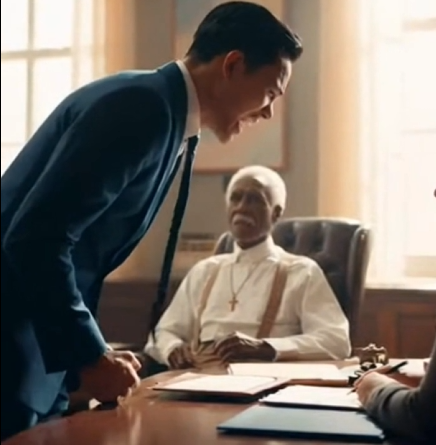
“He’s here to sign documents?” Michael said, not asked.
“Yes.” Richard’s face was carefully neutral.
“About his estate?”
“Among other things.”
Michael practically vibrated with excitement. “Good. Good, that’s… that’s good. He’s been so confused lately, and I think it’s time we made sure everything is protected. Right, Grandpa?”
Robert blinked vaguely. “Are we getting lunch after this?”
“Sure, Grandpa. Whatever you want.” Michael was barely paying attention, his eyes on the documents Richard was pulling from a folder.
“These are the papers Mr. Harrison requested we prepare,” Richard said carefully. “They concern the disposition of his assets.”
“His assets.” Michael nodded. “Right. And I’m assuming, given his condition, that we’re establishing some kind of trust? With proper oversight?”
“Not exactly.”
“What do you mean, not exactly? He can’t manage fifty million dollars by himself. You can see he can barely remember what day it is.”
“I’m aware of Mr. Harrison’s apparent condition.”
“Apparent?” Michael’s voice sharpened. “There’s nothing apparent about it. He’s declining. Rapidly. Last week he asked me who the president was. The week before that, he tried to give his credit card information to a phone scammer. If it wasn’t for me—”
“You stole that credit card,” Robert said quietly.
The room went silent.
Michael turned slowly. “What?”
“You stole my Platinum Amex. Charged fifteen thousand dollars in Vegas. Told your friends you were ‘getting yours early.'” Robert’s voice was steady now, clear. “You also forged a check for twenty-five thousand. Filed a false conservatorship petition. Called Adult Protective Services with fabricated abuse claims about my staff.”
Michael’s face had gone white. “Grandpa, you’re confused—”
“I’m not confused.” Robert sat up straighter. “I haven’t been confused for a single day in the last six months. Every forgotten name, every repeated question, every ‘senior moment’—acting. All of it.”
“That’s… that’s insane. You’re having an episode.”
“I’m having several episodes, actually.” Robert nodded to Richard, who pulled out a tablet. “Episode One: You stealing my credit card. That’s you in the security footage, isn’t it? The Bellagio, September 15th.”
The screen showed Michael at a casino cage, laughing with friends.
“Episode Two: You forging my signature. We have the check. We have the handwriting analysis. We have the deposit into your account.”
Another screen. Clear evidence.
“Episode Three: You calling Adult Protective Services. That’s your voice, isn’t it? We had it analyzed.”
The recording played. Michael’s voice, tight with fake concern, describing abuse that never happened.
“Should I go on?” Robert asked. “I have eighteen episodes documented. Would you like to see them all?”
Michael’s mouth opened and closed. “You… you set me up.”
“I tested you,” Robert corrected. “I wanted to know who in my family actually loved me and who just loved my money. You failed. Spectacularly.”
“This won’t hold up. You’re clearly incompetent if you—”
“I have medical evaluations from three neurologists, dated yesterday, confirming perfect cognitive health. I have psychiatric evaluations confirming I’m of sound mind. I have witness statements from my staff, my lawyers, my doctor. I have six months of documented evidence that this was a planned test.” Robert leaned forward. “What do you have, Michael? Stolen credit cards and forged checks?”
Michael’s hands clenched into fists. “You can’t do this. I’m your grandson. Your only grandson.”
“Which is why I’m not having you arrested,” Robert said. “Yet.”
“You wouldn’t.”
“Try me.”
Richard cleared his throat. “Mr. Harrison, the documents are ready for your signature. Are you prepared to proceed?”
“What documents?” Michael demanded. “What is he signing?”
“I told you,” Robert said. “Important papers.”
He pulled the document closer. Read it slowly, carefully, his eyes scanning every word. Then he picked up the pen.
His hand didn’t shake at all.
The signature flowed across the page—Robert Harrison, clear and firm.
Richard picked up the document. Read it. His face remained professionally neutral, but his voice carried weight.
“This document represents a complete charitable donation of Mr. Robert Harrison’s entire personal fortune, valued at approximately fifty million dollars, to the Children’s Medical Research Foundation, effective immediately.”
The words hung in the air like a bomb.
Michael stared. “What?”
“Fifty million dollars,” Richard repeated. “All of it. The foundation will use it to build a new pediatric cancer research facility. It will be named the Harrison Center for Children’s Health.”
“He can’t— That’s not— Grandpa, you can’t give away all your money!”
“It’s my money,” Robert said calmly. “I can do whatever I want with it.”
“But what about the family? What about me?”
“What about you?”
“I’m your grandson! I deserve—”
“You deserve exactly what you’ve earned,” Robert interrupted. “Which is nothing. Less than nothing.”
Michael’s face was purple now. “You senile old bastard! You’re doing this because you’re losing your mind!”
“We have this room under video and audio surveillance,” Richard said quietly. “Everything you’re saying is being recorded. For the legal record.”
Michael spun toward him. “Legal record?”
“To establish that Mr. Harrison was of sound mind when he made this donation. Your reaction is actually quite helpful. It demonstrates that he clearly understood what he was doing.”
“This is insane!”
“This is justice,” Robert said. He stood, and there was nothing frail about the movement. “You tried to steal from me, Michael. Worse, you tried to have me declared incompetent and locked away so you could control my life. Did you really think I wouldn’t notice?”
“You’re supposed to be confused!”
“I’m supposed to be a lot of things. Rich, for one. But I’m not anymore. I’m a generous philanthropist who just endowed one of the largest pediatric research facilities in the country.” Robert smiled. “How does that feel?”
Michael’s breathing was ragged. “I’ll fight this. I’ll sue. I’ll—”
“You’ll lose,” Richard interrupted. “We’ve been preparing for this for six months. Every document is airtight. Every medical evaluation is current. Every witness is credible. You have no case.”
“My father will—”
“Your father died three years ago,” Robert said softly. “Remember? The funeral you skipped because you were in Cabo? That father?”
Michael’s face crumpled.
“You could have had everything,” Robert continued. “Not the money—I was always going to give most of that away. But the company, the legacy, the knowledge I’ve spent fifty years accumulating. I would have taught you everything. Made you my true heir.”
“I am your heir!”
“You were supposed to be my family.” Robert’s voice broke, just slightly. “But you saw me as a bank account with a pulse. Nothing more.”
“That’s not—”
“You called Adult Protective Services and claimed my housekeeper was stealing from me. Maria. Who’s been with me for thirty years. Who came to your father’s funeral when you didn’t. You tried to destroy her life to get to my money.”
Michael said nothing.
“So here’s what’s going to happen,” Robert continued. “You’re going to leave this bank. You’re going to go home. And you’re going to think very carefully about your choices.”
“And if I don’t?”
“Then I’ll press charges. Credit card fraud, check fraud, filing false reports, attempted conservatorship fraud. I have evidence for all of it. The DA is a personal friend. She’s very interested in this case.”
“You’re bluffing.”
Robert pulled out his phone. Dialed a number. Put it on speaker.
“District Attorney’s office, Janet Morrison speaking.”
“Janet, it’s Robert Harrison.”
“Robert! How did it go?”
“As expected. My grandson is here. Would you like to speak with him?”
Michael’s eyes went wide.
“If he’s willing to listen,” Janet’s voice came through clear and professional. “We have eighteen documented instances of fraud, totaling over two hundred thousand dollars in theft and attempted theft. However, Mr. Harrison has indicated he’d prefer to handle this as a family matter. If Michael Harrison is willing to agree to terms.”
“What terms?” Michael whispered.
“No contact with Mr. Harrison for a period of five years. Full restitution of all stolen funds. A formal apology, in writing, to all staff members you attempted to implicate in false reports. And counseling. Mandatory, weekly, for one year.”
“And if I refuse?”
“Then we prosecute. And you go to jail.” Janet’s voice was matter-of-fact. “Your choice.”
The line went dead.
Robert looked at his grandson. “Well?”
Michael’s hands were shaking. Real shaking, not the performance Robert had given for months. “You really gave it all away. Fifty million dollars.”
“I really did.”
“Why?”
“Because money doesn’t matter. Not like I thought it did when I was your age.” Robert sat back down, suddenly looking his seventy-eight years. “I built that fortune to provide for my family. To create security. To leave a legacy. But what’s the point if my family only sees me as an obstacle to overcome?”
“I didn’t mean—”
“Yes, you did. You meant every bit of it. The question is whether you can become someone different.” Robert’s voice softened. “I hope you can, Michael. I really do. Because the boy I used to know, the one who came to my office and wanted to learn about computers, who asked me a thousand questions about how things worked—that boy had potential. That boy could have been great.”
“That boy is gone.”
“Maybe. Or maybe he’s just buried under a lot of greed and entitlement. Either way, you have five years to figure it out.”
Michael stood on shaking legs. “What will you do? Without the money?”
“I kept the company,” Robert said. “And the house. And a small trust that will cover my expenses. I don’t need fifty million dollars to live. I never did.”
“The company’s worth more than fifty million.”
“I know. But it’s not cash, and it’s not liquid, and it actually produces something of value. It employs two thousand people. It creates technology that helps people. That matters more than money in a vault.”
Michael walked to the door. Stopped. Turned back.
“I’m sorry,” he said quietly.
“I don’t believe you yet,” Robert replied. “But maybe someday I will.”
The door closed.
Richard began gathering papers. “That was difficult to watch.”
“That was necessary to do.” Robert’s shoulders slumped, the act falling away to reveal genuine exhaustion. “Did we get everything?”
“Every word. The legal team confirms all documents are executed properly. The donation is final and irrevocable.”
“Good.”
“Mr. Harrison?” Richard hesitated. “Can I ask why you really did this? The donation, I mean. You could have just cut Michael out of your will.”
Robert was quiet for a long moment.
“When I started the company, I had nothing. Just an idea and a lot of stubborn determination. I made that first million and thought I was rich beyond measure.” He smiled at the memory. “Then it became ten million, and I thought that was real wealth. Then a hundred million. Then more.”
“At some point, I stopped counting. It was just numbers. Abstractions.” He looked at Richard. “But you know what I never stopped counting? The kids we helped with our charitable foundation. The scholarships we funded. The research we supported.”
“The Children’s Medical Research Foundation saved my sister’s daughter fifteen years ago. Experimental treatment for leukemia. She’s in college now, studying to be a doctor.” Robert’s voice was thick. “What’s fifty million dollars compared to that?”
Richard nodded slowly. “Your grandson may not understand that for a long time.”
“Maybe never. But that’s not why I did it.” Robert stood, steady on his feet. “I did it because hoarding wealth for wealth’s sake is pointless. And I did it because I wanted to see what my family was really made of.”
“And?”
“And now I know.” Robert collected his coat. “The company will go to my senior VP when I retire. She’s earned it. The house will go to charity when I die. And Michael gets a chance to become someone worth knowing.”
“That’s generous, considering.”
“That’s family, considering.” Robert walked to the door. “Even when they disappoint you, you keep the door open. You just stop leaving the valuables where they can reach them.”
Richard laughed despite himself.
At the door, Robert paused. “Did the legal team confirm the recording equipment captured everything?”
“Every word. High-definition video, crystal-clear audio. We could submit it to film festivals.”
“Good. Make sure it’s stored securely. If Michael changes his mind about our agreement, I want evidence that I was completely competent when I made these decisions.”
“Already done.”
Robert nodded. Then, in a flash of his old theatrical ability, he let his shoulders slump again, his eyes unfocus, his hands develop a tremor.
“Which way is the exit?” he asked vaguely.
Richard grinned. “Still got it.”
“Damn right I do.” Robert straightened, winked, and walked out with the confident stride of a man who’d just won the longest game of his life.
The Children’s Medical Research Foundation held a press conference three days later announcing the largest single donation in their history. Fifty million dollars to build the Harrison Center for Children’s Health.
Michael Harrison watched it on TV from his apartment, surrounded by credit card bills he could no longer pay.
Robert Harrison watched it from his office, surrounded by the team that had helped build his company and execute his plan.
And somewhere in a hospital, a six-year-old girl with leukemia got access to a clinical trial that might save her life, funded by money that would have sat in a bank account doing nothing.
Robert thought about his grandson. Hoped he’d take the deal. Hoped he’d change.
But mostly, he thought about that little girl.
And smiled.