The front door slammed shut behind Martha, and the lock clicked with a finality that echoed in her bones.
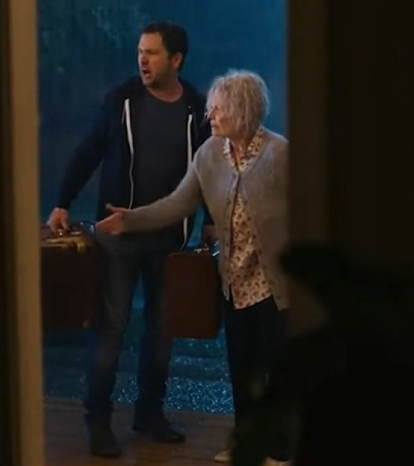
She stood on the porch in the pouring rain, two suitcases at her feet, seventy-two years old and homeless.
“Go to Aunt Linda’s,” her son David had said.
Linda had been dead for ten years.
The rain soaked through her thin cardigan within seconds. Martha’s hands shook as she picked up the suitcases—they were heavier than they looked. Her medications, her clothes, a few photos. Her entire life.
Through the living room window, she could see David and Jessica embracing, his new wife’s smile visible even from the porch.
Three months married, and Jessica had already won.
Martha descended the porch steps carefully. The rain made everything slippery. At seventy-two, a fall could mean broken bones, hospitalization, or worse.
Where was she supposed to go?
Her sister was dead. Her husband was dead. Her friends from church were either in nursing homes or gone.
She made it to the sidewalk before her legs gave out.
Martha sat down on her suitcase, rain plastering her gray hair to her skull, and tried not to cry.
“Mrs. Patterson?” A voice cut through the storm.
Carol Chen, the neighbor from two doors down, was running toward her with an umbrella.
“What are you doing out here?” Carol demanded, shielding Martha from the rain.
“I… David said…” Martha’s voice broke.
Carol’s eyes went to the lit house, to the window where David and Jessica were laughing.
“He threw you out.” It wasn’t a question.
Martha nodded, unable to speak.
“That son of a—” Carol bit off the curse. “Come on. You’re staying with me tonight.”
“I can’t impose—”
“You’re not imposing. You’re accepting help. There’s a difference.” Carol grabbed one suitcase. “Can you manage the other?”
Martha stood on shaking legs and followed Carol through the rain.
Carol’s house was warm, filled with the smell of jasmine tea and cooking spices.
“Sit,” Carol ordered, pointing to the couch. “I’m getting you dry clothes and calling my daughter.”
“Your daughter?”
“She’s a social worker. She’ll know what to do.”
Martha sat in borrowed clothes, drinking hot tea, while Carol made phone calls in rapid Mandarin.
Twenty minutes later, Carol returned with a notepad.
“My daughter says there are options. Emergency housing, senior services, legal aid.”
“Legal aid?”
“To sue your son for elder abuse.” Carol’s voice was sharp. “What he did is illegal, Martha. You lived there five years. He can’t just throw you out.”
“He’s my son.”
“He’s a coward controlled by a manipulative wife.” Carol sat down beside her. “You have rights.”
Martha shook her head. “I don’t want to fight him. I just… I don’t understand what I did wrong.”
“You didn’t do anything wrong. Jessica wanted you gone, and David chose her over you.”
The words hung in the air like a death sentence.
Martha stayed with Carol for three weeks while the social worker—a fierce young woman named Amy—helped her navigate the system.
Emergency housing in a senior apartment complex.
Social Security benefits she’d never applied for.
Medicare coverage for her medications.
A pro-bono lawyer who sent David a letter demanding her belongings and threatening legal action.
David sent everything in boxes. He didn’t include a note.
Six months passed.
Martha adjusted to her new life—a small studio apartment, neighbors who played cards on Thursdays, a community garden where she grew tomatoes.
Carol visited every Sunday. Amy checked in monthly.
Martha didn’t hear from David once.
Then, one year and two months after he’d thrown her into the rain, David showed up at her door.
He looked terrible. Thinner, older, bags under his eyes.
“Mom.” His voice cracked. “Can we talk?”
Martha stood in the doorway of her small apartment, looking at the son who’d betrayed her.
“What do you want, David?”
“Jessica left me. She… she was cheating. The whole time we were married.” He wiped his eyes. “I filed for divorce last month.”
Martha waited.
“I’m sorry.” The words tumbled out in a rush. “I’m so sorry for what I did. I was stupid and weak and I chose wrong. Please, Mom. Please forgive me.”
Martha looked at her son—this man she’d raised, loved, sacrificed for.
She thought about the rain. The suitcases. The locked door.
The way he’d forgotten his aunt was dead.
The way he’d chosen a woman who’d humiliated him over the mother who’d never left his side.
“I brought you into this world,” Martha said quietly. “I held you when you cried. I worked two jobs to send you to college. I moved into your house when you asked me to, helped you save for the wedding, tried to make Jessica happy.”
“I know—”
“And you threw me out like garbage into a rainstorm.” Her voice didn’t rise, but every word landed like a hammer. “You told me to go to my dead sister’s house. You didn’t care if I lived or died.”
“Mom, please—”
“You made your choice.” Martha’s hand tightened on the doorframe. “Now live with it.”
“You’re my mother!”
“I was your mother. That night in the rain, you made me a stranger.”
David’s face crumpled. “Please. I have nobody else.”
“Neither did I.” Martha stepped back. “Goodbye, David.”
She closed the door.
David knocked for five minutes, calling her name, begging.
Martha sat on her couch, hands folded in her lap, listening to her son cry on the other side of the door.
Eventually, the knocking stopped.
Through her window, she watched him walk to his car, shoulders shaking with sobs.
Carol appeared in Martha’s doorway—she had a key for emergencies.
“You okay?” Carol asked gently.
“I don’t know.” Martha wiped her eyes. “Did I do the right thing?”
“You did what you needed to do.” Carol sat beside her. “He made his choice. You don’t owe him forgiveness.”
“He’s my son.”
“And you’re his mother. But he forgot that when it mattered most.”
Martha nodded slowly.
David called seventeen times over the next month. Martha didn’t answer.
He sent letters. She returned them unopened.
He showed up at her apartment twice more. She didn’t open the door.
Three months later, Amy called with news.
“David’s been asking about you at the senior center. He wants to know if you’re okay.”
“Tell him I’m fine.”
“He’s asking if there’s anything he can do.”
“Tell him there isn’t.”
Amy was quiet for a moment. “Martha, I have to ask—do you ever think about forgiving him?”
Martha looked around her small apartment. The tomatoes from the garden on her windowsill. The photos on the wall—her and Carol’s family at a potluck. The knitted blanket from her neighbor Mrs. Rodriguez.
A life she’d built from nothing after her son had destroyed everything.
“I think about the rain,” Martha said finally. “I think about standing on that porch with my suitcases, watching him lock the door. I think about him telling me to go to my dead sister’s house and not even realizing what he’d said.”
“That’s not an answer.”
“Yes, it is.” Martha’s voice was steady. “Some things you don’t come back from. Some choices can’t be unmade.”
“What if he’s truly sorry?”
“Then he’ll have to live with that sorrow.” Martha set down the phone gently. “Just like I had to live with that rain.”
Six months later, Martha celebrated her 73rd birthday surrounded by friends from the senior center, Carol and her family, Amy and her partner.
David wasn’t invited.
He sent flowers. Martha gave them to Carol.
That night, lying in bed, Martha thought about forgiveness.
People said it was for you, not for them. That holding grudges only hurt yourself.
But Martha didn’t feel hurt anymore.
She felt free.
Free from a son who’d valued her so little. Free from the expectation that blood meant unconditional acceptance. Free from the lie that mothers had to forgive everything.
Some betrayals were too deep.
Some wounds didn’t heal.
And some doors, once closed, stayed closed forever.
Martha turned off the light and went to sleep.
Tomorrow, Carol was taking her to the botanical gardens.
Life went on.
Without David.
And Martha was okay with that.