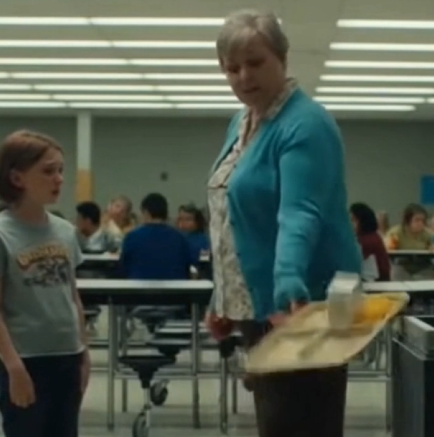
The lunch tray clattered to the floor.
“You don’t get this,” Mrs. Carson said, yanking it from Emma’s hands. “Your family doesn’t qualify.”
Emma was eight years old. Skinny. Wearing the same worn-out sneakers she’d had since last year.
“But… the lady said I get free lunch,” Emma whispered, tears forming. “Because my mom doesn’t have a job right now.”
“The lady was wrong.” Mrs. Carson dumped the tray into the trash. Mac and cheese. An apple. Milk. “Go sit down.”
Emma stood there, stomach growling, watching her lunch disappear into the garbage.
The other kids stared. No one said anything.
This was the third time this week.
What Emma didn’t know was that her name was on the approved list for free lunch. Had been for two months.
What Mrs. Carson didn’t know was that the new principal, Mr. Hayes, had installed cameras in the cafeteria the day before.
And he was watching.
Mrs. Carson had been teaching at Lincoln Elementary for seventeen years. Beloved. Trusted. “Teacher of the Year” three times.
She ran the lunch program like her personal kingdom.
Every day, she’d confiscate lunches from kids on the free meal program. “Budget cuts,” she’d tell them. “Not enough funding.” “Your paperwork wasn’t filed correctly.”
The kids believed her. They were seven, eight, nine years old. They didn’t know how to fight back.
Their parents complained to the old principal. He’d shrugged. “Mrs. Carson knows the system. If she says they don’t qualify, they don’t qualify.”
But three weeks ago, Principal Davis retired.
Mr. Hayes was different.
On his second day, a mother came to his office in tears.
“My daughter comes home starving,” she said. “She’s on the free lunch list. I have the approval letter. But Mrs. Carson won’t give her food.”
Mr. Hayes pulled up the records. The daughter’s name was right there. Approved. Current.
“I’ll look into it,” he said.
He watched Mrs. Carson for two days. Noticed a pattern.
Kids from the free lunch program got turned away. Always the same kids. Always by her.
But those same lunches? They weren’t going into the trash.
On Friday afternoon, he saw where they went.
Mrs. Carson sold them.
To other students. Kids whose parents gave them lunch money.
“Five dollars for a hot lunch,” she’d say quietly. “Better than the cafeteria line.”
She made seventy-five dollars that day. Mr. Hayes counted.
He installed cameras that night.
Monday morning, he watched the footage live from his office.
Emma got in line. Grabbed her tray. The lunch lady smiled at her. “There you go, sweetie.”
Emma carried it carefully to a table.
Mrs. Carson appeared like a vulture.
“Emma Rodriguez?” She read from a clipboard. “You’re not on the list.”
“But Mrs. Patricia just gave it to me—”
“She made a mistake.” Mrs. Carson grabbed the tray. “This isn’t for you.”
“Please, I’m hungry—”
“You should have thought about that before your mother couldn’t hold down a job.”
Emma’s face crumpled.
Mr. Hayes was already moving.
He walked into the cafeteria just as Mrs. Carson dumped the tray.
“Mrs. Carson.”
She turned, smile ready. “Principal Hayes! Just handling a small mix-up with the lunch program.”
“Emma Rodriguez is on the approved list for free meals.”
“Oh, well, I have my own records—”
“The district’s records say she’s approved. As of September 1st.” He looked at Emma. “Sweetie, go get another tray. Tell Mrs. Patricia I sent you.”
Emma hesitated, looking between them.
“It’s okay,” Mr. Hayes said gently. “Get your lunch.”
She ran.
Mrs. Carson’s smile tightened. “I’ve been running this program for fifteen years. I know who qualifies—”
“Then you know Emma does. And Marcus Chen. And Jayla Williams. And seventeen other students you’ve turned away this month alone.”
Her face went pale.
“My office. Now.”
They walked in silence. Mr. Hayes closed the door.
“I installed cameras,” he said simply.
She laughed. Nervous. “Cameras? For what?”
He turned his monitor. Pressed play.
The footage showed everything. Emma’s tray grabbed. Dumped. Mrs. Carson’s cold words.
He fast-forwarded. Same scene. Different child. Different day.
“This is from last week,” he said.
Another video. Mrs. Carson taking cash from a student. Handing over a lunch tray.
“This is from twenty minutes ago.”
She stood frozen.
“How long?” he asked.
“I don’t know what—”
“How. Long.”
Silence.
“Three years,” she whispered finally.
His jaw clenched. “Three years. You’ve been stealing food from hungry children and selling it for profit. For three years.”
“The budget is tight! I was just—”
“Just what? Getting rich off kids who qualify for free meals?”
“It wasn’t like that—”
“You told Emma her mother couldn’t hold down a job. She’s eight years old. You humiliated her in front of her classmates.”
Mrs. Carson’s eyes filled with tears. The performative kind. “I’m sorry. I made a mistake. I’ll fix it—”
“You’re fired.”
“What? You can’t—”
“I can. And I am. Effective immediately.” He picked up his phone. “I’m calling the district superintendent. And the police.”
“The police?!” Her voice cracked. “For what?”
“Theft. Fraud. Embezzlement. Child abuse.”
“Child abuse? I never touched them!”
“You withheld food from children. Food they were legally entitled to. That’s neglect. That’s abuse.”
She sat down hard. “Please. I have a mortgage. I have a family—”
“So do those kids. The ones you starved.”
Two security officers appeared at the door. “You called, Principal Hayes?”
“Mrs. Carson is being terminated. Please escort her off the property. She’s not to take anything except her purse.”
She stood, shaking. “You’re ruining my life over a few lunches?”
“You ruined children’s lives over greed.”
They walked her out. The hallway was full of students heading to next period. They watched in silence as their favorite teacher was escorted away.
Mr. Hayes called an assembly that afternoon.
“Some of you have been told you don’t qualify for free lunch,” he said. “That was wrong. If you have an approval letter, you get lunch. Every single day. No questions asked.”
He looked at Emma in the third row. “And if anyone tells you otherwise, you come straight to my office.”
Seventeen hands went up.
“You can put your hands down,” he said gently. “I already have your names. Starting tomorrow, you all get your lunches. I promise.”
Emma smiled for the first time in weeks.
The investigation moved fast.
Mrs. Carson had made $47,000 over three years. Selling lunches for five to seven dollars each. Pocketing everything.
The school district fired her formally. Revoked her teaching license.
The police charged her with theft, fraud, and child endangerment.
Her lawyer tried to make a deal. “She’ll pay it back. Community service. No jail time.”
The prosecutor said no.
“She stole from children. Hungry children. Children living in poverty. There’s no deal.”
The trial lasted four days.
Parents testified. Emma’s mother. Marcus’s father. Jayla’s grandmother.
“My daughter cried every day,” one mother said. “She thought she wasn’t good enough. That she didn’t deserve to eat.”
Mr. Hayes brought the footage. Hours of it.
The jury deliberated ninety minutes.
Guilty on all counts.
Mrs. Carson got two years in prison. Five years probation. Full restitution of $47,000 plus damages.
And her name on a registry. She could never work with children again.
She sobbed in court. “I’m sorry. I didn’t mean—”
“You meant it every single day for three years,” the judge interrupted. “You knew those children were hungry. You didn’t care.”
After the sentencing, Emma’s mother found Mr. Hayes in the hallway.
“Thank you,” she said, crying. “Thank you for believing us.”
“I should have been here sooner,” he said.
“You’re here now. That’s what matters.”
Mr. Hayes overhauled the entire lunch program.
He hired a new coordinator. Installed a digital system. Made sure every eligible child was flagged automatically.
He posted the free lunch guidelines in every classroom. In English and Spanish.
“No child should ever be ashamed of needing help,” he told the staff. “And no child in my school will go hungry. Ever.”
Emma gained twelve pounds that year. Her grades improved. She smiled more.
At the end-of-year assembly, Mr. Hayes gave out awards.
“This award goes to someone who showed incredible courage,” he said. “Someone who taught me that even the smallest voice matters.”
He called Emma to the stage.
She looked confused. “But I didn’t do anything.”
“You told the truth. Even when it was hard. Even when you were scared.” He handed her a certificate. “Thank you for trusting me.”
She hugged it to her chest.
The cafeteria lady, Mrs. Patricia, quit a month after Mrs. Carson’s arrest.
“I should have said something,” she told Mr. Hayes, crying. “I knew what she was doing. I was scared I’d lose my job.”
“You’re saying something now,” he said. “That counts.”
She testified at trial. Her testimony helped seal the conviction.
Two years later, Mrs. Carson was released early for “good behavior.”
She tried to get a teaching job in another state.
The background check flagged her immediately.
She works retail now. Minimum wage. No contact with children.
Emma is in fifth grade. Straight-A student. Never misses lunch.
She wants to be a principal when she grows up.
“Like Mr. Hayes,” she says. “So I can help kids like me.”
Mr. Hayes keeps her drawing on his office wall. A crayon picture of the cafeteria with the words “Everyone Gets Lunch” in big red letters.
He looks at it every morning.
A reminder of why he does this job.
Not for the pay. Not for the title.
For kids like Emma.
Who deserve to eat.
Who deserve to be heard.
Who deserve someone who believes them.
The school district implemented “Emma’s Law” the following year. Named after her.
Any employee caught withholding approved meals faces immediate termination and criminal charges.
Zero tolerance.
Mr. Hayes was at the board meeting when they passed it.
Emma and her mother were too.
When they read her name, Emma squeezed her mother’s hand.
“You changed things,” her mother whispered. “You actually changed things.”
Emma smiled.
She’d just wanted lunch.
Instead, she’d started a revolution.