Brandon Keller hadn’t slept in three days. His son Lucas, barely four years old, lay dying in Room 417 at Riverbend Children’s Hospital in Austin.
Dr. Ivers closed his tablet. “We’ve exhausted every option, Mr. Keller. I’m estimating days, maybe a week. I’m truly sorry.”
Brandon’s throat tightened. “There has to be something.”
“Sometimes medicine hits a wall,” the doctor said quietly.
After midnight, the door creaked. A little girl walked in—seven years old, school uniform, sneakers worn through. She carried a plastic bottle painted gold.
“Who are you?” Brandon stood. “You can’t be here.”
She climbed onto the stool beside Lucas. “I’m going to help him.”
Before Brandon could react, she poured water from the bottle onto Lucas’s forehead.
“Hey!” Brandon grabbed the bottle. “What are you doing?”
“It’s special water,” the girl insisted. “It helps sick people.”
Brandon hit the call button. Nurses rushed in.
“Ivy,” one nurse said. “What are you doing here again?”
A woman in a gray maintenance uniform appeared, breathless. “I’m so sorry. I’m Denise. I work cleaning on this floor. We’re leaving right now.”
Ivy pulled against her mother’s hand. “I wanted to help Lucas. He’s my friend.”
Brandon froze. “How do you know my son’s name?”
“We played at Sunny Steps,” Ivy said. “We built towers and he made dinosaur noises.”
“My son has never been to any school,” Brandon said slowly.
Denise’s face crumpled. “Please forgive her.”
They left. Brandon stared at the golden bottle.
That afternoon, he called the nanny. “Did you take Lucas to a kindergarten?”
Silence. Then Rosa’s trembling voice: “Only twice a week, Mr. Keller. He was so lonely. I thought I was helping.”
“Where?”
“East Austin. Near the old rail yard.”
Brandon hung up. Anger flooded through him—at Rosa, but mostly at himself for missing his son’s life.
That night he fell asleep in the chair. He woke to whispering.
Ivy was back, holding Lucas’s hand, telling him a story about a brave knight.
“How did you get in?” Brandon asked.
“Staff entrance. I know where Mama keeps her card.”
“You can’t keep doing this.”
“Lucas needs someone to believe he’ll get better,” Ivy said. “Everyone else just looks sad.”
Brandon noticed Lucas’s cheeks looked less pale.
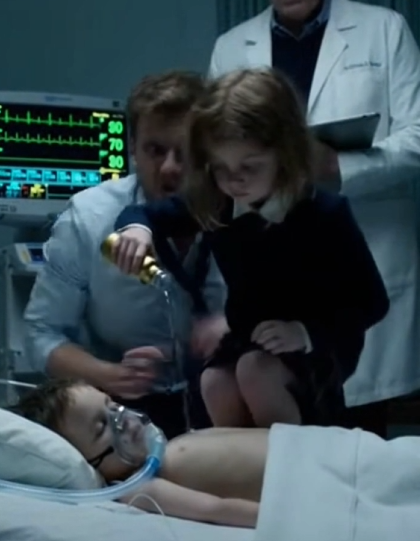
Nurse Paige entered quietly. “Mr. Keller, I should ask her to leave, but after she visited earlier, Lucas’s oxygen levels improved. Not much, but the monitor noticed.”
Brandon looked at Ivy. “What’s in that bottle?”
“Water from the fountain behind the hospital. My grandma says it used to be a well where sick people went. I thought maybe it still works.”
Brandon laughed bitterly. “That sounds like a fairy tale.”
“Do you believe in doctors?” Ivy asked.
“Yes.”
“And they said they can’t help him anymore. So why is it strange to believe in something else too?”
Brandon had no answer.
When Lucas opened his eyes and whispered, “Daddy, Ivy came to see me,” Brandon broke down.
Later, Dr. Ivers stopped him. “Lucas’s blood counts improved. Kidney function is marginally better. I can’t explain it.”
“Is it good news?”
“It’s unexpected,” the doctor admitted.
When Natalie arrived from Denver, Brandon told her everything.
“If that girl makes him smile,” Natalie said softly, “she can come every day.”
Ivy came after school with Denise, bringing drawings and stories. Lucas laughed at her jokes, reached for her hand during long nights.
Hospital administrators tried to enforce rules. Brandon arranged proper permissions. Ivy was allowed to visit.
When Denise confided that Ivy had anemia they couldn’t afford to treat, Brandon paid the bills quietly. “Your daughter is giving us hope. Hope is worth more than money.”
Dr. Ivers tested the fountain water. “It’s just water.”
Yet Lucas kept improving.
First he sat up. Then he ate without help. Weeks later, he stood with Ivy supporting him.
Nurses whispered in corridors. Doctors studied charts in disbelief. Some called it spontaneous remission. Others whispered the word miracle.
Brandon stopped searching for explanations.
When Lucas was finally discharged, Brandon carried his son into bright Texas sunlight. Ivy waited by the courtyard fountain, holding the golden bottle proudly.
“I told you,” she said. “We’d play again.”
Lucas hugged her tight. “I’ll never forget you.”
Brandon felt peace settle in his chest—not from answers, but from gratitude.
He changed his life. Left the office earlier. Listened when Lucas spoke. He and Natalie rediscovered each other through bedtime stories and quiet dinners.
He funded Sunny Steps kindergarten—meals, supplies, scholarships. No plaques, no press releases. Just support.
Denise was promoted to facilities manager with a full benefits package. She cried when Brandon handed her the offer letter. “You’ve already done so much.”
“You raised a daughter who taught my son how to fight,” Brandon said. “That’s worth everything.”
Years later, Lucas—now a healthy teenager—kept the golden bottle on his desk.
“It wasn’t the water,” he told Ivy, who was studying to become a teacher. “It was you. You believed when everyone else was afraid.”
Ivy smiled. “I just didn’t know how to give up.”
Brandon stood in the doorway, watching them laugh together. He still didn’t know if it had been medicine, chance, or something beyond explanation.
But he knew this: When the world said there was no hope, a seven-year-old with a cheap plastic bottle refused to accept that answer.
And because of that refusal, because of her unwavering belief, their lives were given back to them.
Lucas went on to study pediatric medicine. Ivy became an elementary school teacher. They remained best friends.
Brandon never stopped being grateful for the night a stubborn little girl broke the rules and poured fountain water on his dying son.
Sometimes the greatest miracles come from the smallest hands.