Leonard Whitmore hadn’t moved in ten years.
Machines kept him breathing. Specialists from three continents examined him and left with nothing. The name on the door still meant something—billionaire, industrialist, power. But power doesn’t matter in a coma.
“Persistent vegetative state,” the doctors said. No response to voices. No reaction to pain. Nothing behind those closed eyes.
After a decade, they were done trying.
The morning they planned to transfer him to long-term care, Malik wandered in.
Malik was eleven. Skinny. Barefoot half the time. His mother cleaned hospital floors at night, so he waited after school because there was nowhere else. He knew which vending machines worked and which rooms were locked.
Room 701 was supposed to be locked.
But Malik had seen the man through the glass dozens of times. He didn’t look asleep to Malik. He looked trapped.
That afternoon, a storm flooded the neighborhood. Malik came in soaked, covered in mud. Security was distracted. The door was unlocked.
He stepped inside.
The billionaire lay there—pale skin, dry lips, eyes sealed shut by time.
Malik stood quietly.
“My grandma was like this,” he whispered. “Everyone said she was gone. But she heard me. I know she did.”
He climbed onto the chair beside the bed.
“People talk like you’re not here. That’s gotta be lonely.”
Then Malik reached into his pocket.
He pulled out wet mud—dark, thick, smelling like rain.
And gently, he smeared it across the billionaire’s face.
Across his cheeks. His forehead. Down his nose.
“Don’t be mad,” Malik murmured. “My grandma said the earth remembers us. Even when people don’t.”
A nurse burst in.
“WHAT ARE YOU DOING?!”
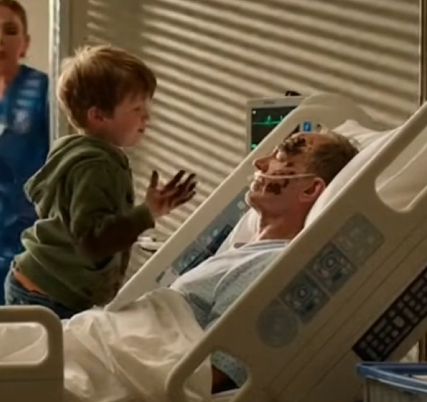
Malik jumped back. Security rushed in, shouting. The boy cried, apologizing as they dragged him out, his muddy hands shaking.
The doctors were furious.
“Contamination risk! Protocols violated!”
They started cleaning Leonard’s face immediately.
Then the heart monitor spiked.
“Wait,” one doctor said. “Did you see that?”
Another beep. Then another.
Leonard’s fingers twitched.
The room went silent.
They ran scans. Brain activity—new, localized, responsive. Not random. Real.
Within hours, Leonard showed signs no machine had recorded in ten years.
Movement. Pupil response. Reaction to sound.
Three days later, Leonard Whitmore opened his eyes.
“What do you remember?” they asked.
His voice cracked.
“I smelled rain. Dirt. My father’s hands. The farm where I grew up… before I became someone else.”
The hospital tried to find Malik.
At first, they couldn’t.
Leonard insisted.
When they finally brought the boy to his room, Malik stared at the floor.
“I’m sorry. I didn’t mean trouble.”
Leonard reached for his hand.
“You reminded me I was still human. Everyone treated me like a body. You treated me like I belonged to the world.”
Tears ran down Malik’s face.
“I just wanted you to feel something.”
Leonard’s voice broke.
“You did more than that. You brought me back.”
Within the week, Leonard paid off Malik’s mother’s debts—every cent. He funded Malik’s education through college. He built a community center in their neighborhood with Malik’s mother’s name on it.
The hospital asked what saved him.
Leonard never said “medicine.”
“A child who believed I was still there,” he said. “And the courage to touch the earth when everyone else was afraid.”
The specialists wrote papers. The media called it a miracle. Leonard called it something else.
“Malik saw me when I couldn’t see myself.”
Six months later, Leonard stood at the ribbon-cutting for the community center. Malik stood beside him, clean clothes, new shoes, holding scissors.
“You ready?” Leonard asked.
Malik grinned.
“Yeah. Let’s do it.”
They cut the ribbon together.
Leonard never went back to the person he was before the coma. He sold half his companies. He funded hospitals in underserved areas. He showed up.
And Malik?
He kept a jar of dirt on his desk.
“The ground remembers us,” he’d say when people asked. “Even when the world forgets.”
Leonard lived another twenty years—active, present, awake.
And every year on the anniversary, he and Malik would meet in that same hospital room.
They’d sit. They’d talk.
And Malik would bring a handful of earth.
“Just in case,” he’d say, smiling.
Leonard would smile back.
“Just in case.”