The cemetery was the only place Thomas Harlan didn’t have to pretend.
At work, he was functional. At the grocery store, he said fine when people asked. At his sister Carol’s house on holidays, he ate what was put in front of him and answered questions and did all the social math required of a man who was grieving but not, apparently, catastrophically.
But here.
Here he could just be what he was.
A man who had lost too much.
He came every Sunday. Fifty-seven Sundays now — he’d stopped keeping count around month nine and then started again because the counting made him feel like someone was marking the time, even if it was just himself.
The rain this morning was thin and grey and relentless.
It had been raining since three a.m. Thomas knew because he’d been awake at three a.m., as he was awake most nights in the hour where the silence of the house became its own kind of noise.
He walked the east path.
Left at the chipped stone angel.
Straight past the veterans’ row.
Second turning after the shed.
He knew this walk so well it required nothing from him, which was why he almost didn’t see her until he was fifteen feet away.
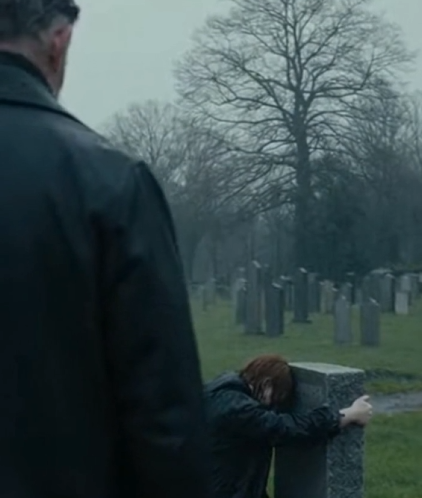
She was kneeling at Daniel’s grave.
Both arms around the headstone.
Her forehead pressed against the engraved letters of his son’s name.
She was young — early twenties, maybe — and completely soaked. Her coat was a dark, saturated charcoal grey that had probably been something lighter before the rain got to it. Her hair was dark and flat against the back of her neck.
She wasn’t moving.
Thomas stopped.
He stood on the path and stared at her and felt the specific, particular wrongness of the scene settle over him.
He didn’t know this young woman.
He had never seen her before.
And she was holding his son’s headstone like she was trying to hold Daniel himself.
He took a step forward. Then another.
The gravel crunched.
She heard it.
She didn’t startle — she lifted her head slowly, like someone surfacing. Like someone who had been somewhere else and was choosing now to come back.
She turned her head, then her body.
She looked up at him.
Thomas’s heart stopped.
He felt it stop.
A physical interruption — a lurch, a skip — behind his sternum, because the eyes looking up at him from that pale, rain-wet, twenty-something face were Ellen’s eyes.
Green.
Shot through with gold at the outer edges.
The specific shade and shape that he had looked into every morning for eleven years and had described to three separate people since losing her, because description was the only form of keeping he had left.
Ellen Morrison Harlan.
Dead eight years.
Her eyes in this stranger’s face.
Thomas’s hand found the iron fence beside the path.
The cold metal steadied him.
Barely.
The young woman held his gaze.
She didn’t look afraid.
She looked like someone delivering something they had carried a very long distance.
“He’s my brother,” she said quietly.
Thomas couldn’t speak.
The rain fell between them.
The oak tree dripped.
And the world he’d understood for fifty-four years quietly began to restructure itself.
He found his voice somewhere around the thirty-second mark of silence.
“I’m sorry,” he said, which was not at all what he’d meant to say. “I’m — this is my son’s grave.”
She nodded.
She got to her feet slowly, unfolding from the wet gravel, and he saw that she was small — five-three, maybe — and that she’d been kneeling long enough that her knees had left marks in the wet ground.
She was shaking slightly.
From cold, he thought. Probably cold.
“I know,” she said. “Daniel Harlan.” She glanced at the stone. “He was twenty-four.”
“Twenty-five,” Thomas said, automatically. “He turned twenty-five in March. He died in June.”
A pause.
“Right,” she said softly. “I didn’t — I didn’t know him well. I found out about him late.”
Thomas stared at her.
“What’s your name?” he asked.
She looked at him for a moment before answering, like she was deciding something.
“Maggie,” she said. “Maggie Reed.”
He waited.
“That’s my foster name,” she added, and her voice didn’t change when she said it — no flinch, no apology. Just a fact, delivered clean. “I never had a legal last name that stuck. I went through a few.”
Thomas looked at her face.
He looked at her eyes.
He said, carefully: “You said he was your brother.”
“Yes.”
“How.”
It wasn’t a question. It came out flat. Too much in it to shape into the grammatical form of a question.
She looked at him steadily.
“Same mother,” she said. “Different — I mean, same father too. Same parents. We’re twins.”
The word landed like something dropped from a height.
Twins.
Thomas heard it and then un-heard it and then heard it again.
“That’s not possible,” he said.
“I know,” she said. “I know it sounds — I know.”
“Ellen was pregnant with one child,” Thomas said. “They told us. She had every scan. There was one —”
“There were two,” Maggie said quietly. “There were two of us.”
Thomas let go of the fence post.
He immediately wished he hadn’t.
“What are you saying to me?” he asked.
She wrapped her arms around herself — against the cold, he thought, or against the necessary vulnerability of what she was about to say.
“Can we sit somewhere?” she asked. “Or stand somewhere that isn’t — I’ll explain everything. I’ll show you everything I have. But I need to not be standing in the rain for this part.”
Thomas looked at her.
He looked at his son’s grave.
He looked back at her eyes.
“There’s a covered bench,” he said. “Near the main path.”
“Okay,” she said.
They walked together in silence, separated by three feet of wet gravel path.
The bench was under an oak tree that still had half its leaves, and the rain hit the wood and dripped but didn’t pour.
She sat at one end.
He sat at the other.
She opened the backpack she’d been wearing — he hadn’t registered the backpack, hadn’t registered any details beyond her eyes — and pulled out a ziplock bag that was protecting a worn manila envelope.
She held it in both hands.
“I grew up in foster care,” she said. “I went in as a newborn. I was at St. Catherine’s — that’s the receiving home in Galveston — for about two months, and then I started moving.”
She said this without drama. Without asking for a reaction.
“Seven placements before I was twelve. Three after that.” She paused. “I aged out at eighteen.”
Thomas was very still.
“I started looking into my birth records when I was twenty,” she continued. “That’s when the sealed record law changed in Texas, and adoptees and foster kids could petition for their original birth certificates.”
She opened the envelope.
She pulled out a document and held it toward him.
He took it.
It was a birth certificate.
The mother’s name was Ellen Adrienne Morrison.
There were two names on the line for children born.
Daniel Arthur.
And Margaret Ellen.
Below that, the father’s name.
Thomas James Harlan.
He read it twice.
He read it a third time.
He looked up at her.
“I’ve had this for two years,” she said. “I’ve been trying to — I didn’t know if I should approach. I didn’t know how to approach. I looked you up. I found out that Daniel — that he had died. That was four months ago.” She swallowed. “I came here three times before today. I left before anyone saw me.”
Thomas looked at the document in his hand.
The rain tapped against the leaves above them.
“My wife died eight years ago,” he said.
“I know. I’m sorry.”
“She never told me.” His voice came out wrong — too flat, too careful. “She never told me there was — she never said anything.”
Maggie nodded slowly.
“I think,” she said carefully, “it might not have been her.”
She reached into the envelope again.
She pulled out a second document — older, the paper yellowed at the edges.
“This is from the state’s records. The intake file for St. Catherine’s.” She pointed to a line. “This is who brought me in.”
Thomas read the name.
He read it again.
The blood left his face.
He felt it leave — a slow, downward drain, like something had been pulled from him.
The name on the intake document was Patricia Louise Harlan.
His mother.
He drove home in something that was beyond silence.
Maggie sat in the passenger seat with her wet coat and her manila envelope and she didn’t speak either, because there was a quality to Thomas’s silence that said not yet, and she’d learned to read that quality in people.
She’d been reading people carefully her whole life.
You had to, when the people around you changed every two years.
Thomas’s house was a mid-century ranch on a quiet street that was probably beautiful in summer and was currently grey and bare and wet.
He unlocked the front door and went inside and turned on the kitchen light.
“Coffee?” he asked, from old habit, from the automatic hospitality of a man raised by a certain generation.
“Yes,” Maggie said. “Please.”
He made coffee.
She sat at the kitchen table and looked at her hands and waited.
He put a mug in front of her and sat across from her and said, “My mother died three years ago.”
“I know,” Maggie said quietly.
“She’s not here for me to ask.”
“I know.”
He wrapped both hands around his mug.
“She came from a very specific time,” he said. “And a very specific kind of family. Where things like this were — handled. Quietly. Without discussion.”
Maggie nodded.
“Do you have her number?” Thomas asked, and then immediately shook his head. “Sorry. You said she passed.”
“I know she did. Yes.” Maggie paused. “I don’t — I’m not here to condemn her. I’m not here to — I don’t know what she told herself. I don’t know what she thought she was doing.”
Thomas looked at her.
“You seem very calm,” he said.
She met his eyes.
“I’ve had two years to be angry,” she said. “I’m on the other side of the angry part now.” A beat. “Mostly.”
He almost smiled.
It surprised him — the almost-smile.
“I need to ask you something,” he said.
“Okay.”
“The DNA. Have you —”
“Yes,” she said. “I did a test through GeneticOrigins. Seven months ago.” She reached into the envelope again and slid a printed page across the table. “I didn’t submit it directly to you because I didn’t know if you’d respond. I’ve been working with the state’s family advocate office.”
He looked at the printout.
Predicted relationship: Full sibling to user D.Harlan_TestKit2019.
He looked at her.
She looked at him.
“Daniel did a test,” Thomas said, slowly. “Two years before he died. He was interested in the genealogy side — ancestry percentages, that kind of thing.”
“I know,” she said. “His profile was public. That’s how I found him.” Her voice went quiet. “He didn’t know about the match. The system flagged it as a close relative but he never checked the notifications.”
Thomas stared at the table.
Daniel had been two feet away from knowing.
Two feet, and a notification he’d never opened.
“I wrote him a letter,” Maggie said. “I mailed it six months before he — before.” She stopped. “He never wrote back. I don’t know if he got it.”
“He moved apartments,” Thomas said, his voice rough. “In the fall. The mail got lost in the transition. He was terrible with mail.”
She nodded.
She didn’t say anything.
She just looked at her coffee mug and nodded, and Thomas watched her absorb that information the way you absorb something you’ve spent a long time being afraid to know.
“I’m sorry,” he said.
She shook her head.
“Don’t be.”
“He would have — ” Thomas stopped. Started again. “He would have wanted to know you. I know that about him. That’s the kind of person he was.”
Maggie pressed her lips together.
Her jaw tightened.
She nodded again.
In the garage, there were nine boxes of Patricia Harlan’s belongings that Thomas had never been able to make himself sort.
He’d moved them from her house to his garage three years ago when he’d cleared her place out, and then he’d closed the garage door and not thought about them in any sustained way since.
He took a flashlight now, because the garage light was out, and he went through the boxes with Maggie standing in the doorway.
It took forty minutes.
In the seventh box, between a Bible and a collection of church programs, he found a sealed envelope with no name on it.
He brought it inside.
He sat at the kitchen table.
He opened it.
Inside: three pages of Patricia Harlan’s handwriting, dated fourteen years ago.
If you are reading this, Thomas, something has happened and I am gone, and I need you to understand why I did what I did. I need you to understand, even if you can’t forgive it.
Thomas read it.
He read all three pages.
Then he put it face-down on the table and sat very still for a moment.
“She knew,” he said.
Maggie waited.
“Ellen went into premature labor,” he said. “She was alone — I was traveling, I couldn’t get back in time. My mother was with her.” His voice was careful, methodical. “Ellen delivered twins. The second birth was complicated. Ellen lost a lot of blood and was unconscious by the time it was over.” He swallowed. “My mother decided —”
He stopped.
He pressed his hand flat on the table.
“My mother decided that one infant was enough. That Ellen was not — that the marriage would not survive the pressure of two premature infants when the finances were what they were, when Ellen’s health was what it was.” He looked up. “She told herself she was protecting us.”
Maggie’s face was very still.
“She brought you to St. Catherine’s before Ellen came out of recovery,” Thomas said. “She told Ellen — she told Ellen that one of the twins had not survived.”
The kitchen was completely silent.
“Ellen believed her,” he said.
“Of course she did,” Maggie said quietly. “Why wouldn’t she.”
“She grieved a death that didn’t happen.”
Maggie nodded slowly.
“She grieved you,” Thomas said. “All those years. She grieved you.”
He looked at Maggie and Maggie looked at him and the kitchen was very quiet.
“She never knew,” Thomas said.
“No,” Maggie said.
“Then she died not knowing.”
“Yes.”
Thomas put his face in his hands for a moment.
Not crying — just pausing.
Just taking a breath inside the magnitude of what he was holding.
He lifted his head.
“I want to do a formal DNA test,” he said. “A legal one. Through a certified lab.”
“I expected that,” Maggie said. “I want that too.”
“And then,” he said carefully, “I want to contact the family advocate office. I want to understand what the legal options are. My mother is gone, but —”
“I know,” Maggie said. “I’ve already been working with them. There are civil options. The records exist.”
Thomas nodded.
He looked at her across the table.
She had Ellen’s eyes and Daniel’s chin and she was sitting in Thomas Harlan’s kitchen on a Sunday morning with wet hair and a worn backpack and twenty-two years of somebody else’s last name.
“You’ve been alone with this for two years,” he said.
“Most of my life was alone,” she said, simply. “This wasn’t the hardest part.”
He absorbed that.
“I’m sorry,” he said.
She shook her head.
“You couldn’t have known.”
“I’m sorry anyway.”
She looked at him.
She nodded.
“Okay,” she said softly.
The certified DNA test took eleven days.
Thomas paid for expedited processing.
He told his sister Carol on day four, because Carol had to be told — she was the kind of person who found things out anyway, and finding out after the fact hurt her more than finding out during.
Carol cried on the phone.
Then she said, “What do you need from me?”
“Nothing yet,” Thomas said. “I’ll tell you when.”
He and Maggie texted during the eleven days. Short messages.
How are you doing.
Okay. You?
Okay.
Once she sent him a photo — an old one, black and white, that the foster agency had given her when she requested her file. She was maybe four months old in it, wide-eyed, in a white onesie.
He held his phone for a long time looking at that photo.
Then he sent back: You have your mother’s eyes. She had green eyes. Everyone always noticed.
A pause.
Then: I have a photo of her. I’ve been looking at it since I found her name. She’s beautiful.
He closed his eyes.
Yes, he wrote back. She was.
On day eleven, the results came.
He called Maggie immediately.
She answered on the first ring.
“99.97%,” he said.
A silence.
Then, very quietly: “Okay.”
“Okay,” he said.
Another silence.
“What happens now?” she asked.
“Now,” Thomas said, “I make some calls.”
The family advocate at the Texas Department of Family and Protective Services was a woman named Linda Ostrowski, who had the particular combination of gentleness and precision that Thomas recognized in people who dealt with difficult truths for a living.
She had been working with Maggie’s case for eight months.
She laid it out clearly.
Patricia Harlan had committed civil fraud by providing false information to the state receiving home regarding the circumstances of the infant’s placement. She had also signed documentation identifying herself as the child’s sole presenting guardian with authority to place, which constituted legal misrepresentation. And she had falsified records at the hospital by telling Ellen that the second child had not survived, a statement that had been entered into the postnatal notes.
“She’s deceased,” Linda said. “So criminal prosecution isn’t on the table.”
“I know,” Thomas said.
“But civil action can still proceed against an estate. You are the executor of the estate.”
Thomas sat with that.
“What does Maggie want?” he asked.
“She wants acknowledgment,” Linda said. “She wants the record corrected. She wants her original birth certificate to be her legal document. And —” Linda paused. “She wants to know that this happened. That it will be noted somewhere official. That it won’t just disappear.”
Thomas thought about his mother.
He thought about the letter.
The way she’d written I did what I thought was best and the marriage would have suffered and two premature infants was too great a burden.
He thought about Ellen grieving a child who was alive for eight years before Ellen died.
“Do whatever she needs,” Thomas said. “I’ll cooperate with everything. And I’ll fund it.”
Linda was quiet for a moment.
“Mr. Harlan, I want to be clear — Maggie isn’t pursuing this for financial —”
“I know,” Thomas said. “This isn’t about finance. It’s about the record.” He paused. “It’s about her name.”
Four months after the rainy Sunday at Millbrook Cemetery, the probate court in Galveston County issued a formal finding.
Patricia Louise Harlan had committed civil fraud. The placement of the infant Margaret Ellen at St. Catherine’s Receiving Home in January 2002 had been conducted through misrepresentation and falsified documentation. The birth record was amended. The original certificate, listing both children, became the legal document of record.
Maggie Reed became — legally, officially, finally — Maggie Harlan.
She cried in the parking lot outside the courthouse.
Thomas stood next to her and didn’t say anything for a while, because she needed the cry to finish before she needed words.
When she straightened up and wiped her face, she looked at him.
“Sorry,” she said.
“Don’t,” he said.
She nodded.
She looked at the courthouse.
“I didn’t expect it to feel like anything,” she said. “A name. It’s just a name.”
“It’s not just a name,” Thomas said.
She looked at him.
“No,” she agreed. “It’s not.”
His sister Carol was waiting at the restaurant three blocks away — she’d insisted on a lunch, and Thomas had learned not to argue with Carol about things that mattered to her.
They walked together.
Maggie had shorter legs and a faster pace and Thomas had spent his whole life at a particular unhurried stride and they found, over the four blocks, something in the middle that worked.
Lunch was loud.
Carol cried twice and apologized for it both times and Maggie told her she didn’t need to apologize and Carol said I know I just can’t help it and Maggie smiled — a real smile, Thomas noted, one that reached the green-gold eyes.
He noticed every time she smiled.
He was cataloguing them.
The way a person does when they’ve been given something they didn’t expect to have and are not yet sure of the full dimension of it.
He’d asked her, carefully, two months after the courthouse, whether she was still at the same address.
She’d been moving. She mentioned it in passing — lease ending, looking at a couple of places.
He’d said, carefully, that he had a spare room.
She’d looked at him for a moment.
“That’s a big offer,” she said.
“I know.”
“I don’t want to be a project,” she said, directly. No apology. “I don’t want you to feel obligated.”
“I’d feel less alone,” he said.
A pause.
“That’s more honest,” she said.
“I’m trying.”
She moved in on a Saturday in March, with two duffel bags and a cardboard box and a plant she’d been hauling between rentals for three years and refused to abandon.
It was, Thomas thought, the right amount of belongings for a person who’d spent her life learning not to get attached to spaces.
He helped carry the box.
She put the plant on the kitchen windowsill.
She stood in the kitchen looking at it for a moment, in the afternoon light.
“Good spot?” he asked.
“Good spot,” she said.
She turned to look around the kitchen — at the window, the table, the old coffee maker that he’d had since before Daniel was born and refused to upgrade.
“It’s a good kitchen,” she said.
“It is,” Thomas said.
They ate dinner that night at the kitchen table.
He made the only three things he could reliably cook, and she turned out to be a significantly better cook than he was and started cutting vegetables for a fourth dish without asking.
They ate.
They talked.
Not about everything — not about the things that were still too big or too recent — but about normal things.
Her job at the architecture firm where she’d been a draftsperson for two years.
His upcoming project in Austin.
Whether the coffee maker was actually better than a French press or whether he’d just gotten used to it.
She had opinions.
Specific, direct, argued-with-warmth opinions.
Thomas thought, not for the first time and with a specific kind of ache: She would have driven Daniel absolutely crazy. He would have loved it.
After dinner, she washed and he dried, and they were halfway through the stack of dishes when she said, without looking at him, in the most ordinary tone in the world —
“Thanks, Dad. This was good.”
She didn’t hear herself say it.
She went right on washing the next plate.
Thomas stopped drying.
He stood very still with the dish towel in his hands.
He looked at her profile.
She was focused on the dish.
She hadn’t noticed.
He turned back to the drying rack.
He put the plate away.
He kept his voice completely even.
“It was,” he said.
And he dried the next dish, and the one after that, and the kitchen was warm and ordinary around them, and he didn’t say anything else about it.
He didn’t need to.
Some things were so true that naming them would only make them smaller.
End.