The Whitmore mansion sat at the end of a long private road, behind iron gates and old trees, the kind of house that looked like money had always been there and always would be.
It had twelve rooms. Three floors. A garden that ran to a hedge wall in the east and a frozen pond in the west.
Claire had never owned anything like it.
She’d grown up in a two-bedroom apartment in Columbus, Ohio. She’d paid her own way through her degree in early childhood development. She’d lived, most of her adult life, in other people’s houses — not because she had to, but because the houses had children in them who needed someone, and she was good at being that someone.
She was thirty-three now. She had two boxes of books and a suitcase and a savings account that was respectable but not sufficient for the kind of loss she was currently absorbing.
She stood in the foyer of the Whitmore mansion on the last night she would ever stand there, and she thought: I am going to be all right. That is simply a fact.
She repeated it while the chandelier poured gold light down on the marble floor.
She repeated it while Nora stood beside her with one hand wrapped around two of her fingers.
She had arrived here on a February Tuesday four years ago.
The agency had called it a “sensitive placement.” The dossier had used the words non-verbal and post-traumatic grief response and multiple prior caregivers unsuccessful. Claire had read it on the train, sitting in a window seat watching bare Connecticut trees go by, and she’d felt the particular interior settling that happened when a job was right — not comfortable, but right, the way a key feels right before you turn it.
Nora had been three years old. Her mother Kate had died nine months earlier of a brain aneurysm — sudden, total, no warning. One morning she’d had a headache. Thirty-six hours later, she was gone.
Nora had been in the hospital. She’d seen the machines. She’d stood at the bedside and said: Mommy, wake up.
Then she hadn’t said anything else.
By the time Claire arrived, there had been three previous nannies. One had quit after two weeks. One had raised her voice during a tantrum and been let go. The third had lasted four months and then told Daniel she didn’t feel she was the right fit for a child with “needs of this complexity.”
That last one had bothered Claire most. Needs of this complexity. As though Nora were a problem to be adequately resourced rather than a child to be known.
Claire had walked into Nora’s room, sat down on the floor, opened a book, and started reading.
Nora had sat on her bed and stared at the wall.
Claire had read for forty minutes. Then she’d said, “Same time tomorrow,” and left.
She’d done it for twenty-two days before Nora sat down beside her.
Not close. Not touching. But beside her, on the floor, and Claire had kept her voice absolutely steady and not changed a single thing, because she understood that any acknowledgment of the small miracle of a traumatized child choosing proximity would spook it.
She’d just kept reading.
On the thirty-first day, Nora had pressed her forehead against Claire’s shoulder for approximately four seconds and then moved away.
Claire had kept reading.
That was how it went. Inch by inch, in the direction of trust. Nora had been methodical — deliberate, not desperate. She’d extended an inch and waited to see what happened. And what happened was always the same: Claire was there. Claire came back.
By the end of the first year, Nora slept through the night.
By the end of the second, she’d started school.
By the end of the third, the therapist’s reports used the word flourishing.
Daniel Whitmore was a good man with a talent for absence.
He loved his daughter. Claire had never doubted that. She’d seen it in the way he looked at Nora across a room, the private ferocity of it. But his way of loving Nora had always been from a slight distance, conducted through practicalities — the right therapists, the best school, the excellent nanny.
He’d never quite learned Nora’s language.
He tried. He sat with her, offered things, generated activities. But he didn’t have the patience for silence that it required — the specific patience of waiting without pushing. He’d sit beside Nora for ten minutes and then his phone would vibrate and Nora would see his hand twitch toward his pocket and whatever moment they’d been in would close.
Grief had taken different things from father and daughter. From Nora it had taken her voice. From Daniel it had taken his stillness.
He was not a bad father. He was a father who had learned to cope by keeping busy, and who had outsourced the parts of parenthood that required him to be very still and very patient to a woman who was exceptional at all three.
Claire had understood that arrangement from the beginning. She’d accepted it.
She hadn’t anticipated Victoria.
She’d met her in October.
She’d come down for a glass of water at eleven p.m. and found Daniel in the kitchen with a woman in a cream silk blouse who looked at Claire with the warm, calibrating gaze of someone who files things away.
“This is Claire,” Daniel had said. “She takes care of Nora.”
Victoria had shaken her hand and asked about Nora’s progress with genuine-seeming interest and listened with her head slightly tilted. Then she’d said, “It must be so rewarding,” and smiled.
By January, Victoria was there five nights a week.
By February, Daniel had a ring in his jacket pocket. Claire had found it accidentally, looking for his pen. She’d closed the pocket and moved on and not told anyone.
By March, Victoria had requested a meeting.
She’d done it at the kitchen table. Informal setting. Poured Claire coffee. Sat down with her hands clasped and her voice gentle and said:
“I want to be honest with you, because I respect what you’ve done for this family.”
Don’t, Claire had thought.
“Nora has made extraordinary progress. The work you’ve done here has been genuinely remarkable.”
Please don’t.
“But I think — and Daniel agrees — that as we move into this next phase, some changes need to happen. For Nora’s long-term wellbeing. We want to make sure that her primary attachments are to family, not staff.”
There it was. Not staff.
Claire had looked at the coffee cup. She’d found the distance between what she wanted to say and what she was going to say was quite large.
“I understand,” she’d said.
“We’d of course provide a glowing reference. And two months’ severance.”
“That’s very generous.”
“We want this to be a good transition. Especially for Nora.”
Claire had nodded. Drunk her coffee. Thanked Victoria for the honesty. Walked out of the kitchen and gone upstairs and stood in the bathroom with the door locked and run the cold water and held her hands under it for two minutes, watching her fingers go white.
Then she’d dried her hands and gone to check on Nora.
The hardest part was not packing.
The hardest part was the three days between the conversation and the leaving, during which she was still in the house, still in Nora’s life, still doing all the things she did every day, but with the knowledge that each thing was the last time.
Last breakfast. Last garden walk. Last reading. Last night-check, standing in the dark doorway listening to Nora breathe.
She’d been careful not to act like goodbyes. Careful to be normal — exactly, precisely, studiedly normal — because Nora watched her face the way some people watch weather.
She’d almost managed it.
Nora had found the suitcase on the second day.
She’d come down from her nap and stood at the top of the stairs and looked at the suitcase in the hall below. Claire had watched from the kitchen doorway and seen the understanding cross Nora’s face — not slow and dawning but sudden, complete, the understanding of a child who has been waiting for this for four years.
Nora had walked down the stairs and put both hands on the suitcase.
Claire had crossed the hall and sat down on the marble floor beside it.
They’d sat there together for a long time.
It was the most honest conversation they’d ever had.
The night of the leaving was a Thursday.
The car was coming at seven. Victoria had mentioned this, and Daniel had nodded, and Ruth had excused herself from the table and not come back for dinner.
Claire got Nora through the day. Breakfast. School. She sat in the car outside the school for a moment after Nora went in, watching the door close.
Then she went home and finished packing.
At six-thirty, Nora came downstairs in her star pajamas.
She’d changed into them early — she’d started doing this, the pajamas as armor against evenings that felt uncertain. She stood in the doorway of Claire’s room and looked at the suitcase and then at Claire.
Claire said: “Come here.”
Nora came. She sat on the stripped bed beside Claire and Claire put her arm around her and they sat like that while the light outside went from grey to dark.
Claire said all the things. She said them carefully, in order. She said: I love you. I’m going to love you every day I’m alive. Nothing that’s happening is because of you. You are the bravest kid I have ever known. You are going to be okay.
Nora sat and listened and her face did its controlled, ancient thing.
When Claire finished, Nora reached over and picked up Bunny from the pillow and held him out.
Take this.
“No,” Claire said. “Bunny stays with you.”
Nora held the rabbit more firmly toward her.
“Nora.”
Nora’s jaw set.
Claire took the rabbit gently and placed him back on the pillow. “He’s yours. He protects you. I don’t need protecting.”
Nora looked at her with an expression that said: you are wrong about that.
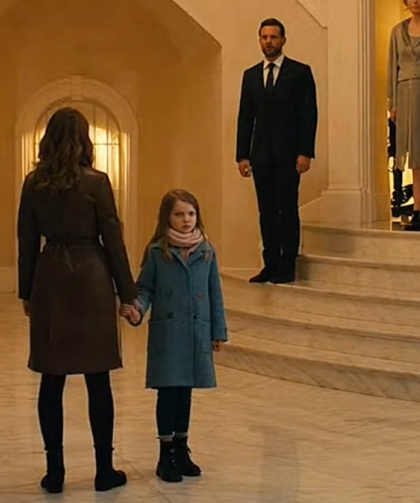
They came downstairs at seven.
The foyer was lit completely. Someone had tested the full chandelier for an upcoming event and left it on. The effect was operatic — too bright, too golden.
Ruth was in the sitting room doorway. She’d been there when Claire came down the stairs with the suitcase and hadn’t moved.
Daniel came down the stairs at seven-fifteen. He’d changed into a jacket and slacks. Claire understood: he’d needed to do something with his hands during the last two hours, and dressing had been the thing.
He stood on the second step and looked at her.
He said: “Claire.”
She said: “It’s all right.”
He said: “No.” And then nothing else.
Victoria came down at seven-thirty with the composed grace of a woman who has decided the correct posture for this moment and is executing it. She stood behind Daniel. She put a hand briefly on his arm.
The taxi came at seven-fifty. Its headlights swept across the sidelights flanking the front door.
Claire put her hand on her suitcase handle.
Nora, who had been standing beside her for fifty minutes holding two of her fingers, tightened her grip.
Claire looked down at her.
Nora looked up.
In her eyes: everything. All four years of it. The floor-reading and the nightmares and the breakfast table and the garden and the drawings and the stones and the feathers and Bunny and the thousand nights of I’m here, you’re safe, I’m not leaving.
I’m not leaving.
Claire thought it. She closed her eyes for one second and opened them and reached down and began to gently uncurl Nora’s fingers from hers.
Nora let go.
And said: “You lied.”
Barely audible. But in the marble foyer with the chandelier overhead and the snow falling silent outside, barely audible was more than enough.
Daniel’s head came up. His whole body went rigid. He stared at his daughter.
Victoria’s hand dropped from his arm.
Ruth made a sound — just a breath, involuntary.
Nora was looking at Claire. Her voice had been stored for four years and it showed — rough-edged, uncertain of itself. But the words had been clear. Aimed.
“Nora,” Claire said. Her own voice was doing something unsteady.
Nora’s eyes didn’t waver. Her face said: you told me every day without words that you were always going to be here. You told me with every day you came back. You lied.
“I know,” Claire said. “I know. I’m so sorry.”
“Don’t go.”
Two more words. Daniel made a sound in his chest.
Claire’s throat closed entirely. She crouched down, right there in the marble foyer, coat and all, and put both hands on Nora’s face.
“Listen to me,” she said, and her voice broke on the second word and she kept going. “You are the best thing I have ever been trusted with. Do you understand me? The absolute best. And I would stay if I could. I would stay forever if I could.”
“Then stay.” Firm. Clear. Not a question.
Claire closed her eyes. She pressed her forehead to Nora’s.
Behind her, she heard the taxi driver knock on the front door. She heard Daniel cross the foyer and open it and say, “Give us a few minutes,” and close it again.
She pulled back from Nora. She started to stand up.
Nora walked outside.
The front door was open and in the gap, snow was falling. The porch light was on. Beyond it: darkness and white.
Nora walked through the open door onto the porch, in her star pajamas and bare feet, and stood in the snow.
Claire was moving before she’d consciously decided to. She came through the front door onto the porch and the cold hit her and she stopped.
Nora stood three steps down from the porch, in the snow, in her bare feet, looking up at the sky. The flakes fell on her face and her hair and her pajamas, and she stood there and let them.
“Nora,” Claire said. “Come inside. You’re not wearing shoes.”
Nora looked at her.
In the foyer behind Claire, she heard footsteps — Daniel, and then Ruth’s slower ones.
Nora opened her mouth.
The word she said next was the size of the whole house, the whole cold dark, the whole four years.
“Mama.”
The silence lasted four seconds.
Daniel, behind Claire, said: “What did she just—” and then stopped.
Claire turned toward him. His face was doing something she had never seen on it. Something that cracked straight down the middle of the composure he’d been maintaining since his wife died.
“She said it before,” Claire said. “Upstairs. Earlier. When she found the suitcase.” She looked at him steadily. “The first word was liar, Daniel. About me leaving.”
He looked at his daughter standing in the snow.
He took one step through the front door. Then another.
“Nora,” he said.
Nora looked at him. Snow in her hair. Bare feet in three inches of white. Her face held no particular expression — just the directness she’d always had, the ancient directness of a child who has decided to stop pretending.
“Come here,” Daniel said, his voice wrecked.
Nora didn’t move.
Daniel crossed the porch and went down the steps and picked his daughter up out of the snow, all of her, lifted her completely. He held her against him with both arms. She let him. She put her face against his neck.
Claire stood on the porch. She was crying. She hadn’t known she was going to and now there was no stopping it. She wiped her face with the back of her hand.
She looked at the taxi in the drive. She thought: six steps.
She heard Victoria in the doorway behind her say, quietly: “Daniel—”
Ruth’s voice, dry and absolute, cut her off: “Don’t.”
Daniel carried Nora back inside.
He set her down on the foyer floor and crouched to her height — he was a tall man and crouching didn’t come naturally. He held Nora’s face in both hands and looked at his daughter with his whole face open for the first time in years.
“Can you say it again?” he said.
Nora looked at him. Something passed through her expression — a calculation, an assessment. Then she looked past him at Claire.
“Mama’s staying,” she said.
Three words. Clear as a bell.
Victoria made a sound in the doorway. It was not a word.
Daniel stood up slowly. He was a tall man. He took a breath. He turned and looked at Victoria.
“Daniel,” Victoria said, her voice precise and low. “Think about this clearly.”
“I’m thinking clearly for the first time in six months,” he said.
“This is—”
“Victoria.” He said her name once, quietly. “Not now.”
She looked at him for a long moment with the look of a woman recalculating. Then she said, “I see,” in the tone of a verdict, and walked back up the stairs.
Nobody stopped her.
The foyer was quieter when she’d gone.
Ruth exhaled. She sounded like a woman who has been holding a breath for quite some time.
Daniel looked at Claire. He looked at her the way he’d been not looking at her for six months — directly, without the mediation of practicality or professional courtesy.
“Stay,” he said. “Tonight. I need to think. I need to make some calls. Just — stay tonight.”
Claire looked at Nora, who was looking up at her waiting to see what the adults were going to do.
“All right,” Claire said.
Nora slid her hand back into Claire’s fingers.
Victoria left an hour later.
Claire didn’t see her go. She was in the kitchen making Nora a cup of warm milk with honey — the nighttime cup, the routine, same as always — when she heard heels on the marble and then the front door and then silence.
Ruth came into the kitchen and sat down at the table.
“Tea?” Claire said.
“Please.”
Claire made tea. She set it in front of Ruth and leaned against the counter.
Ruth wrapped both hands around the mug. “I should have said something more clearly,” she said. “Three weeks ago. I said things to Daniel, but I should have been louder.”
“You couldn’t have known what would happen.”
“I knew what needed to happen.” She sipped her tea. “My son is not a stupid man. He is a man who was trying very hard to believe he could have something simple and found a way to make himself believe it at the expense of something complicated and true.”
Elisa— Claire was quiet.
“He loves her,” Ruth said. “He loves both of them.” She looked up over the mug. “He doesn’t know how to say that. He has never learned how to say things in time.”
“I know,” Claire said.
“Do you?”
Claire looked at the window. The garden lay outside in the dark, white and still.
“I think so,” she said.
Nora was asleep before nine.
She fell asleep holding Bunny, curled on her side, her breathing deep and even and utterly untroubled. Claire sat beside her bed until she was sure, then stood up and looked at her for a long moment in the dark.
All the things she’d been going to say to herself about Connecticut and the new family and professional distance felt very distant.
She turned off the light and left the door open two inches, which was how Nora had always liked it.
Daniel was in his study when she came downstairs.
She knocked on the open door. He looked up from his desk, where his phone and a legal pad sat in front of him.
“She’s asleep,” Claire said.
“Good.” He rubbed his face. “Come in.”
She sat in the chair across from his desk — the chair she’d sat in for a hundred practical conversations over four years.
“I called my lawyer,” Daniel said. He looked at the legal pad. “I want to understand what it would take — legally — to formalize your role here.”
Claire looked at him. “Formalize it how?”
“As her guardian. Or—” He stopped. He picked up his pen and put it down. “The lawyer is going to give me options. I don’t know the vocabulary yet.”
“Daniel,” Claire said.
He looked at her.
“Before we talk about legal vocabulary,” she said carefully, “I need to understand what’s changed for you tonight. Because I need to know it’s not just reactionary. I need to know you’ve thought about what you actually want.”
He held her gaze. It cost him something.
“I want my daughter to stop being afraid I’m going to take away the only person who’s made her feel safe.”
“She’s not afraid of that anymore. She proved that tonight.”
“She shouldn’t have had to prove it.” His voice went rough. “I should have said something three weeks ago. I should have said something six months ago.”
“You should have,” Claire agreed. Not unkindly. Directly.
He looked at the legal pad. “I know.”
“So this isn’t about what happened tonight,” Claire said. “This is about what you actually believe.”
“I believe,” he said slowly, “that Nora called you mama tonight. And that she’s been calling you that for years without a word.”
The room was very quiet.
“And I believe I have been afraid of what that means,” he went on. “Afraid it meant something about Kate, about replacing her. But Nora didn’t call you mama instead of her mother. She called you mama because you’re the one who showed up.”
Claire waited.
“Every single morning,” he said. “For four years. You showed up.”
“That’s the job,” Claire said.
“No.” He looked at her. “It’s not. And you know it’s not.”
She looked at the window. Snow on the garden. Still world.
“What does your lawyer say the options are?” she said.
“He says formal guardianship can be shared. In cases where there’s an existing bond and the biological parent is living and involved but wants to recognize a non-biological caregiver’s role legally.” He looked up. “He’s drafting a framework for me to look at tomorrow.”
Claire said nothing. She held the silence the way Nora had taught her.
“I want to do this right,” Daniel said. “I’m not going to do it badly again.”
She looked at him. She believed him.
“Okay,” she said.
The documents took three weeks.
Daniel’s lawyer drafted a joint guardianship agreement that Claire signed on a Tuesday afternoon in a downtown Hartford conference room, with Ruth as witness.
Ruth put a photograph of Claire and Nora in a frame and set it on the mantle in the sitting room, next to Kate’s portrait. She did it on a Saturday while Daniel was at work and didn’t mention it when he came home. He saw it at dinner. He looked at it for a moment and said nothing. The photograph stayed.
Nora began speech therapy. Not for the first time — she’d had years of unsuccessful speech therapy. But this was different, because Nora now appeared to want to speak.
She was deliberate about it the way she was deliberate about everything: purposeful, incremental, choosing each word like something valuable.
She said “Claire” in week two of therapy, clearly and completely. Her therapist, a calm woman named Dr. Walsh who’d been working with selectively mute children for fifteen years, said she’d never seen a child make that particular leap so quickly.
“She’s been ready for a while,” Dr. Walsh said, in a session debrief with both Claire and Daniel. “She was waiting to be sure it was safe.”
“Safe from what?” Daniel asked.
Dr. Walsh looked at him steadily. “From another loss.”
The night the documents were signed, Claire went upstairs at nine to check on Nora.
Nora was awake. She was sitting up in bed with Bunny in her lap, in her star pajamas, looking at the door.
Claire sat on the edge of the bed.
Nora looked at her with Kate’s eyes, which were also Nora’s eyes, which were also their own eyes by now — she’d claimed them through four years of looking.
“The lawyer came today,” Claire said. “Do you know what that means?”
A small, deliberate nod.
“It means that officially, on paper, you have two people looking out for you. Your dad, and me. Both of us. All the time.” She paused. “Is that okay?”
Nora considered this. It was a real consideration — Claire could see her working through it, weighing it.
Then she said: “Good.”
One word. A verdict.
Claire put her arm around her. Nora leaned in. They sat in the dark of the bedroom with Bunny between them and the snow on the garden outside and the chandelier quiet at the bottom of the stairs.
After a while, Nora said, in her new voice — rough-edged and deliberate and completely hers:
“I knew you’d stay.”
Claire looked down at her. “Did you?”
“Yes.” A pause. “I just had to say it out loud.”
Claire pressed her cheek against Nora’s hair. She thought about the foyer. The suitcase. The six steps she hadn’t taken.
“Say it again,” she said softly.
Nora tilted her face up.
“Mama.”
In the grand house at the end of the long road, in the winter-lit dark, the word finally had a home.
Three months later, on Nora’s eighth birthday, she blew out the candles on a yellow cake Claire had made from scratch. She made a wish with her eyes closed and her face completely serious. When she opened them, Daniel said: “What did you wish for?” Nora looked at him. Then she looked at Claire. Then she smiled — her wide, full smile, the one that had been stored for so long — and said: “I’m not telling. It already came true.”