Marcus Cole hadn’t taken a real walk in three years.
Not the kind of walk where you look at things. Not the kind where the city gets in.
His walks were transit — point A to point B, phone in hand, mind already in the meeting.
But that Tuesday morning, something made him leave the phone on the nightstand.
Maybe it was the season. October in New York had a way of demanding attention, the trees doing something theatrical with color along every block of Central Park’s perimeter, the air sharp and clean in a way that the other three seasons never quite managed.
He buttoned his coat and went outside.
He told his assistant he’d be an hour.
He walked north along Fifth Avenue, past the museum, past the hot dog cart that had been in the same spot since at least the nineties, past the tourists with their cameras pointed at everything.
He was almost past the park entrance when he saw the bench.
He almost didn’t stop.
Later, he would turn this moment over and over — the moment he almost didn’t stop — and feel something he couldn’t name, something large and hinge-like, as though the entire architecture of whatever came next depended on whether a man who hadn’t taken a real walk in three years happened to glance left at the right instant.
He glanced left.
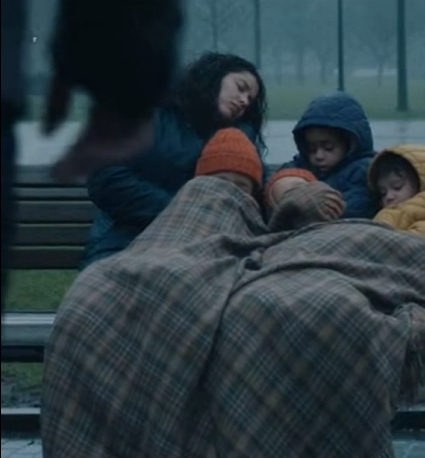
The bench sat back from the path, partly in shadow under the elm trees. The morning light came through the leaves in pieces, scattered and intermittent, and it moved across the bench and the woman on it and the four children sleeping around her.
Marcus stopped.
He stood on the pavement and looked.
His brain ran its first pass and came back with homeless woman, four children, note to self, donate to shelter.
His brain ran its second pass and came back with something that wasn’t an assessment.
Something that was a name.
Rachel.
He knew her from across the park the way you know the melody of a song before you can remember the title — recognition without words first, something older than language kicking in before he’d consciously processed a single feature.
But the features followed.
The line of her jaw. The particular way she held her left hand even in sleep, fingers slightly curled. The hair — it was longer than he’d ever seen it, tangled now, spread across the wooden slat she’d made into a pillow.
Rachel Simmons.
His Rachel.
Twenty-eight years old, master’s degree in urban planning, three languages, the sharpest mind he had ever sat across a dinner table from, the best laugh he had ever heard, the woman he had left on an October morning fourteen months ago in a conversation he had engineered to be calm and reasonable and final.
She was on a park bench.
She was on a park bench in Central Park in October with four children.
Four.
Marcus walked forward.
He couldn’t have said whether his legs decided this or his body simply moved without consulting his legs.
He got close enough to see their faces — the children’s faces — and he counted again, needing the second count to confirm the first wasn’t wrong.
One, two, three, four.
The oldest looked about three years old. Dark curly hair. Rachel’s brow, Rachel’s chin. Sleeping with both fists balled up and pressed to his cheeks.
Two girls beside him, close in age, maybe eighteen months, maybe two years — twins, possibly, their sleeping faces so similar it was difficult to separate them.
And the youngest: a baby, four or five months at most, tucked inside a soft carrier strapped to Rachel’s chest, rising and falling with her breathing, face pressed into the warm space below her collarbone.
Marcus looked at the youngest child’s face for a long time.
He looked at his own hands.
He sat down on the edge of the bench very carefully, at Rachel’s feet, and he just sat there for a moment, in the scattered elm-tree light, with the city moving around him and not touching him at all.
Then he said her name.
“Rachel.”
She didn’t wake.
He said it again, louder.
“Rachel.”
Her eyes opened.
Fast — the kind of fast that doesn’t come from rest but from vigilance, from weeks or months of sleeping in places where you had to be ready.
Her arms went around the nearest child before she was fully conscious.
Then she saw him.
And what happened on her face in the first second — before she could arrange it into something guarded — was the most complicated thing Marcus had ever seen on a human face.
It was relief and rage and grief and pride and exhaustion, all of it at once, and it lasted exactly one second before her expression settled into something flat and controlled and very tired.
“Marcus,” she said.
Her voice was even. Low. It gave nothing.
Marcus looked at her — at the coat with the broken zipper he could see now up close, at the newspapers folded under the bench, at the thinness of her face, at the dark circles that weren’t just today’s or this week’s but months of sleeping outside pressed into the skin around her eyes.
“My God,” he said. The words came out rough, stripped of everything he usually wore in public. “Rachel — what happened to you?”
She didn’t answer right away.
She sat up slowly, adjusting the baby in the carrier without disturbing it, pulling the sleeping toddler slightly closer with one arm.
Her eyes were on Marcus’s face.
They were measuring him.
“That’s an interesting question from you,” she said finally.
Her voice was quiet enough that it wouldn’t wake the children.
Marcus swallowed. “Rachel—”
“The answer to your question,” she said, “is you. Partly.” She looked away, across the park. “The rest was just what happens.”
“You have — Rachel, you have four children.”
“I’m aware.”
“Are they—” He stopped. He started again. “Are they mine?”
She looked back at him then.
It was a different look. Still controlled, still guarded, but underneath it something raw and exhausted and done.
“They have your eyes,” she said. “The oldest one especially.”
Marcus looked at the boy with the curled fists.
He had thought it was Rachel’s brow, Rachel’s chin. He hadn’t let himself look at the eyes.
He looked now.
“I didn’t know,” Marcus said.
“I know you didn’t.”
“Why didn’t you—”
“Because,” Rachel said, with a patience that was clearly costing her a great deal, “you made it clear that you were done. You said you needed to focus. You said the relationship was taking energy you didn’t have. You gave me a very clean, very logical explanation for why I didn’t fit into your life.” She paused. “And then I found out I was pregnant.”
Marcus was silent.
“I was two months along when you ended it,” Rachel said. “I didn’t know yet. I found out three weeks later.” Her jaw worked briefly. “I wasn’t going to call you and tell you that you had to come back because I was pregnant. That’s not — that’s not who I am.”
“That was my choice to make,” Marcus said.
“Yes,” Rachel said. “It was. And I made it for you.” She looked down at the baby. “I thought I could do it on my own. I had a job. I had a plan.”
“What happened to the job?”
“The twins,” she said simply. “I had the first one — your son, the one there — at a hospital that nearly destroyed me financially. Then I was pregnant again almost immediately. I don’t know if you remember, but we didn’t exactly — anyway. The twins came at thirty-four weeks. NICU for six weeks. The bills—” She stopped. Breathed. “The bills were the size of a small country’s GDP. I lost the apartment. I lost the job because I couldn’t get childcare for three children under two on no income.”
“And the baby—”
“The baby,” Rachel said, looking down at the small face tucked against her chest, “was an accident. My accident, not yours. I’d already lost the apartment by then. I’d already been trying to figure out the shelter system, which, in case you haven’t looked into it, is — not easy. Not with four children. Not in this city.” She smoothed the baby’s hair with one finger, very gently. “She was born in April. She’s five months old.”
Marcus was quiet for a long time.
Around them, the park moved — joggers, cyclists, a woman with an enormous stroller who gave them a curious glance as she passed.
One of the twins stirred, made a small sound, then settled back into sleep.
“You have no family?” Marcus said.
“My mother passed away two years ago. Before I knew I was pregnant. My brother is in the military, overseas, unreachable.” She paused. “So no. I have no family. I have four children. And I have this bench, which has been mine for five nights now because the shelter I was in asked me to leave for a reason I don’t want to explain to you right now.”
Marcus nodded slowly.
He looked around the park. He looked at the bench. He looked at the newspapers under the bench. He looked at the children.
He looked at Rachel.
He said: “Come home with me.”
Rachel turned and looked at him.
She looked at him for a long time without speaking.
The park moved. A squirrel ran across the path. The baby shifted, made a dream sound, was still.
“No,” Rachel said.
Marcus blinked. “What?”
“No,” she said again, just as calmly. “Not like this.”
“Rachel, you’re on a bench—”
“I know where I am.”
“It’s October. It’s going to rain tonight.”
“I know that too.”
He sat forward. “Then what—”
“I’m not going home with you because you walked past a bench and felt guilty,” Rachel said. “I’m not a charity project, Marcus. I’m not a problem you can solve so you can go back to feeling okay about yourself.”
Marcus opened his mouth.
Closed it.
“If you walk me out of this park and into your building and give me a room and buy things for the children,” Rachel said, “and then in three months or six months or a year you decide again that I’m too much, that we’re too much, that you need to — focus — ” She said the word with a precision that was worse than anger. “If you do that, I will sue you. I want you to understand that clearly and in advance. Not as a threat. As information.”
“I’m not going to—”
“You don’t know that,” she said. “And neither do I. Which is why I need you to understand what you’re signing up for before you try to sign up for it.” She looked at him steadily. “I am not easy right now. My children are not easy. The oldest has nightmares. The twins are in the phase where everything is a question. The baby doesn’t sleep more than three hours without waking.” She paused. “I am exhausted in a way that I don’t think you have a reference point for. I am angry in a way that I’ve been managing for fourteen months and haven’t fully processed.”
Marcus listened.
“I am also,” Rachel said, “completely out of options. Which means that if you offer me something real, I’m going to take it. Not because I want to need you. But because my children need to sleep inside and eat properly and not spend their first years on this bench.”
Marcus was very still.
“So before you say come home with me again,” Rachel said, “I need you to tell me what that means. What you actually mean. Because I won’t move these children twice.”
Marcus looked at her.
He thought about what he was about to say.
He thought about how he usually spoke — measured, efficient, designed to close.
He decided to not do that.
“I looked at you on this bench,” he said slowly, “and I thought about the morning I left. And I thought about all the mornings after that where I didn’t pick up the phone. And I know that I can’t undo any of that.” He met her eyes. “What I can tell you is that I walked past the phone this morning for the first time in three years. That I was already thinking about you before I saw you. That the sight of that boy — my son — sleeping on a park bench is something I will not be able to survive being responsible for if I don’t do something about it right now.”
Rachel was watching him.
“I’m not asking you to trust me,” Marcus said. “I’m not asking you to forgive me. I’m asking you to let me take you somewhere warm today.”
A long pause.
“And tomorrow?” Rachel said.
“And tomorrow I’d like to try to be someone who deserves to know your children,” Marcus said.
The baby woke then, quietly, opening eyes that were Marcus’s exact shade of dark brown and looking up at her mother, then at Marcus, with the serene, uncomplicated gaze of someone meeting the world for the first time.
Rachel looked at the baby.
Marcus looked at the baby.
“Her name is Grace,” Rachel said quietly. “Your son is Eli. The twins are Mara and June.”
Marcus nodded.
He waited.
“Okay,” Rachel said. “Today.”
Getting four children off a bench and moving through Central Park was not fast.
Eli had to be woken — he did not want to wake, he made this clear through a noise that several nearby pigeons took offense to — and the twins had to be untangled from each other, and Grace had to be resettled in the carrier, and Rachel had to gather everything from beneath the bench with an efficiency that Marcus watched silently, not helping yet because she hadn’t asked yet.
When she had packed the bags — one backpack, one canvas tote, one child’s backpack sized for a toddler — she straightened up and adjusted the baby and looked at Marcus.
“You can take the tote,” she said.
He took it.
They walked.
Eli walked between them, holding Rachel’s hand, looking up at Marcus with the frank, unguarded assessment of a three-year-old.
“Who is you?” Eli said.
Marcus glanced at Rachel.
“This is Marcus,” Rachel said carefully. “He’s a friend.”
“A friend,” Eli repeated, with the particular intonation that children use when they’re filing information away for later retrieval.
“Yeah,” Marcus said. “A friend.”
Eli seemed to accept this. He went back to examining the pavement.
They reached Fifth Avenue.
Marcus flagged a cab — then reconsidered, pulled out his phone, called a car.
“I have a place on the Upper East Side,” he said while they waited. “Three bedrooms. The third one—” He paused. “I’ll get beds today. Whatever you need.”
Rachel nodded.
She was watching Eli examine a crack in the sidewalk with the intensity of a scientist.
“He’s smart,” Marcus said.
“He’s three,” Rachel said.
“So yes.”
Something shifted slightly at the corner of her mouth. It wasn’t a smile. But it was the edge of one.
The car arrived.
The apartment was on the fourteenth floor, with windows that ran floor to ceiling on the park side, and the light that came through them on an October morning was the kind of light that costs money — not because the light itself costs anything, but because the view of it, unobstructed, the park spread below in full autumn color, was the kind of thing that a Manhattan real estate listing justified with a price that contained more digits than most people’s annual salary.
Rachel stood at the window with Grace in the carrier.
She stood there for a while without saying anything.
Marcus stood back and watched.
Eli ran directly to the couch, examined it with both hands as though conducting a structural assessment, and then climbed onto it and stood up.
“Eli,” Rachel said, without turning from the window.
Eli sat down.
The twins — Mara and June — stood in the entryway, holding hands, observing the apartment with an identical expression of cautious assessment.
“You can come in,” Marcus said to them.
They did not move.
“They’re shy,” Rachel said, still at the window. Then, a beat later: “This is a very nice view.”
“I know,” Marcus said.
“I used to see apartments like this from the street,” Rachel said. “In the last few months. I’d look up at the lit windows and think about what was inside them.”
Marcus didn’t say anything.
“I’m not saying that to make you feel bad,” Rachel said, turning from the window. “I’m saying it because I want you to understand what this looks like from where I’m standing.”
“I understand,” Marcus said.
“You don’t,” Rachel said, without heat. “But I think you’re trying to. Which is something.”
She looked around the apartment.
“I need to clean them up,” she said, practical now, moving into the mode that he would come to recognize as her default — the mode of a woman who had been managing impossible logistics for over a year and whose competence was so thoroughly developed it ran even when she was running on empty.
“There’s a bathroom down the hall,” Marcus said. “I’ll get towels.”
“Do you have food?”
“I’ll get food.”
“The twins eat everything. Eli doesn’t eat anything yellow. Grace is still mostly nursing but she needs—” She stopped. “You don’t need all of this right now.”
“I do need all of this right now,” Marcus said. “Tell me what Grace needs.”
A pause.
“Oatmeal. The plain kind. And there’s a specific formula—” She reached into the backpack and handed him a photo she’d taken of the can on her phone. “This kind. The pediatrician said—” She stopped again. “She had a pediatrician. Before.”
“She’ll have one again,” Marcus said.
Rachel looked at him.
She looked at him the way she’d looked at him on the bench — measuring, careful.
“I’ll call a service,” Marcus said. “Today. Whatever they need.”
Rachel nodded.
She picked up June — one twin, who had finally decided the apartment was acceptable — and carried her toward the bathroom.
“Marcus,” she said, pausing in the hallway.
He looked up.
“Don’t make promises you won’t keep,” she said. “I know where to find lawyers.”
“You mentioned,” he said.
“I’m serious.”
“I know you are.”
She went down the hall.
Marcus stood in the living room for a moment, looking at Eli on the couch and Mara in the entryway and the light coming through the windows and the city below, and he took out his phone and called his assistant.
“Clear the afternoon,” he said.
“The Morgan meeting—”
“Reschedule it.”
“The Morgan meeting has been rescheduled three—”
“Reschedule it again,” Marcus said. “I’ll explain later.” He paused. “I need a pediatrician who does house calls and someone to set up three beds in the spare room by tonight and groceries. Full groceries. Whatever a family needs.”
A beat on the other end.
“Full groceries,” his assistant repeated.
“Full groceries,” Marcus confirmed. “And a car. Child seats. As many as needed.”
He ended the call.
He sat down on the couch next to Eli.
Eli looked at him.
“Are you staying?” Eli said.
Marcus thought about the question. He thought about all the ways he would have answered it in the past — all the carefully hedged, technically accurate, non-committal answers that were designed to keep options open.
“Yeah,” he said. “I’m staying.”
Eli nodded, apparently satisfied, and turned back to examining the couch cushion.
Three days later, Rachel came downstairs from a shower — a full shower, uninterrupted, the first one in months — and found a man in a suit sitting at Marcus’s kitchen table.
She stopped in the hallway.
Marcus was across from him. Both men looked up.
“Rachel,” Marcus said, standing. “This is David Chen. He’s a family attorney.”
Rachel looked at the attorney.
She looked at Marcus.
“I’m not here to discuss anything adversarial,” the attorney said. He had the practiced calm of someone who spent his professional life in rooms with high tension. “Mr. Cole asked me to come because he thought it might be useful for you to have independent legal counsel present for a conversation we’re going to have.”
“What conversation?” Rachel said.
“About financial support for the children,” Marcus said. “And about what I’d like to do going forward. I wanted you to have someone here who represents you, not me. So that everything is on the table and you can hear it from someone you can trust.”
Rachel looked at him for a long moment.
“David represents me?” she said.
“He does,” Marcus said.
“You’re paying him?”
“Yes.”
“That seems like a conflict—”
“I’ve waived any claim on his advice,” the attorney said. “I’m here for you, Ms. Simmons. Anything you tell me is protected. If you want me to leave the room while you two speak, I will. If you want to speak privately, I’ll speak privately. You’re the client.”
Rachel came to the table.
She sat down.
She looked at Marcus.
“Okay,” she said. “Talk.”
Marcus talked.
He had been up the night before working on it — working on the actual substance of what he wanted to do, not the version that sounded good but the version that was real and had numbers attached and could be held to.
He talked about setting up a trust for each of the children. Education, healthcare, housing — actual numbers, not gestures.
He talked about what he wanted to do about the living situation — not stay here until I feel like leaving but an actual, legally structured arrangement with Rachel’s name on it and her ability to stay with the children protected regardless of what happened between the two of them.
He talked about child support at a level that his attorney — his own attorney, who had helped draft the proposal — had described as “significantly above the maximum that any court would impose.”
He talked about health insurance, effective immediately.
He talked about Rachel going back to school or returning to work if she wanted to, with childcare covered so that she could do either, and he talked about it as Rachel’s choice, not his provision.
He talked for about twenty minutes.
When he was done, Rachel’s attorney looked at Rachel.
Rachel looked at the table for a moment.
“Why?” she said.
Marcus waited.
“Why all of this,” she said. “Why not just — send a check. Sign papers. Why this?”
“Because a check is how I would have handled it a year ago,” Marcus said.
“And now?”
“Now I know I have a son,” Marcus said. “And I know I have daughters. And I know that I’m the reason their mother slept on a park bench.” He paused. “You don’t have to trust me. But I would like the chance to — be present for this. Not from a distance. Here.”
Rachel was very still.
“And us?” she said.
Marcus met her eyes.
“I don’t know,” he said honestly. “I don’t think you should trust me yet. I think I need to earn that. I’m asking for the chance to try.” He paused. “What I know is that I sat next to you on that bench three days ago and I haven’t stopped thinking about it since. And what I’m asking — the only thing I’m asking today — is to be here.”
Rachel looked at her attorney.
The attorney gave her a small, professional nod that said the documents are real, the numbers are real, this is as much legal protection as a person can have.
Rachel looked back at Marcus.
“If you leave,” she said, “I’m not going to be okay about it. I want you to understand that. Not because of me. Because of Eli.” She paused. “He already asked me this morning if you live here.”
Marcus swallowed.
“What did you tell him?”
“I told him to ask you himself.”
A beat of silence.
“Rachel,” Marcus said.
“What.”
“I’m not leaving.”
She looked at him for a long time.
“Okay,” she said finally. “Then let’s see.”
That evening, Marcus was on the living room floor.
He was on the floor because Eli had wanted to show him something — a very specific arrangement of couch cushions that, apparently, constituted a fort — and Marcus had sat down to observe and Eli had pulled him all the way down.
So Marcus was on the floor, inside the cushion fort, having a conversation with a three-year-old about whether dragons were real, a topic Eli had strong opinions on.
“They’re real,” Eli said firmly.
“How do you know?” Marcus said.
“Mama read me.”
“Your mom read you about dragons?”
“She reads me every night,” Eli said, with the emphasis of someone who needed Marcus to understand the magnitude of this. “Every. Single. Night. Even on the bench.”
Marcus was quiet for a moment.
“Even on the bench,” he repeated.
“She had a flashlight,” Eli said matter-of-factly. “A little one. On her keychain.”
Marcus looked at the ceiling of the fort.
“Your mom is pretty amazing,” he said.
“I know,” Eli said.
A pause.
“Marcus,” Eli said.
“Yeah.”
“Do you live here?”
Marcus sat up slightly.
He looked at this boy — his son, three years old, who had his grandmother’s widow’s peak and Rachel’s chin and was looking at him with the completely undefended, completely present gaze of someone who had not yet learned to ask questions with any protection built in.
“Yes,” Marcus said. “I live here.”
Eli nodded.
He seemed to process this.
“Okay,” he said. “You can be in the fort.”
Marcus lay back down.
“Thanks,” he said.
“You’re welcome,” Eli said, and handed him a dinosaur.
From the hallway, Rachel stood and watched the two of them in the cushion fort.
She stood there for a minute.
Then she went to the kitchen and started making dinner, and for the first time in fourteen months, she was making dinner for more people than she needed to count on one hand, and there was enough food, and the lights were on, and the baby was sleeping in the next room, and the sound coming from the living room was the sound of her son showing someone a dinosaur.
She stood at the stove.
She let herself feel it — the enormity of it, the grief inside it, the anger that hadn’t gone anywhere and would probably need to go somewhere eventually, and also, underneath all of that, quiet and stubborn, something that felt like the beginning of possibility.
She was angry at Marcus Cole.
She was going to stay angry at Marcus Cole for a while, because the anger was correct and had been earned.
But she was also making dinner.
And the lights were on.
And Grace was sleeping.
And from the living room, she could hear her son explaining the structural integrity of the fort.
Rachel took a breath.
She picked up the wooden spoon.
And she kept cooking.
Six weeks later, Rachel came to Marcus’s home office at eleven at night.
She knocked.
“Come in,” he said.
She was in the doorway. The baby was asleep. The children were asleep. The apartment was quiet.
“I need to say something to you,” she said.
Marcus closed the laptop.
He waited.
“I’ve been angry at you for a year and a half,” Rachel said. “Not performed angry. Actually angry. The kind that sits in your chest and makes everything harder.”
“I know,” Marcus said.
“I don’t need you to apologize again,” she said. “You’ve apologized. I’ve heard it.” She looked at him. “What I need you to understand is that I chose to come here. Not because I had no options — I will always find options, I am not someone who has no options — but because I thought this might be worth trying.”
Marcus nodded.
“And I’m telling you this,” Rachel said, “because I don’t want there to be a version of this where you think I’m here because you rescued me. I’m here because I decided to give you a second chance. Those are different things.”
“They are,” Marcus said.
“Good,” Rachel said. “As long as we’re clear.”
She started to go.
“Rachel,” Marcus said.
She paused in the doorway.
“Thank you,” he said.
She looked back at him.
“For what.”
“For deciding,” he said simply.
A pause.
“Don’t make me regret it,” she said.
“I won’t,” Marcus said.
She went to bed.
Marcus sat in the office for a while after, in the dark, with the city outside the window and the quiet of four sleeping children in the next hallway over.
Then he opened a blank document and started typing.
He typed: Things I am going to do differently.
He filled the page.
Then he opened a new tab and looked up pediatric specialists and school enrollment and the process for amending a birth certificate and everything else he should have already known and was only now learning.
He was there until two in the morning.
He was there at two in the morning because, for the first time in a very long time, being somewhere — this somewhere — was the only place he wanted to be.
Epilogue: One Year Later
The birthday party was in the park.
Not because they had to be in the park. Because Eli had requested the park specifically, on the grounds that the fort they’d built there out of branches last spring was “still there and needs to be checked.”
Marcus had checked it. It was, structurally, still present.
So they were in Central Park, on a Saturday in October, with a small group of Eli’s nursery school friends and their parents and a cake that Mara had helped decorate by pressing every available piece of candy into the frosting with aggressive enthusiasm.
Grace, now one year and change, was sitting on a blanket tearing grass and examining each piece with the focused intensity of a researcher.
June was asleep against Rachel’s shoulder.
Eli was running.
Marcus was watching Eli run.
Rachel appeared beside him, holding two cups of coffee.
She handed him one.
He took it.
They stood together watching Eli try to lead three other four-year-olds in a game that had rules only Eli fully understood.
“He’s got your drive,” Rachel said.
“He’s got your stubbornness,” Marcus said.
“Those are the same thing,” Rachel said.
He smiled.
She smiled back.
It wasn’t easy between them, not always. There were nights when old anger surfaced and had to be dealt with honestly. There were conversations that were hard and long. There was the lawyer’s number still in Rachel’s phone, not as a threat, but as a fact — I will not be left without recourse — and Marcus had never once asked her to delete it.
He understood now what she’d been telling him on the bench.
This wasn’t a rescue. It was a choice she’d made, and kept making, and he was in the ongoing process of becoming someone who deserved it.
It was the most important work he had ever done.
It was harder than anything he had ever built.
It was, without question, the thing he was most proud of.
Grace threw a piece of grass in the air and watched it fall with an expression of complete scientific satisfaction.
“Grace,” Rachel said.
Grace looked up.
“What is she doing?” Marcus said.
“Experiments,” Rachel said. “She’s been doing this for twenty minutes.”
Marcus crouched down next to Grace.
He picked up a piece of grass.
He threw it in the air and watched it fall.
Grace observed this and then, with great deliberateness, threw another piece of grass.
“That’s your daughter,” Rachel said.
“Our daughter,” Marcus said.
A pause.
He heard it — the slight catch in it, the weight of those two small words.
Rachel heard it too.
She looked down at Grace.
“Our daughter,” she said quietly.
Eli came running back, panting, and threw himself at Marcus’s legs.
“Fort check,” he announced breathlessly. “Fort is structurally compromised.”
“That’s a big word,” Marcus said.
“Mama taught me.”
“Of course she did,” Marcus said, and looked up at Rachel.
She was looking at him with the same evaluating look she’d had on the bench a year ago — measuring, precise, giving nothing away easily.
But behind it, now, was something else.
Something that had grown slowly and carefully over twelve months of hard, honest work.
Something that looked a lot like trust.
“Happy birthday, Eli,” Marcus said.
“It’s not my birthday yet,” Eli said. “It’s practice.”
“Practice,” Marcus repeated.
“Mama says every good thing needs practice.”
Marcus laughed.
He looked at Rachel.
She raised her coffee cup slightly — a small, private gesture.
He raised his.
And in Central Park, on an October afternoon, in the same season that had started all of it, the four children and the two adults who were figuring out what it meant to be a family occupied a blanket and a birthday cake and an already-compromised fort, and the city moved around them without touching them at all.