A Story About Debts, Daughters, and the Long Arm of Consequence
The cream dress cost twelve dollars on a clearance rack in October and meant considerably more than that.
Maya Reeves had worn it once to try it on, hung it on her closet door, and looked at it every morning for eight months as a reminder of why she was getting up at 5 AM to study organic chemistry in a dorm room the size of a walk-in closet.
Tonight she wore it for real.
Pearce University’s graduation ceremony had ended at four in the afternoon. The party at Sigma Epsilon had started at seven. Maya arrived at eight, alone, knowing maybe four people in attendance, and spent the first forty minutes convincing herself she had a right to be there.
She did. She had earned it. That was the whole point.
The Sigma house pool area was strung with lights and loud with music, and the particular cruelty of the evening hadn’t started yet — it was still just a party, still just the last night of a version of her life that was ending, and Maya allowed herself to stand at the pool’s edge and feel something close to peace.
She had her sparkling cider. She had her dress. She had graduated magna cum laude with a degree in biochemistry from a university that had almost not accepted her and had definitely not made it easy.
She had her father, nine days out of Leavenworth, who had called her this morning and said, I’m proud of you, Maya-bug, in a voice that sounded like something had cracked open in him.
She had everything.
She didn’t feel Tyler Calloway come up behind her.
That was the thing she would remember, later. Not the push itself — the push was quick and mechanical and almost impersonal. What she would remember was not feeling him coming. How she’d had no warning. How one moment she was standing on solid ground and the next the ground was gone and the cold was enormous.
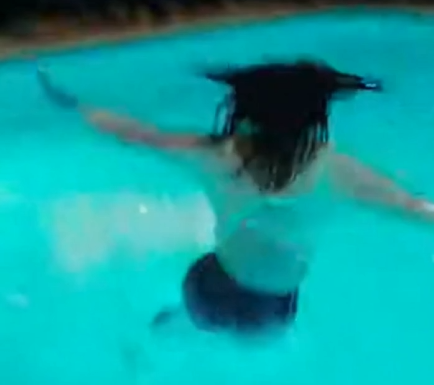
She hit the water flat. The dress went heavy immediately, dragging her down, and she sank two feet before her feet found the bottom and she pushed up hard.
She came up gasping.
And heard the laughter.
It hit her before she’d even cleared the water from her eyes — full, bright, immediate laughter, the kind that had clearly been primed and waiting. She blinked and saw the phones. Rows of them. Blue-lit rectangles held up in a wall around the pool, all pointed at her.
“OH MY GOD!” Brittany Calloway was shrieking somewhere to Maya’s left, the laughter so strong it had become structural, holding her up. “DID YOU SEE HER FACE?”
Maya grabbed the pool ladder.
Tyler Calloway stood at the edge three feet from her, twenty-dollar bill already folded between his fingers, shaking Jake Henderson’s hand. Still laughing. Still recording.
“Pay up, bro,” he said. “Said I’d do it in ten minutes. Took me eight.”
Maya pulled herself up rung by rung. Her dress was heavy as a second body. Her carefully straightened hair was flat and dripping. Her mascara was — she could feel it — running in two black lines down her face.
She got to the top and stood.
She was shaking. Not from cold — or not only from cold. From the particular physical effort of keeping herself contained when everything in her wanted to come apart.
Someone threw a towel at her feet. Not handed. Threw.
She looked at it for one moment. Then she bent down, picked it up, and wrapped it around her shoulders.
She would not cry. Not here. Not in front of them.
“Careful,” Tyler said pleasantly, pocketing the twenty. “Pool deck’s slippery.”
The crowd around him lost it again.
Maya looked at Tyler Calloway’s face and memorized it. The jaw. The smirk. The specific confidence of a man who had never been told no by anyone who could make it stick.
She looked at it and she said nothing.
She was still holding herself together, towel around her shoulders, when the music stopped.
Not faded. Stopped. Like a cut, surgical and complete.
The DJ — a senior named Marcus who had been playing this party for three years — stood frozen with his headphones around his neck, staring at the gate.
Everyone turned.
The gate was heavy iron, set into the brick wall at the far side of the yard. It opened inward. It opened now, slowly, pushed from outside.
They came in single file.
Eight of them. Leather vests with patches. Boots that hit the concrete like they meant it. The kind of group that didn’t hurry because they had never needed to hurry, because things arranged themselves around their arrival without being asked.
The man at the front was the reason for the arrangement.
Ray Donovan was six-foot-three, two hundred and forty pounds, bald as a stone, with a gray beard that had been growing since before most of these kids were born. His forearms, resting at his sides, were covered in thirty years of ink. He wore a leather cut that had been on his back through more situations than could be inventoried.
He walked into the Sigma Epsilon yard and the yard became a different kind of place.
He found Maya in four seconds.
He looked at her — the wet dress, the towel, the two black lines of mascara — and something passed through his face that was there and then gone so fast that only Maya, who had been reading that face her whole life, caught it.
It was the expression of a man who had been trying, very deliberately, not to be what he was — and had just been given a clear and specific reason to stop trying.
His face went still.
He turned to the crowd.
“I need,” he said, in the voice that carried in absolute silence, “the person who did this to come stand in front of me.”
Nobody moved. Nobody spoke.
His eyes moved across the crowd with the patience of someone who had time. They stopped on Tyler Calloway — specifically, on the twenty-dollar bill that Tyler, against every rational instinct, was still holding.
“Son,” Ray said. “Come here.”
Tyler Calloway did not come.
But he also did not run, because Tyler Calloway had grown up watching his father never run from anything, and the DNA of that was strong.
“I don’t know who you are,” Tyler said, “but this is a private party.”
Someone near him took a visible step away.
Ray Donovan looked at Tyler for a long moment. Then he looked at Maya.
“Did he do it?”
Maya held her father’s gaze. She wanted to say don’t. She wanted to say it’s not worth it, leave it, I’m fine.
She said: “Yes.”
Ray nodded once. He looked back at Tyler.
“You’re going to get in the pool,” Ray said. “Right now.”
Tyler laughed — short, dismissive, the laugh of someone who found the situation absurd. “Excuse me?”
“You pushed my daughter into the pool for twenty dollars,” Ray said. “In front of everyone. While they recorded it.” He paused. “So you’re going to get in the pool. In front of everyone. You’re going to know what that felt like.”
“Man, I don’t know who you think you are—”
“I’m Ray Donovan.” No inflection. No threat in the tone. Just the statement, offered as a fact, the way you might identify a weather system.
Something shifted in the crowd. A few people, clearly, knew the name.
Tyler didn’t, or didn’t know it well enough.
“I’m calling the police,” Tyler said.
“Go ahead,” Ray said. “Call them.”
Tyler pulled out his phone.
And Cutter — the man at Ray’s right shoulder, compact and quiet with a gray-streaked beard and the eyes of someone who catalogued things — said, very quietly: “Before you do that, Tyler. Your dad is Robert Calloway. DA. Right?”
Tyler’s eyes flicked to Cutter. “Yeah. And?”
“Just making sure I have the name right,” Cutter said.
He said it in a way that landed like a question that was actually an answer.
Tyler stared at him. Then he looked at his phone. Then, slowly, he put it in his pocket.
He looked at the pool.
He looked at Ray.
Something in his face was working through a calculation. The twenty people still recording. The man in front of him who had not moved.
He took off his shoes.
He jumped in.
The crowd, to its credit, did not cheer.
There was something about Ray Donovan standing at the pool’s edge watching Tyler Calloway surface and grab the ladder that made cheering feel inadvisable.
Tyler climbed out. He was soaking. His polo shirt was transparent. He stood at the edge of the pool and looked exactly the way he had not imagined he would ever look: small.
Ray looked at him for a moment.
“Now you know,” he said.
He turned and walked to Maya. He stopped in front of her. She was looking up at him with the expression she’d been wearing since she was four years old — the one that meant she had a lot of feelings she was deciding whether to deploy.
“You okay?” he said.
“My dress is ruined,” she said.
“I’ll get you another dress.”
“It was twelve dollars.”
“I’ll get you a twelve-dollar dress.”
She almost smiled. He almost smiled back.
“Let’s go,” he said.
They walked out through the gate. His brothers followed. The crowd parted and closed behind them like water.
Marcus the DJ, after a moment, put his headphones back on and pressed play.
The call came to Ray’s phone at eleven that night.
He was at a diner twelve miles from campus, sitting across from Maya in a booth, watching her eat a plate of pancakes with the focus of someone who hadn’t eaten since morning. She was wearing his leather jacket over the cream dress.
He answered it. A voice he didn’t know said: “Mr. Donovan. My name is Detective Bryce Hartwell. We need to talk.”
“About what.”
“About charges being filed in connection with an incident at Pearce University earlier tonight.”
Ray was quiet.
“Against whom,” he said.
“Against you, sir.”
He looked at Maya, who had looked up from her pancakes.
“Mr. Donovan, the District Attorney is alleging—”
“I know what he’s alleging,” Ray said.
He did. He had known the moment Cutter said Tyler Calloway, son of Robert Calloway, DA that this was coming. He had known it with the specific predictive knowledge of someone who had been through the machinery before and knew how its teeth were shaped.
“I’ll come in tomorrow morning,” he said. “Eight o’clock.”
He hung up.
Maya was looking at him.
“Tell me,” she said.
He told her.
She put down her fork. “Dad—”
“I know.”
“He’s going to try to send you back.”
“I know.”
“This is what he does. His father — this is what they do. They come at you with everything—”
“Maya.” His voice was calm. “Eat your pancakes.”
She stared at him. “How are you calm right now?”
“Because I’ve been planning for Robert Calloway for about four days,” Ray said. “And he doesn’t know that.”
District Attorney Robert Calloway was not a man who was often afraid.
He had been in this office for eleven years. He had prosecuted two hundred and sixty-seven cases. He had a conviction rate that he mentioned at dinner parties. He had the kind of self-assurance that came not from never facing danger but from having faced it and come out on top enough times to stop distinguishing between confidence and certainty.
He was behind his desk at nine on Monday morning when his assistant told him a man named Ray Donovan was in the lobby, asking for fifteen minutes.
Robert leaned back in his chair.
He had filed the charges Sunday evening, fast-tracked through a contact in the night-duty DA’s office. Intimidation. Threatening behavior. Menacing. Enough to pull the parole condition that could send Donovan back to Leavenworth with minimal judicial friction.
Tyler had been fine with that.
Robert had been better than fine with that.
“Send him in,” he said.
Ray Donovan came through the door the way he came through all doors — like he’d agreed to be there and was not in a hurry.
He sat down in the chair across from Robert without being invited.
He put a manila envelope on the desk.
Robert looked at the envelope. He looked at Ray. “Mr. Donovan. You’re here in an official capacity? You have representation?”
“I’m here informally,” Ray said. “I thought we’d talk first.”
“I don’t negotiate with defendants—”
“Open the envelope,” Ray said.
His voice had no particular emphasis. It was the voice of a man who had learned that the most effective delivery was to simply let the information carry itself.
Robert Calloway looked at the envelope for a moment.
He opened it.
Inside were photographs. Documents. A transcript — eleven pages, with specific dates and amounts highlighted in yellow. A copy of a wire transfer record. A deposition from a man named Harold Simms, who had been assistant chief of staff in the DA’s office from 2017 to 2020.
Robert’s face did not change. He was very good at that — at keeping his face from registering things.
But his hands, Ray noticed, went very still on the papers.
“This is—” Robert started.
“Three hundred and forty thousand dollars,” Ray said. “Across nineteen transactions over six years. From four different defendants. Two of them had cases dismissed. One was convicted on reduced charges. One—” he paused “—is currently a city councilman.”
Robert set the papers down carefully.
“Where did you get this,” he said.
“Does it matter?”
“This is— there are legitimate explanations for every one of these—”*
“Harold Simms doesn’t think so,” Ray said. “And Harold Simms has been talking to a reporter at the State Journal for about three weeks. The story runs Wednesday.”
Robert Calloway looked across his desk at Ray Donovan.
Ray Donovan looked back.
“I didn’t come here to threaten you,” Ray said, quietly. “I came here because I’d like those charges dropped today. And I’d like Tyler to be required — formally, through whatever channel you want to use — to issue a public apology to my daughter. Something she can keep. Something that says, on the record, what he did.”
“And if I don’t.”
“Harold Simms talks to the State Journal on Wednesday,” Ray said. “And a separate package goes to the FBI field office on Thursday.”
“You’re blackmailing a district attorney,” Robert said, his voice carefully controlled.
“I’m informing you of a situation,” Ray said. “What you do with that information is up to you.”
He stood. He left the envelope on the desk.
“I’ll expect to hear from your office by four this afternoon,” he said.
He walked out.
Robert Calloway sat at his desk for a long time after Ray Donovan left.
He was not a stupid man. That was the thing — he was genuinely smart, had always been genuinely smart, and he knew that the envelope on his desk was the kind of thing that could not be undone. Harold Simms was real. The records were real. He had been careful for six years, but careful and invisible were different things, and somewhere in the gap between those two words was a manila envelope on his desk on a Monday morning.
He thought about calling his attorney.
He thought about calling his contacts at the state party.
He thought about Tyler, who had called him last night proud of himself for having problems solved, not understanding — never understanding — that his father’s capacity to solve problems was not infinite, was in fact built on a very specific and very fragile architecture that a single well-placed push could—
Robert picked up his phone.
He called the night-duty assistant who had filed the charges.
“Drop them,” he said. “All of them. Today.”
The apology came in the form of a typed letter, on DA letterhead, signed by Tyler Marcus Calloway, on Tuesday afternoon.
It was delivered by a courier to Maya Reeves’ campus address.
She was packing her dorm room when it arrived. She read it standing in the middle of cardboard boxes, still in her pajamas, hair loose.
It was formal. It was stiff. It had clearly been written by a lawyer. It acknowledged the incident. It used the words inappropriate and regrettable and without justification. It was about as warm as a parking citation.
It was, however, in writing.
On DA letterhead.
Signed.
Maya read it twice. Then she folded it carefully and put it in the box labeled IMPORTANT DOCUMENTS, next to her diploma.
She texted her dad: It came.
He texted back: Good.
Then, after a moment: Proud of you, Maya-bug.
She sat down on the floor of her half-packed dorm room and let herself cry — not from sadness, but from the specific, exhausted relief of having held something together for so long that setting it down felt like a physical sensation.
She cried for about three minutes.
Then she got up and kept packing.
Robert Calloway’s arrest was not something Ray had planned.
It was, in the end, Harold Simms’ decision. Harold had been carrying the knowledge of those transactions for years — carrying it with the particular weight of a person who had been complicit and knew it and had decided, at some point in the interim, that he wanted a different relationship with himself.
The story ran in the State Journal on Wednesday anyway, because Harold had already given it to the reporter before Ray walked into Robert’s office, and the reporter was not interested in whatever deal the DA’s office might or might not be trying to make.
The FBI field office received its package on Thursday, as scheduled.
The investigation took four months.
Robert Calloway was indicted on six counts of bribery and two counts of obstruction of justice on a cold October morning. His mug shot — tie slightly loosened, an expression of dignified disbelief — ran on the front page of every regional paper.
Tyler, when reached for comment, said nothing.
Ray Donovan was at a gas station outside Wichita when the news broke, filling up his bike before a three-hour ride.
His phone buzzed. Cutter, sending a screenshot of the headline.
Ray looked at it for a moment. Then he put the phone in his pocket and finished filling the tank.
He had a dinner reservation. Maya was driving up from her new apartment — she’d started a research position at a lab in Kansas City, Monday through Friday, setting her own alarm, doing it herself the way she’d always done it.
She’d asked him to be on time.
He was on time.
They sat across from each other in a booth at a place that served good steaks and terrible coffee, and the coffee was fine because neither of them drank coffee anyway. She told him about the research. He told her about a job he’d taken doing mechanical work for a fleet company outside Topeka, legitimate and steady and boring in a way that felt, after everything, like its own kind of freedom.
She had the folded letter in her bag. She always carried it. She’d told him once, in a text, that it was because it reminded her that things could be set right — that the world had a mechanism for it, even if the mechanism was slow and sometimes required pushing.
He’d understood that.
He’d always understood her.
Over dessert, she said: “I want you to come to my first conference presentation. It’s in March.”
“What’s it about?”
“Protein folding. You won’t understand any of it.”
“I’ll understand the part where you’re presenting.”
She looked at him across the table. That expression — the complicated one, the one that held four years and three years of visiting days and one ruined cream dress and one wet Tyler Calloway climbing out of a pool.
“Dad.”
“Yeah.”
“Thank you.”
Ray Donovan looked at his daughter.
“You didn’t need me,” he said. “You were already standing when I got there.”
She thought about that.
“I know,” she said. “But it helped.”
He nodded. He picked up his fork.
“March,” he said. “I’ll be there.”
Six months later, Robert Calloway was sentenced to four years in federal prison.
Tyler issued no further public statements.
Maya’s research was cited in a paper published in a peer-reviewed journal the following spring.
Ray Donovan made it to March.