Duke Callahan was on the last quarter of his cheeseburger when the girl ran in.
He’d been coming to Ray’s Diner every Tuesday for eleven years. Booth seven. Double cheeseburger, extra pickles. Large cola. Side of onion rings if he felt like it. The routine was load-bearing — one of the small, deliberate structures he’d built his life around after county, after the years that preceded county, after the version of himself that had made county inevitable.
He was forty-eight years old.
He ate alone.
The jukebox was on something slow and steel-guitar-heavy. Deb had just refilled his cola without being asked. The September afternoon light came through the windows at an angle that turned the diner gold.
Duke was watching a truck pull out of the parking lot when he felt the shift.
The door banged open.
He turned.
She was running.
Young — twelve, maybe thirteen. Gray hoodie, ponytail half-destroyed, sneakers squeaking on the linoleum. She scanned the diner in under two seconds, found him, and ran directly at him with a speed and certainty that told him she’d been pointed here by someone.
Nobody ran toward Duke Callahan.
He put his burger down.
She reached his table and stopped and held out her arm without saying a word.
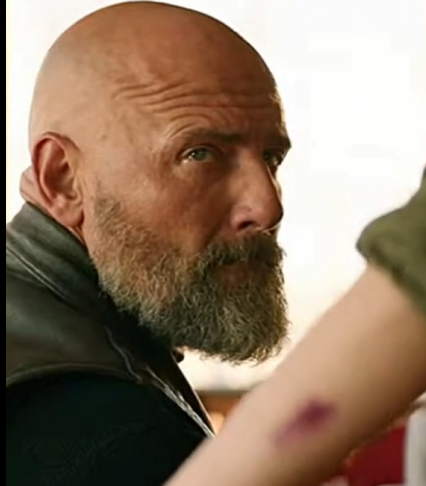
The bruise covered the inside of her forearm from the wrist to the elbow. Dark purple, almost black at the center, sick yellow at the edges. Not an accident. He’d catalogued enough violence in his life to read it the way a doctor reads an X-ray — the shape of the bruise told him grip, both hands, significant force, held not hit.
Someone had restrained this girl.
He looked up at her face.
She was holding herself together with the particular tense composure of someone who made a decision on the way here and is sticking to it no matter what.
“My brother,” she said. “His name is Marcus. He’s nine years old.”
“Sit down,” Duke said.
She sat.
“What’s your name?”
“Lily. Lily Reyes.”
“How long have they had him, Lily?”
She blinked. She’d expected more questions before this one. “Since this morning. Like — nine, nine-thirty.”
Duke looked at the window. Did the math. Four, four and a half hours. His jaw tightened once, then relaxed.
“Who has him.”
“Some boys from Millhaven High. I don’t know all their names.” She reached across the table and pulled a napkin toward herself, twisted it in her fingers. “There’s one called Bryce. He’s like — a junior, I think. He and his friends have been messing with Marcus for a few weeks. Following him. Taking his stuff.” Her voice stayed controlled but her hands betrayed her, wringing the napkin steadily. “Today after school they grabbed him. I saw it happen from a block away. I ran up and tried to pull him back and—” She looked at her arm. “Bryce grabbed me. Told me if I called the police or told anyone he’d hurt Marcus worse.”
“And you came here.”
“Mrs. Carmichael told me to.” A pause. “The librarian on Elm.”
Something shifted in Duke’s expression. Barely perceptible. The corner of his mouth moved. Mrs. Carmichael. Seventy-three years old. Had a cat named Gerald and made Duke take his boots off when he came to return library books. She’d told a twelve-year-old girl to come find him.
He’d been described, apparently, as a resource.
He picked up his phone.
“D,” he said when the call connected. “Where are you right now.”
The voice on the other end said something.
“No. Drop it. I need you at Ray’s.” He paused. “It’s a kid thing.” Another pause. “Yeah. Bring Ronnie.”
He hung up.
He looked at Lily.
“Two of my people are coming. Five minutes.” He put his phone flat on the table. “While we wait, I want you to tell me everything you know about where they have him. The rail yard off Grover — which end? Is there a building? A chain link fence?”
Lily Reyes was twelve years old and she had spent most of her life being told, in a hundred different subtle and unsubtle ways, that people like her didn’t get help.
Not from authorities. Not from systems. Not from institutions.
She’d been raised in a county where that lesson was taught early and reinforced often, and she had absorbed it the way children absorb everything — not as an opinion but as the physical texture of reality.
But Mrs. Carmichael, who was seventy-three and white and had known Duke Callahan since before he was what he was, had sat her down that morning before the school day started and said, quietly, if you’re ever in real trouble, real trouble, you go to Ray’s Diner and you find the man in booth seven.
Mrs. Carmichael did not clarify what kind of trouble qualified as real trouble.
Apparently grabbing qualified.
She answered Duke’s questions precisely and quickly, organizing what she knew into sequence the way her sixth-grade teacher had taught her to organize essay arguments. The rail yard was on the east end of Grover, near the old switching station. There was a chain link fence with a section torn back that the older kids used as an entrance. Inside there were three or four low concrete buildings, old storage structures, and in the one at the far left — she’d heard Marcus’s voice from there when she’d gotten close enough before Bryce grabbed her.
Duke listened without interrupting.
He had a phone out and was pulling up a satellite image of the rail yard, studying it with the focused economy of a man who was already solving the logistics.
The diner door opened.
Two men walked in.
The diner’s ambient sound dropped by approximately half.
The first man was Duke’s age, lean and long, with a weathered face and a mechanic’s hands. He wore a flannel shirt and jeans and his eyes swept the room and landed on Lily with a quick, neutral assessment.
“This her?” he said to Duke.
“This is Lily. The kid’s Marcus. She’s going to walk us in.”
The second man — Ronnie — was younger, late thirties, built wide, wearing a canvas jacket. He looked at the bruise on Lily’s arm and then looked away, the way people look away from things that make them angry in ways they need to manage.
“How many kids we talking?” Flannel Shirt asked. His name, Lily would learn, was Danny.
“Three or four. High school. One named Bryce.”
Danny nodded. Pulled out a chair and sat down like he’d been invited, which, in a sense, he had. “You want me to call any of the others?”
“No.” Duke folded his phone closed. “Three adults showing up is already a message. More than three and it gets complicated.”
He looked at Lily.
“You ready?”
She had spent the last four hours in the specific hell of feeling completely powerless. She’d tried everything — she’d gone to the school office, where the secretary had told her they couldn’t do anything off school grounds. She’d called the non-emergency police line and been put on hold for twelve minutes before hanging up. She’d called her mother, who was on a shift at the hospital and couldn’t leave, and who had started crying, which made Lily cry, and crying wasn’t useful.
And then she’d gone to Mrs. Carmichael.
And Mrs. Carmichael had sent her here.
And here was three large men standing up to go find her brother.
“Yeah,” she said. “I’m ready.”
The rail yard was eight blocks from Ray’s Diner.
They walked. Duke’s Harley stayed in the parking lot — it was a tool for distance, not for eight blocks in a neighborhood where arriving quiet was smarter than arriving loud.
Duke walked in the middle. Danny on his right, Ronnie on his left. Lily matched their pace, which meant walking fast because all three of them had longer legs than she did.
The afternoon was cooling. The September air had gone sharp at the edges, and the light was starting its slow lean toward gold.
Lily watched Duke out of the corner of her eye.
He walked the way big men walk when they’re not trying to seem smaller — without apology, taking up the space he needed, his presence preceding him like a bow wave. He didn’t talk. Danny and Ronnie didn’t talk either. The four of them moved through the blocks in a silence that felt different from regular silence — it had weight to it, purpose.
She had a strange thought: this is what safe feels like when it’s moving toward something.
She pushed the thought away and focused on the rail yard ahead.
The chain link fence that surrounded the old switching station had a long history of teenagers, shopping carts, and at least one dog who’d apparently lived there for a full summer in 2019. The torn section near the east corner was large enough for a person to duck through without turning sideways.
Large enough for Lily.
Possibly not large enough for Duke.
She watched him assess it.
He put one hand on the fence post and pulled, once, steadily. The bolt at the base of the post, half-rusted, gave with a metallic screech, and the whole section swung out like a gate.
“After you,” he said.
The interior of the rail yard smelled like rust and old motor oil and something organic underneath — weeds forcing themselves through cracked concrete. The low afternoon sun created long shadows from the storage buildings, and the ambient sound of the neighborhood — traffic, wind, a distant lawn mower — became muffled once you were inside.
Lily led them left.
Toward the concrete buildings.
She could hear them before she could see them — voices, male, carrying the particular confident casual cruelty of teenagers who have decided no adult is watching.
“—just need to wait till she stops crying. She won’t call anyone—”
“—should’ve grabbed his bag too, that phone had to be—”
“—shut up, shut up, someone’s coming—”
Duke walked around the corner of the building at a normal pace. Not aggressive. Not theatrical. Just walked.
There were four of them.
They were standing in a loose semicircle around a smaller figure sitting on the ground against the building’s concrete wall with his knees pulled to his chest. The boy — Marcus — was nine and small for nine, with his sister’s dark eyes and a streak of dried blood from a split lip.
The four teenagers froze.
They were sixteen, seventeen. The one nearest — tall, broad-shouldered, expensive sneakers — took a half-step backward before he caught himself.
This was Bryce.
Duke stopped walking about twelve feet away.
He looked at Bryce. Then at the other three. Then at Marcus on the ground. Then back at Bryce.
He didn’t say anything.
Bryce had the social intelligence of a teenager who’d been the biggest person in every room since he was fourteen, and he still hadn’t figured out that this skill had a ceiling. He pulled himself up to full height.
“Who are you?” He tried to make it sound challenging. It came out as a question.
Duke looked at him.
“I’m the man who drove those cars in the parking lot outside the diner on Route 9,” Duke said. His voice was conversational. “You probably know which ones.”
The three boys standing behind Bryce clearly did. One of them took a step back. Another one looked at the fence.
Bryce’s jaw worked.
“This is private property,” he said.
“It’s county land,” Duke said. “Public record. You can look it up.” He tilted his head slightly. “How old are you?”
“Sixteen.”
“Sixteen.” Duke nodded slowly, as if filing this information. “And that—” He gestured toward Marcus without looking away from Bryce. “He’s nine.”
The number hung in the air between them.
One of the three behind Bryce said, quietly, to the others: “I’m gonna—” and gestured at the fence. Neither of the others stopped him. He left at a quick walk that became a jog about five steps in.
Bryce watched him go. Something in his face was recalculating furiously.
“We were just messing around,” he said. “It wasn’t—”
“I know what it was,” Duke said.
The tone hadn’t changed. Still conversational. Still quiet. But there was something in the quality of the quiet — the way silence is quality before a very large engine starts — that made the word conversational somewhat inadequate.
The second of the three backup boys said, “Bryce, man, I’m out,” and left. The third followed without saying anything.
Bryce was alone now.
He looked at the three adults. He looked at Duke specifically. He looked at the ground.
Something in the architecture of his confidence — that specific teenage confidence that gets built in the years when you’re the biggest person in every room and nobody stops you and it starts to feel like a law of the universe rather than a temporary circumstance — that architecture made a sound.
Like something structural giving way.
“We were just—” he started again.
“Stop,” Duke said.
He did.
“Go home,” Duke said. “Not to your friends’ house. Home. And I strongly recommend you think very carefully about whether you need to mention this to anyone. Think carefully, Bryce. I’ll be thinking about you too.”
Bryce looked at him for three full seconds.
Then he left. Not running. But not slowly either.
Duke walked to where Marcus was sitting.
He crouched down — all two hundred and sixty pounds of him folding down to be at eye level with a nine-year-old — and looked at the boy’s face.
“You Marcus?”
The boy nodded. He was holding it together with the same tense composure as his sister, but his chin was trembling.
“Your sister’s here.”
Lily pushed past Duke and dropped to her knees and wrapped both arms around her brother, and Marcus made a sound that was not words — a sound that had been waiting to be made for four and a half hours, compressed and painful and finally, finally released.
Lily held him.
Duke stood.
He looked at Danny and Ronnie. Danny was watching the gate. Ronnie was looking at his phone.
“Kid’s lip needs looked at,” Ronnie said.
“I know,” Duke said.
He waited.
Lily pulled back from Marcus and held his face in both hands, looking at him the way people look when they’re confirming that the thing they feared is not true. Then she looked at his lip.
“We need to get him to urgent care,” she said.
“Can you walk?” Duke asked Marcus.
Marcus nodded. He was looking at Duke with the enormous careful attention of a child trying to understand what he was looking at.
“You’re really big,” Marcus said.
Duke looked at him.
“Yeah,” he said.
“Are you a superhero?”
Behind Duke, Danny made a sound that might have been a cough.
Duke reached down and offered his hand. Marcus took it — his small hand disappearing into Duke’s — and Duke pulled him gently to his feet.
“No,” Duke said. “Just someone your sister found.”
They walked out of the rail yard the same way they’d come in.
Duke on one side of Marcus, Lily on the other, Danny and Ronnie a few steps back. Marcus walked slowly, still shaky, but he was walking and his eyes were moving around taking in the world with the particular alertness of someone recently returned to it.
“Where are we going?” Marcus asked.
“Urgent care first,” Duke said. “Then we’re going to call your mom.”
Lily looked up at him. “She’s at work. She can’t—”
“What hospital?”
“Millhaven General.”
“Danny,” Duke said.
“Yeah.”
“Can you call ahead?”
Danny pulled out his phone. He had, in a past life, done favors for the administrative director of Millhaven General. The director preferred not to think about that period. Danny preferred the administrative director.
“I’ll handle it,” Danny said.
The urgent care clinic on Marsh Street was staffed on Tuesday afternoons by a doctor named Patricia Owens who had been practicing medicine for twenty-two years and who believed, firmly, that she had seen everything.
She revised this position slightly when Duke Callahan walked into her waiting room with a nine-year-old and a twelve-year-old and two very large men in flannel and canvas jackets.
She treated Marcus’s lip — superficial, no stitches needed — and documented the bruising on his arms and torso carefully, with practiced clinical efficiency. She asked the children’s names, asked how it happened, and wrote down everything Lily told her.
“You understand I’m obligated to report this,” she said, looking at Duke.
“Good,” Duke said. “I’d appreciate it if the report included specific names.”
She looked at him for a moment.
“Do you have them?”
Duke looked at Lily.
“Bryce something,” Lily said. “He’s a junior at Millhaven High. I know two of the others — Cameron and Dre. I don’t know the last one.”
Dr. Owens wrote it down.
She looked at Duke again. “Are you family?”
“No.”
“Then what are you?”
Duke considered this.
“Someone their mom will want to thank,” he said.
Sofia Reyes arrived at the clinic at four forty-five, still in her hospital scrubs, having left her shift forty minutes early on the strength of a phone call from the administrative director of Millhaven General who had communicated, through specific implication, that this was a situation requiring her immediate presence.
She came through the door fast and found her children sitting in the waiting area — Marcus with a bandaged lip, Lily with her arm now properly wrapped, both of them sitting on either side of a very large bald man in a leather vest who was explaining something about engines to Marcus with the patient specificity of someone who has found, for the first time in a while, an interested audience.
Sofia stopped.
Duke looked up.
Their eyes met.
She crossed the waiting room in about three seconds and pulled both her children into her arms simultaneously. The sound she made was not language. It was older than language.
Duke stood. He put two feet of space between himself and the family and looked at the wall.
After a minute, Sofia let her children go. She stood up. She turned around.
She was five-foot-four and currently held herself like she was eight feet tall.
“You’re Duke,” she said.
“Yes.”
“Mrs. Carmichael called me while I was driving here.” She looked at him steadily. “She said if it weren’t for you, these boys might not have backed down.”
Duke said nothing.
“She also said you’re not someone who accepts thank-yous easily.” A pause. “She said to tell you anyway.”
Duke looked at Marcus, who was watching him with undiminished fascination.
“He’ll be okay,” Duke said. “The lip’s nothing. He’s tougher than he looks.”
“I know he is.” She didn’t look away. “Why did you do this?”
The question was direct. No buildup, no softening. She asked it the way people ask things when they genuinely need the answer.
Duke took a moment.
“Your daughter walked into a room full of people,” he said, “and came to me specifically.” He paused. “I thought that deserved a response.”
Sofia Reyes looked at him for a long beat.
Then she extended her hand.
Duke took it. They shook once, firm, brief.
“Thank you,” she said.
Duke Callahan was on the last quarter of his cheeseburger when the girl ran in.
He’d been coming to Ray’s Diner every Tuesday for eleven years. Booth seven. Double cheeseburger, extra pickles. Large cola. Side of onion rings if he felt like it. The routine was load-bearing — one of the small, deliberate structures he’d built his life around after county, after the years that preceded county, after the version of himself that had made county inevitable.
He was forty-eight years old.
He ate alone.
The jukebox was on something slow and steel-guitar-heavy. Deb had just refilled his cola without being asked. The September afternoon light came through the windows at an angle that turned the diner gold.
Duke was watching a truck pull out of the parking lot when he felt the shift.
The door banged open.
He turned.
She was running.
Young — twelve, maybe thirteen. Gray hoodie, ponytail half-destroyed, sneakers squeaking on the linoleum. She scanned the diner in under two seconds, found him, and ran directly at him with a speed and certainty that told him she’d been pointed here by someone.
Nobody ran toward Duke Callahan.
He put his burger down.
She reached his table and stopped and held out her arm without saying a word.
The bruise covered the inside of her forearm from the wrist to the elbow. Dark purple, almost black at the center, sick yellow at the edges. Not an accident. He’d catalogued enough violence in his life to read it the way a doctor reads an X-ray — the shape of the bruise told him grip, both hands, significant force, held not hit.
Someone had restrained this girl.
He looked up at her face.
She was holding herself together with the particular tense composure of someone who made a decision on the way here and is sticking to it no matter what.
“My brother,” she said. “His name is Marcus. He’s nine years old.”
“Sit down,” Duke said.
She sat.
“What’s your name?”
“Lily. Lily Reyes.”
“How long have they had him, Lily?”
She blinked. She’d expected more questions before this one. “Since this morning. Like — nine, nine-thirty.”
Duke looked at the window. Did the math. Four, four and a half hours. His jaw tightened once, then relaxed.
“Who has him.”
“Some boys from Millhaven High. I don’t know all their names.” She reached across the table and pulled a napkin toward herself, twisted it in her fingers. “There’s one called Bryce. He’s like — a junior, I think. He and his friends have been messing with Marcus for a few weeks. Following him. Taking his stuff.” Her voice stayed controlled but her hands betrayed her, wringing the napkin steadily. “Today after school they grabbed him. I saw it happen from a block away. I ran up and tried to pull him back and—” She looked at her arm. “Bryce grabbed me. Told me if I called the police or told anyone he’d hurt Marcus worse.”
“And you came here.”
“Mrs. Carmichael told me to.” A pause. “The librarian on Elm.”
Something shifted in Duke’s expression. Barely perceptible. The corner of his mouth moved. Mrs. Carmichael. Seventy-three years old. Had a cat named Gerald and made Duke take his boots off when he came to return library books. She’d told a twelve-year-old girl to come find him.
He’d been described, apparently, as a resource.
He picked up his phone.
“D,” he said when the call connected. “Where are you right now.”
The voice on the other end said something.
“No. Drop it. I need you at Ray’s.” He paused. “It’s a kid thing.” Another pause. “Yeah. Bring Ronnie.”
He hung up.
He looked at Lily.
“Two of my people are coming. Five minutes.” He put his phone flat on the table. “While we wait, I want you to tell me everything you know about where they have him. The rail yard off Grover — which end? Is there a building? A chain link fence?”
Lily Reyes was twelve years old and she had spent most of her life being told, in a hundred different subtle and unsubtle ways, that people like her didn’t get help.
Not from authorities. Not from systems. Not from institutions.
She’d been raised in a county where that lesson was taught early and reinforced often, and she had absorbed it the way children absorb everything — not as an opinion but as the physical texture of reality.
But Mrs. Carmichael, who was seventy-three and white and had known Duke Callahan since before he was what he was, had sat her down that morning before the school day started and said, quietly, if you’re ever in real trouble, real trouble, you go to Ray’s Diner and you find the man in booth seven.
Mrs. Carmichael did not clarify what kind of trouble qualified as real trouble.
Apparently grabbing qualified.
She answered Duke’s questions precisely and quickly, organizing what she knew into sequence the way her sixth-grade teacher had taught her to organize essay arguments. The rail yard was on the east end of Grover, near the old switching station. There was a chain link fence with a section torn back that the older kids used as an entrance. Inside there were three or four low concrete buildings, old storage structures, and in the one at the far left — she’d heard Marcus’s voice from there when she’d gotten close enough before Bryce grabbed her.
Duke listened without interrupting.
He had a phone out and was pulling up a satellite image of the rail yard, studying it with the focused economy of a man who was already solving the logistics.
The diner door opened.
Two men walked in.
The diner’s ambient sound dropped by approximately half.
The first man was Duke’s age, lean and long, with a weathered face and a mechanic’s hands. He wore a flannel shirt and jeans and his eyes swept the room and landed on Lily with a quick, neutral assessment.
“This her?” he said to Duke.
“This is Lily. The kid’s Marcus. She’s going to walk us in.”
The second man — Ronnie — was younger, late thirties, built wide, wearing a canvas jacket. He looked at the bruise on Lily’s arm and then looked away, the way people look away from things that make them angry in ways they need to manage.
“How many kids we talking?” Flannel Shirt asked. His name, Lily would learn, was Danny.
“Three or four. High school. One named Bryce.”
Danny nodded. Pulled out a chair and sat down like he’d been invited, which, in a sense, he had. “You want me to call any of the others?”
“No.” Duke folded his phone closed. “Three adults showing up is already a message. More than three and it gets complicated.”
He looked at Lily.
“You ready?”
She had spent the last four hours in the specific hell of feeling completely powerless. She’d tried everything — she’d gone to the school office, where the secretary had told her they couldn’t do anything off school grounds. She’d called the non-emergency police line and been put on hold for twelve minutes before hanging up. She’d called her mother, who was on a shift at the hospital and couldn’t leave, and who had started crying, which made Lily cry, and crying wasn’t useful.
And then she’d gone to Mrs. Carmichael.
And Mrs. Carmichael had sent her here.
And here was three large men standing up to go find her brother.
“Yeah,” she said. “I’m ready.”
The rail yard was eight blocks from Ray’s Diner.
They walked. Duke’s Harley stayed in the parking lot — it was a tool for distance, not for eight blocks in a neighborhood where arriving quiet was smarter than arriving loud.
Duke walked in the middle. Danny on his right, Ronnie on his left. Lily matched their pace, which meant walking fast because all three of them had longer legs than she did.
The afternoon was cooling. The September air had gone sharp at the edges, and the light was starting its slow lean toward gold.
Lily watched Duke out of the corner of her eye.
He walked the way big men walk when they’re not trying to seem smaller — without apology, taking up the space he needed, his presence preceding him like a bow wave. He didn’t talk. Danny and Ronnie didn’t talk either. The four of them moved through the blocks in a silence that felt different from regular silence — it had weight to it, purpose.
She had a strange thought: this is what safe feels like when it’s moving toward something.
She pushed the thought away and focused on the rail yard ahead.
The chain link fence that surrounded the old switching station had a long history of teenagers, shopping carts, and at least one dog who’d apparently lived there for a full summer in 2019. The torn section near the east corner was large enough for a person to duck through without turning sideways.
Large enough for Lily.
Possibly not large enough for Duke.
She watched him assess it.
He put one hand on the fence post and pulled, once, steadily. The bolt at the base of the post, half-rusted, gave with a metallic screech, and the whole section swung out like a gate.
“After you,” he said.
The interior of the rail yard smelled like rust and old motor oil and something organic underneath — weeds forcing themselves through cracked concrete. The low afternoon sun created long shadows from the storage buildings, and the ambient sound of the neighborhood — traffic, wind, a distant lawn mower — became muffled once you were inside.
Lily led them left.
Toward the concrete buildings.
She could hear them before she could see them — voices, male, carrying the particular confident casual cruelty of teenagers who have decided no adult is watching.
“—just need to wait till she stops crying. She won’t call anyone—”
“—should’ve grabbed his bag too, that phone had to be—”
“—shut up, shut up, someone’s coming—”
Duke walked around the corner of the building at a normal pace. Not aggressive. Not theatrical. Just walked.
There were four of them.
They were standing in a loose semicircle around a smaller figure sitting on the ground against the building’s concrete wall with his knees pulled to his chest. The boy — Marcus — was nine and small for nine, with his sister’s dark eyes and a streak of dried blood from a split lip.
The four teenagers froze.
They were sixteen, seventeen. The one nearest — tall, broad-shouldered, expensive sneakers — took a half-step backward before he caught himself.
This was Bryce.
Duke stopped walking about twelve feet away.
He looked at Bryce. Then at the other three. Then at Marcus on the ground. Then back at Bryce.
He didn’t say anything.
Bryce had the social intelligence of a teenager who’d been the biggest person in every room since he was fourteen, and he still hadn’t figured out that this skill had a ceiling. He pulled himself up to full height.
“Who are you?” He tried to make it sound challenging. It came out as a question.
Duke looked at him.
“I’m the man who drove those cars in the parking lot outside the diner on Route 9,” Duke said. His voice was conversational. “You probably know which ones.”
The three boys standing behind Bryce clearly did. One of them took a step back. Another one looked at the fence.
Bryce’s jaw worked.
“This is private property,” he said.
“It’s county land,” Duke said. “Public record. You can look it up.” He tilted his head slightly. “How old are you?”
“Sixteen.”
“Sixteen.” Duke nodded slowly, as if filing this information. “And that—” He gestured toward Marcus without looking away from Bryce. “He’s nine.”
The number hung in the air between them.
One of the three behind Bryce said, quietly, to the others: “I’m gonna—” and gestured at the fence. Neither of the others stopped him. He left at a quick walk that became a jog about five steps in.
Bryce watched him go. Something in his face was recalculating furiously.
“We were just messing around,” he said. “It wasn’t—”
“I know what it was,” Duke said.
The tone hadn’t changed. Still conversational. Still quiet. But there was something in the quality of the quiet — the way silence is quality before a very large engine starts — that made the word conversational somewhat inadequate.
The second of the three backup boys said, “Bryce, man, I’m out,” and left. The third followed without saying anything.
Bryce was alone now.
He looked at the three adults. He looked at Duke specifically. He looked at the ground.
Something in the architecture of his confidence — that specific teenage confidence that gets built in the years when you’re the biggest person in every room and nobody stops you and it starts to feel like a law of the universe rather than a temporary circumstance — that architecture made a sound.
Like something structural giving way.
“We were just—” he started again.
“Stop,” Duke said.
He did.
“Go home,” Duke said. “Not to your friends’ house. Home. And I strongly recommend you think very carefully about whether you need to mention this to anyone. Think carefully, Bryce. I’ll be thinking about you too.”
Bryce looked at him for three full seconds.
Then he left. Not running. But not slowly either.
Duke walked to where Marcus was sitting.
He crouched down — all two hundred and sixty pounds of him folding down to be at eye level with a nine-year-old — and looked at the boy’s face.
“You Marcus?”
The boy nodded. He was holding it together with the same tense composure as his sister, but his chin was trembling.
“Your sister’s here.”
Lily pushed past Duke and dropped to her knees and wrapped both arms around her brother, and Marcus made a sound that was not words — a sound that had been waiting to be made for four and a half hours, compressed and painful and finally, finally released.
Lily held him.
Duke stood.
He looked at Danny and Ronnie. Danny was watching the gate. Ronnie was looking at his phone.
“Kid’s lip needs looked at,” Ronnie said.
“I know,” Duke said.
He waited.
Lily pulled back from Marcus and held his face in both hands, looking at him the way people look when they’re confirming that the thing they feared is not true. Then she looked at his lip.
“We need to get him to urgent care,” she said.
“Can you walk?” Duke asked Marcus.
Marcus nodded. He was looking at Duke with the enormous careful attention of a child trying to understand what he was looking at.
“You’re really big,” Marcus said.
Duke looked at him.
“Yeah,” he said.
“Are you a superhero?”
Behind Duke, Danny made a sound that might have been a cough.
Duke reached down and offered his hand. Marcus took it — his small hand disappearing into Duke’s — and Duke pulled him gently to his feet.
“No,” Duke said. “Just someone your sister found.”
They walked out of the rail yard the same way they’d come in.
Duke on one side of Marcus, Lily on the other, Danny and Ronnie a few steps back. Marcus walked slowly, still shaky, but he was walking and his eyes were moving around taking in the world with the particular alertness of someone recently returned to it.
“Where are we going?” Marcus asked.
“Urgent care first,” Duke said. “Then we’re going to call your mom.”
Lily looked up at him. “She’s at work. She can’t—”
“What hospital?”
“Millhaven General.”
“Danny,” Duke said.
“Yeah.”
“Can you call ahead?”
Danny pulled out his phone. He had, in a past life, done favors for the administrative director of Millhaven General. The director preferred not to think about that period. Danny preferred the administrative director.
“I’ll handle it,” Danny said.
The urgent care clinic on Marsh Street was staffed on Tuesday afternoons by a doctor named Patricia Owens who had been practicing medicine for twenty-two years and who believed, firmly, that she had seen everything.
She revised this position slightly when Duke Callahan walked into her waiting room with a nine-year-old and a twelve-year-old and two very large men in flannel and canvas jackets.
She treated Marcus’s lip — superficial, no stitches needed — and documented the bruising on his arms and torso carefully, with practiced clinical efficiency. She asked the children’s names, asked how it happened, and wrote down everything Lily told her.
“You understand I’m obligated to report this,” she said, looking at Duke.
“Good,” Duke said. “I’d appreciate it if the report included specific names.”
She looked at him for a moment.
“Do you have them?”
Duke looked at Lily.
“Bryce something,” Lily said. “He’s a junior at Millhaven High. I know two of the others — Cameron and Dre. I don’t know the last one.”
Dr. Owens wrote it down.
She looked at Duke again. “Are you family?”
“No.”
“Then what are you?”
Duke considered this.
“Someone their mom will want to thank,” he said.
Sofia Reyes arrived at the clinic at four forty-five, still in her hospital scrubs, having left her shift forty minutes early on the strength of a phone call from the administrative director of Millhaven General who had communicated, through specific implication, that this was a situation requiring her immediate presence.
She came through the door fast and found her children sitting in the waiting area — Marcus with a bandaged lip, Lily with her arm now properly wrapped, both of them sitting on either side of a very large bald man in a leather vest who was explaining something about engines to Marcus with the patient specificity of someone who has found, for the first time in a while, an interested audience.
Sofia stopped.
Duke looked up.
Their eyes met.
She crossed the waiting room in about three seconds and pulled both her children into her arms simultaneously. The sound she made was not language. It was older than language.
Duke stood. He put two feet of space between himself and the family and looked at the wall.
After a minute, Sofia let her children go. She stood up. She turned around.
She was five-foot-four and currently held herself like she was eight feet tall.
“You’re Duke,” she said.
“Yes.”
“Mrs. Carmichael called me while I was driving here.” She looked at him steadily. “She said if it weren’t for you, these boys might not have backed down.”
Duke said nothing.
“She also said you’re not someone who accepts thank-yous easily.” A pause. “She said to tell you anyway.”
Duke looked at Marcus, who was watching him with undiminished fascination.
“He’ll be okay,” Duke said. “The lip’s nothing. He’s tougher than he looks.”
“I know he is.” She didn’t look away. “Why did you do this?”
The question was direct. No buildup, no softening. She asked it the way people ask things when they genuinely need the answer.
Duke took a moment.
“Your daughter walked into a room full of people,” he said, “and came to me specifically.” He paused. “I thought that deserved a response.”
Sofia Reyes looked at him for a long beat.
Then she extended her hand.
Duke took it. They shook once, firm, brief.
“Thank you,” she said.
He was back at Ray’s by five-fifteen.
His burger was long gone — Deb had cleared the plate and he didn’t begrudge her. He sat in booth seven with a fresh cola and the particular quiet of a man who has done something that uses muscles he’d forgotten he had.
Deb came by.
“Long afternoon?” she said.
“Medium,” Duke said.
She refilled his cola without asking and moved on.
Duke looked at the window. The light had shifted — the gold was gone, the blue of early evening coming in to replace it. The parking lot was different at this hour, fewer vehicles, different people.
His phone was on the table.
It buzzed.
He looked at it.
An unknown number. A text.
This is Lily. My mom wanted me to say thank you again. Marcus wants to know if he can see the motorcycle someday. I told him probably not but he made me send it anyway.
Duke read the text twice.
He put the phone down.
He picked it up again.
He typed, slowly: Tell him it’s a 2009 Harley-Davidson Road King. If he wants to know anything else about it he can ask.
He sent it.
He put the phone back down.
He looked at the window.
The thought that arrived — quietly, without announcement — was that he had spent twelve years eating alone in this booth and building his life into a small, managed, carefully bounded thing. He had done this because he was afraid of what he was without the bounds. He had done this because the alternative — being what he’d been — was unacceptable.
But somewhere between being what he’d been and being a man who ate alone in a diner until he disappeared — somewhere in the middle of that range — there was apparently a third option.
An option where a twelve-year-old girl runs toward you instead of away.
Where a nine-year-old asks if you’re a superhero.
Where a tired woman in hospital scrubs shakes your hand and means it.
Duke Callahan sat in booth seven.
He ordered the pie.
Three weeks later.
The report that Dr. Patricia Owens filed on that Tuesday afternoon arrived on the desk of the Millhaven Unified School District’s student conduct office on a Wednesday morning. By Thursday, the families of all four boys had been contacted. By the following Monday, three of the four — Cameron, Dre, and the fourth whose name turned out to be Tyler — had been suspended for ten school days and placed in a mandatory conflict resolution program.
Bryce received a fifteen-day suspension and a meeting with the school counselor, the principal, and a representative from the district’s anti-bullying task force. His father, who had the specific confidence of a man who is used to problems going away, attempted twice to have the suspension reduced. Both attempts failed.
The school also reached out to Marcus Reyes’s family to implement a safety plan and offered Sofia Reyes a meeting to discuss next steps.
She attended.
She brought Lily.
Lily, according to Sofia, spoke for twenty minutes without notes and requested, specifically, that the rail yard be cited to the county for safety violations, because she’d done research and the torn fence met the criteria for a municipal hazard.
The fence was repaired four weeks later.
Mrs. Carmichael heard about all of it secondhand through the specific, dense information network of a small county librarian who has been in the same position for thirty years and who knows, consequently, everyone.
On the Saturday following the rail yard afternoon, she was behind her desk when the door opened and Duke Callahan walked in.
He was holding two books.
He set them on the counter.
“Returning these,” he said.
She scanned them. Stamped them.
She looked up at him.
“I heard,” she said.
“Figured.”
She looked at him for a moment over the rims of her glasses.
“Your mother would be pleased,” she said.
Duke Callahan said nothing.
He put on his sunglasses.
He left.
He walked across the library parking lot to where the Road King sat in the morning sun, chrome catching the light like a quiet signal fire.
He put on his helmet.
He rode.