Maya Chen had been awake since four.
That wasn’t unusual. Forensic investigators didn’t keep banker’s hours. She’d gotten the call at 3:47 a.m. — suspicious death, East Side, possible homicide staged as natural causes — and by 4:15 she was in her car, coffee in the cupholder, Rex in the back.
Rex was a four-year-old Belgian Malinois. He had a face that looked permanently annoyed and a work ethic that made Maya’s colleagues look lazy. She’d raised him from a pup, trained him herself, certified him twice. He was the best partner she’d ever had, human or otherwise.
The crime scene was downtown — a brownstone apartment, third floor, elderly woman found unresponsive by a neighbor. The neighbor had called 911. The paramedics had called the coroner. The coroner had called Maya.
She processed the scene in two hours. Photographed everything. Collected samples. Tagged, bagged, documented. Rex worked the perimeter, calm and precise, pausing once near the kitchen trash with a quiet sit — a drug signal. Maya noted it. She’d tell Detective Walsh when she filed the report.
By 7 a.m. she was back in her car.
By 7:30 she was pulling into the county forensics complex on Morrison Street.
By 7:45 she was standing in front of the morgue’s intake corridor with a fresh coffee and a stack of form folders, trying to decide which job to tackle first.
“Come on,” she told Rex. “Quick sweep of cold storage, then I’m doing paperwork until noon.”
Rex gave her his signature look — a barely perceptible tilt of the head that she’d come to interpret as understood.
She badged through the cold room door and pushed it open.
The cold room smelled the same as always — bleach, metal, and something underneath both of those things that no amount of industrial cleaning ever fully erased. The fluorescent lights were on. The room was empty except for the equipment and the gurneys.
There were six body bags against the far wall.
Maya knew about three of them. The other three had come in overnight while she was working the brownstone. She’d need to cross-reference the intake logs.
Rex walked in beside her, head down, moving normally.
And then he stopped.
Maya went two more steps before she noticed. “Rex?”
He was standing completely still in the middle of the room. His ears had gone forward — not relaxed and open the way they were when he was just working, but rigid, pointing, like antennae locked onto a signal.
“Rex. Work.”
He didn’t work.
His nose dropped. He inhaled once — slow, deliberate, enormous. His entire barrel chest expanded with the effort.
And then he bolted.
The leash went taut so fast it yanked Maya’s entire arm backward. She grabbed with her other hand too late — she’d already been pulled two full steps forward before she could dig in.
“Rex — heel!”
He didn’t heel.
He was at the end of the six-foot leash, all forty-three pounds of driven Belgian Malinois, pulling with everything he had, claws scraping against the tile. Maya planted her feet. She held on. He pulled harder.
They crossed the room in a stumbling, chaotic diagonal — Maya’s sneakers squeaking on the tile, her coffee sloshing, her file folders dropping to the floor behind her in a cascade of papers.
“Rex — stop — what is—”
She gave up talking and used both hands.
It didn’t matter. He was faster. He was stronger in this moment than she’d ever felt him. And his focus was locked on the back wall with an intensity that made the hair on her arms go up.
They reached the gurneys.
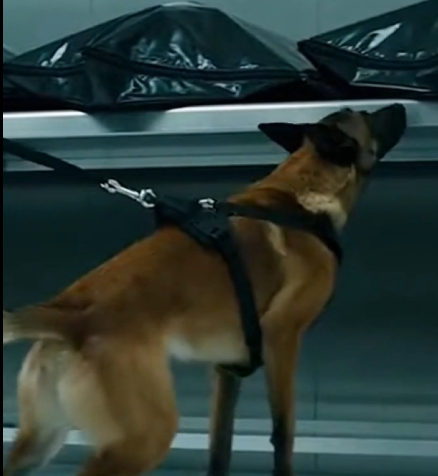
Rex stopped at the third bag from the left. He pressed his entire face against the black vinyl and whined — high, urgent, insistent — then backed up half a step and sat down.
Not a cadaver alert. Not the quiet, passive signal for death.
A live find.
Maya stood still.
Rex looked up at her. His eyes were completely clear. His breathing was fast.
She looked at the bag.
It was sealed. White intake tag. Last night’s date. Name listed as Jane Doe / Unidentified Female / Apparent Cardiac Event.
She looked back at Rex.
“You’re sure,” she said. Not a question.
He whined again.
Maya reached for the bag.
Her hands were steady. That was the training — keep your hands steady. She found the zipper. Cold metal pull tab, industrial weight. She drew it down six inches. Stopped. Drew it down further.
The bag opened.
And an old woman looked up at her.
Maya’s brain short-circuited for approximately three full seconds.
The woman was elderly — late seventies, maybe eighty. White hair pressed flat against her temples. Her face was pale, her lips slightly bluish at the corners, but her eyes were open. Dark brown, sharp, and completely, undeniably, absolutely alive.
Her mouth moved.
“Help,” she whispered. “Please.”
Maya was already on her radio. “Dispatch, this is Chen — I need a medical team in cold storage at Morrison Forensics, now. Right now. Do you copy?”
“Copy, Chen — can you—”
“Now.”
She unzipped the bag the rest of the way in two fast pulls, already pulling at the vinyl edges, already checking the woman’s pulse at her wrist — weak, thin, but there.
“Can you hear me?” Maya’s voice was level. Professional. Everything her body felt was not professional. “You’re safe. I’m right here. I’ve got you.”
The woman’s eyes found hers.
“I could hear everything,” the woman said. Her voice was paper-thin. “I tried to make noise. I couldn’t.”
“Don’t talk. Just breathe.”
“I was cold.”
“I know. Help is coming.” Maya kept one hand on her wrist. With the other, she stroked the woman’s hand — the gesture automatic, unplanned, something her training had never covered. “What’s your name?”
The woman closed her eyes. “Eleanor.”
“Eleanor. I’m Maya. You’re okay.”
Rex sat beside the gurney with his chin resting gently on the edge of the vinyl, watching Eleanor’s face with the focused, quiet attention of a dog who understood exactly what he’d found.
The medical team arrived in four minutes.
They came in fast — two paramedics, a nurse, the on-call physician Dr. Samuels who was still pulling on his coat. They assessed Eleanor on the gurney, fired questions at Maya, called for a stretcher, and started an IV.
Maya stepped back and let them work.
She stood against the far wall with Rex at her feet and watched them move around the woman she’d found sealed in a body bag at 7:52 on a Wednesday morning.
She was shaking. She noticed this clinically, the way she noticed things — the slight unsteadiness in her hands, the too-fast rhythm of her breathing. She’d been in this job for eight years. This was new.
Rex pressed his head against her knee.
She put her hand on his neck.
“Good boy,” she said quietly. “That was a very good boy.”
The story, once reconstructed, was equal parts tragic and absurd.
Eleanor Marsh, 79, had been a resident at Lakewood Senior Living, fifteen blocks from the brownstone Maya had worked overnight. Eleanor had experienced a syncopal episode — a sudden, complete loss of consciousness — in the early hours of the morning, alone in her room.
The night aide had found her unresponsive and called 911.
The paramedics, working a brutal overnight shift and overwhelmed with four concurrent calls, had assessed her pulse as absent — likely impeded by her position and the aide’s panicked description of her medical history, which included a prior cardiac event.
They had called it.
The coroner’s office, equally overwhelmed, had collected her, tagged her, and placed her in cold storage for morning processing.
No one had rechecked.
No one, in the entire chain of exhausted, overextended, overwhelmed professionals, had rechecked.
Except Rex.
Eleanor spent four days in intensive care at County General. Mild hypothermia. Dehydration. A bruised rib from an unrelated prior fall that the intake documentation had missed.
On the fifth day, she was moved to a regular room.
On the seventh day, she asked to see Maya.
Maya came in on her lunch break, still in her work clothes — dark pants, her department polo, her badge clipped to her hip. She had Rex with her because the hospital had said it was fine and she hadn’t wanted to leave him in the car.
Eleanor was sitting up in bed.
She looked completely different than the pale, barely-conscious woman Maya had unzipped from a body bag a week earlier. She was small but upright. Her white hair had been brushed. She had reading glasses on and a paperback novel face-down on the tray beside her.
She looked like someone’s grandmother. She looked like she’d been there forever, like someone who had always been sitting in that particular hospital bed being quietly, stubbornly alive.
“There she is,” Eleanor said.
Maya stopped in the doorway. “Hi.”
“And the dog.” Eleanor’s face changed when she saw Rex — something warm and immediate crossing her features. “Come here, sweetheart.”
Rex looked up at Maya.
“It’s fine,” Maya said.
He walked to the bedside. Eleanor reached out and put her hand flat on the top of his head with the practiced ease of someone who had spent decades around dogs. Rex leaned into it.
“Sit down,” Eleanor told Maya.
Maya sat down.
They talked for almost an hour.
Eleanor had grown up in Vermont. She’d been a high school English teacher for thirty years. She’d had a husband — Richard, wonderful man, gone twelve years ago — and two children who lived in California and Texas respectively and visited on holidays.
“They don’t know yet what happened,” Eleanor said. “I told the nurses not to call them until I was settled. They’d only panic.”
“You were in a body bag,” Maya said.
“I know where I was.”
“Your family probably should—”
“My family will hear about it in my own time, in my own way, and I will manage their reactions as I always have.” Eleanor looked at her over the reading glasses. “I’ve been managing my children’s reactions to things for fifty years. I’m quite good at it.”
Maya laughed. It surprised her.
“You have a good laugh,” Eleanor said. “You should do it more. You walked in here looking like you were prepared for a deposition.”
“I’m a forensic investigator. Depositions are kind of my whole life.”
“Dreadful.” Eleanor shook her head. “All those dead people.”
Maya looked at her.
Eleanor looked back.
They both started laughing at the same time.
When the visit was winding down, Eleanor reached into the drawer of her bedside table.
“I want to give you something,” she said.
“You don’t have to—”
“I know I don’t have to. I want to.” Eleanor produced a small velvet box — the kind that held rings. She held it out across the tray. “Take it.”
Maya took it.
She opened it.
Inside was a ring. Platinum band, large central diamond, smaller stones flanking it. Clean, classic, genuinely beautiful.
Maya stared at it.
“That was my engagement ring,” Eleanor said. “Richard gave it to me in 1968. He saved for three years. I’ve worn it every day of my adult life until my hands got too swollen for it.” She paused. “My children would sell it. They’re practical people, which they get from Richard. I would rather it go to someone who would wear it.”
Maya looked up. “Eleanor, this ring is—” She hesitated. “I can’t accept—”
“You can,” Eleanor said simply. “You saved my life. I was awake in that bag for over an hour. I could hear the room. I could hear the ventilation. I could hear my own heartbeat and I couldn’t make a single sound and I understood, fully, that if no one found me I was going to die in a cold room in a bag because someone made a mistake.” She paused. “And then I heard a dog going absolutely berserk.”
Rex, at their feet, raised his head.
“He knew,” Eleanor said. “Before you. He knew.”
“He’s trained for it,” Maya said. “He—”
“Humor an old woman.” Eleanor’s voice was gentle but firm. “The ring is for both of you. It’s for the two of you not walking past.”
Maya looked at the ring for a long time.
She thought about the sixty seconds she’d spent trying to hold Rex back. The way she’d almost overridden him — trained instinct saying calm the dog, assess the scene, do the intake first.
She was glad she hadn’t won that argument.
“Okay,” she said. “Thank you.”
Eleanor nodded. “Good. Now tell your dog he can have one of those biscuits from the nurse’s station. The overnight nurse puts them on the tray cart for visiting dogs. Third floor south, next to the elevator.”
Maya blinked. “How do you—”
“I’ve been here a week. I know everything about this floor.” Eleanor picked up her paperback. “The biscuits are beef flavor. I believe he deserves it.”
The department held an informal review of the incident three weeks later.
Maya submitted her report. The paramedic crew and coroner’s office both cooperated with the investigation. It was determined that Eleanor’s cardiac history and the circumstances of her presentation had created a confluence of errors — no single person was solely responsible, and no single person had been negligent in a way that exceeded what the system had demanded of them.
The system itself, however, had failed.
The recommendation that came out of the review: a mandatory recheck protocol for all apparent-cardiac intake at the county coroner’s office, requiring a second-party vital sign confirmation before cold storage placement.
The recommendation was adopted.
Maya was in the room when they announced it.
She thought about Eleanor saying I was awake in that bag for over an hour.
She kept her face professional and her hands still.
Rex received a departmental commendation — a framed certificate, somewhat absurd, that Maya hung in her office between her licensure and a photo of her and Rex at his certification ceremony.
Visitors noticed the certificate and asked about it.
She told them he’d found something that nobody else had.
She never said more than that unless they asked.
Most people assumed it was a crime scene. Maya didn’t correct them.
The ring lived on her right hand.
She wore it every day.
Twice, she’d gone to visit Eleanor at the rehabilitation facility where she’d spent six weeks recovering. They’d gotten coffee from the facility’s small cafeteria and talked about books — Eleanor had opinions about contemporary literary fiction that were precise and devastating — and once Eleanor had gotten on the floor to play with Rex, and the nursing staff had nearly had a collective cardiac event, and Eleanor had waved them off with the authority of a woman who had survived considerably worse than a sit-down with a Belgian Malinois.
“You’re going to give the nurses a heart attack,” Maya told her.
“I’ve survived a body bag,” Eleanor said serenely, scratching Rex under his chin. “A little floor time isn’t going to kill me.”
Rex closed his eyes in the satisfaction of a dog who understood, in whatever way dogs understand things, that this was exactly right.
On the last visit, before Eleanor transferred back to Lakewood, she held Maya’s right hand and looked at the ring for a moment.
“Good fit,” Eleanor said.
“Perfect fit,” Maya said.
Eleanor patted her hand once.
“Don’t let them make you hard,” she said. “All those dead people. That job.” She looked at Maya directly. “You have to stay soft enough to follow the dog.”
Maya thought about that on the drive home.
Rex was in the back, chin on his paws, watching the buildings go by.
“You know she’s right,” Maya told him.
He looked at her in the rearview mirror with that flat, slightly annoyed face.
“Don’t give me that look.”
He looked back out the window.
She smiled the whole way home.